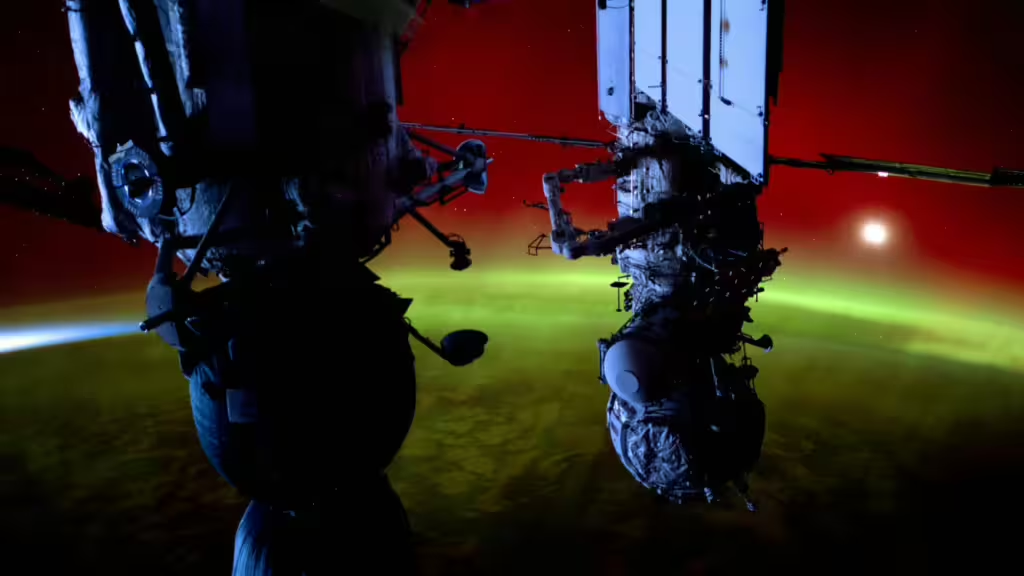
‘Stunning was the word’: Astronauts snap amazing aurora photo from ISS during severe geomagnetic storm
On the night of October 10, 2024, astronauts aboard the International Space Station (ISS) were treated to an extraordinary natural light show — a dazzling aurora intensified by a severe geomagnetic storm. NASA astronauts Don Pettit and Matthew Dominick, seasoned space photographers, captured stunning images of this celestial spectacle from their unique vantage point in orbit. The event was triggered by a massive coronal mass ejection (CME) from the Sun, which sent charged solar plasma hurtling toward Earth, igniting the planet’s upper atmosphere with vibrant, glowing colors. This article delves into the science behind the aurora, the astronauts’ experience witnessing it firsthand, and the significance of capturing such moments from space.
The Science Behind Auroras and Geomagnetic Storms
Auroras, commonly known as the Northern and Southern Lights, are natural light displays caused by charged particles from the Sun interacting with Earth’s magnetic field and atmosphere. When solar wind — streams of charged particles — collides with Earth’s magnetosphere, it excites atmospheric gases, causing them to emit light in various colors, predominantly green and red.
A geomagnetic storm occurs when a particularly strong influx of solar particles, often from a coronal mass ejection (CME), disturbs Earth’s magnetic environment. These storms can intensify auroral activity, creating more vivid and widespread light displays visible at lower latitudes than usual. The October 10 event was driven by a powerful CME that propelled a dense cloud of solar plasma toward Earth, resulting in a severe geomagnetic storm.
The interaction between solar particles and the atmosphere during such storms can also affect satellite operations, communications, and power grids on Earth. However, for astronauts aboard the ISS, these storms provide a rare opportunity to witness and photograph the auroras from orbit, offering a perspective impossible to achieve from the ground.
Astronauts’ Unique Perspective: Seeing Auroras from Orbit
Astronauts aboard the ISS have a privileged vantage point, orbiting approximately 420 kilometers above Earth. From this altitude, they can see auroras not just as shimmering curtains of light on the horizon but as immersive, three-dimensional phenomena enveloping the planet’s atmosphere.
On October 10, astronauts Don Pettit and Matthew Dominick described the aurora as ‘blood red’ and ‘like flying in a neon sign.’ Such vivid descriptions highlight how different the experience is compared to viewing auroras from the ground, where the spectacle is often limited by atmospheric conditions and horizon views.
The ISS’s Cupola module, with its panoramic windows, serves as the perfect observation post for capturing these events. Pettit and Dominick, both skilled photographers, capitalized on this opportunity by quickly setting up multiple cameras to document the aurora’s dynamic and vibrant display during the storm.
Capturing the Moment: Photography in Space
Photographing auroras from the ISS presents unique challenges and opportunities. The station’s rapid orbit — about 28,000 kilometers per hour — means the view changes quickly, requiring astronauts to act swiftly to capture the best shots. Additionally, lighting conditions vary dramatically, demanding careful camera settings and coordination.
Don Pettit and Matthew Dominick used several cameras simultaneously to maximize their chances of capturing the aurora’s fleeting beauty. Pettit described a ‘syncopated rhythm’ of shutters clicking as they seized the moment, highlighting their professional approach despite being caught off guard by the sudden intensity of the aurora.
These images not only provide stunning visuals for public appreciation but also contribute valuable scientific data. High-resolution photographs and videos from space help researchers study auroral structure, dynamics, and the effects of geomagnetic storms on Earth’s atmosphere.
The Role of Solar Activity in Space Weather
Solar activity, including sunspots, solar flares, and CMEs, governs space weather conditions that impact Earth and its near-space environment. The Sun’s 11-year activity cycle influences the frequency and intensity of such events, with solar maximum periods producing more frequent storms.
The CME responsible for the October 10 geomagnetic storm was a massive expulsion of plasma and magnetic fields from the Sun’s corona. When this plasma cloud reached Earth, it compressed the magnetosphere and injected energetic particles into the upper atmosphere, triggering the spectacular auroral displays.
Understanding and monitoring solar activity is critical for protecting technological infrastructure and astronaut safety. Space agencies worldwide operate satellites and ground-based observatories to forecast space weather events, allowing timely warnings and preparations for geomagnetic storms.
Astronauts’ Experiences and Reactions to the Aurora
Despite their extensive training and experience in space, astronauts Pettit and Dominick were genuinely astonished by the intensity and beauty of the aurora during this storm. Pettit admitted they were initially reluctant to set up cameras after a long day, only to be compelled by the breathtaking sight through the Cupola windows.
The astronauts’ descriptions emphasize the emotional impact of witnessing Earth’s natural phenomena from orbit. Pettit’s words, ‘Stunning was the word,’ capture the awe and wonder that even seasoned space travelers experience when confronted with such a vivid display of nature’s power.
Their reactions also underscore the importance of human presence in space for direct observation and appreciation of dynamic planetary processes, complementing automated instruments and remote sensing technologies.
Implications for Earth and Space Exploration
Severe geomagnetic storms, while visually spectacular, can have significant consequences on Earth’s technological systems, including satellite operations, GPS navigation, and power grids. Monitoring these events from space enhances our ability to predict and mitigate their impacts.
For space exploration, understanding space weather is vital for the safety of astronauts and spacecraft. Intense solar storms increase radiation exposure risks and can disrupt communication and navigation systems critical for missions beyond low Earth orbit.
The observations and data collected during events like the October 10 storm contribute to improving space weather forecasting models. This knowledge supports the planning of future missions, including lunar and Mars expeditions, where solar storm exposure poses greater challenges.
The Future of Auroral Observations from Space
As space technology advances, new instruments and platforms will enable even more detailed and frequent observations of auroral phenomena. Satellites equipped with specialized sensors and cameras can monitor auroras continuously, complementing the unique human perspective from the ISS.
Upcoming missions may include dedicated aurora monitoring satellites and enhanced observation capabilities aboard future space stations or lunar orbiters. These efforts will deepen our understanding of Earth’s magnetosphere and its interactions with solar activity.
Public engagement through astronaut photography shared on social media platforms continues to inspire interest in space and atmospheric sciences. The breathtaking images captured during events like the recent geomagnetic storm foster greater appreciation for Earth’s dynamic environment and the Sun’s influence.
Conclusion
The breathtaking auroral display witnessed by astronauts Don Pettit and Matthew Dominick aboard the International Space Station during the severe geomagnetic storm of October 10, 2024, highlights the awe-inspiring beauty and power of space weather phenomena. This rare celestial event, fueled by a massive coronal mass ejection from the Sun, not only provided a spectacular visual experience but also underscored the importance of monitoring and understanding solar activity and its effects on Earth and space exploration. As technology and space missions evolve, the ability to observe and study auroras from orbit will deepen our knowledge of Earth’s magnetosphere and enhance our preparedness for future space weather challenges. The stunning images captured serve as a vivid reminder of our planet’s dynamic environment and the extraordinary vantage point that astronauts have while orbiting above.
Originally reported by space.com. Adapted for our readers.
Recent advances in machine perfusion technology are not only preserving donated livers but also making them biologically younger at a molecular level. This breakthrough…
What happens when human imagination, artificial intelligence, art and technology come together? From September 1 to 6, Samsung Electronics presented a special exhibition themed…