NASA’s C-130 aircraft en route to india in support of NISAR mission
Science & Technology

NASA’s C-130 aircraft en route to india in support of NISAR mission

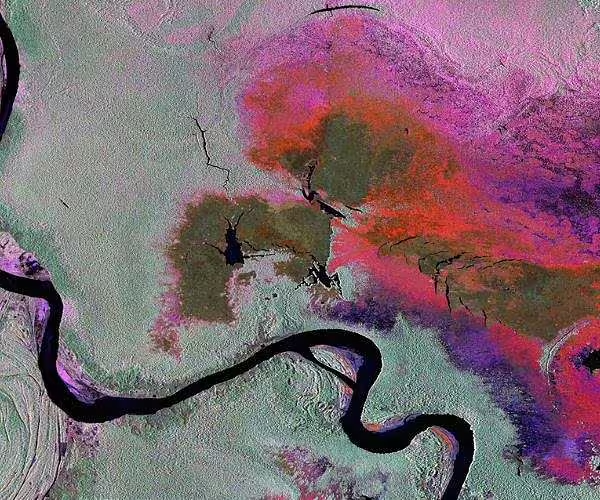
NASA Space Technology NASA's C-130 aircraft en route to india in support of NISAR missionby Olivia LittletonWallops Island VA (SPX) Oct 18, 2024NASA's globetrotting C-130 Hercules team is carrying out a cargo transport mission to Bengaluru, India, in support of the NASA-ISRO Synthetic Aperture Radar (NISAR) mission.The C-130 departed from NASA's Wallops Flight Facility in Virginia, Tuesday, Oct. 15, to embark on the multi-leg, multi-day journey. The flight path will take the aircraft coast to coast within the United States, across the Pacific Ocean with planned island stops, and finally to its destination in India.The goal: safely deliver NISAR's radar antennae reflector, one of NASA's contributions to the mission, for integration on the spacecraft. NISAR is a joint mission between NASA and ISRO (Indian Space Research Organisation).The cargo transport mission will encompass approximately 24,500 nautical...

Continue reading
Alien life is out there. Can AI find it?
Science & Technology

Alien life is out there. Can AI find it?

NASA Space Technology As a machine learningscientist at NASA, Hamed Valizadegan once trained an algorithm to examine images of blood vessels in astronauts’ retinas, improving efforts to understand vision changes in microgravity. It was important work, but Valizadegan, who never lost his childhood love of the night sky, couldn’t shake his desire to study the stars.“I could watch the sky for hours, contemplating the meaning of life and whether we are alone in this vast universe,” he says. Early on, however, his space scientist colleagues seemed reluctant to embrace artificial intelligence as a tool for exploring the cosmos. That may be because advanced algorithms don’t typically show their work. Sophisticated AI systems are inspired by the brain, so individual synthetic “neurons” make computations and then pass information to other nodes in the network. The resulting...
Continue reading
NASA launches coding competition to organize solar eclipse images
Science & Technology

NASA launches coding competition to organize solar eclipse images

NASA Space Technology The sun's corona and solar flares appear during totality of the eclipse on April 8, 2024, in Indianapolis, Indiana. On Tuesday, NASA's Eclipse Megamovie project announced a coding competition to organize eclipse images from more than 145 citizen scientists. File Photo by Edwin Locke/UPI | License PhotoOct. 15 (UPI) -- NASA is launching a coding competition to get some much-needed help with organizing images from April's solar eclipse for the 2024 Eclipse Megamovie project."Thanks to the efforts of over 145 citizen scientists, more than 1 terabyte of photographs were collected and are now being analyzed," NASA said. "These images will help scientists track disappearing jets and plumes, shedding light on how these solar events impact space weather and our understanding of the sun's outer atmosphere."The Eclipse Megamovie project asked volunteers to...
Continue reading
Nuclear rockets could travel to Mars in half the time − but designing the reactors that would power them isn’t easy
Science & Technology

Nuclear rockets could travel to Mars in half the time − but designing the reactors that would power them isn’t easy

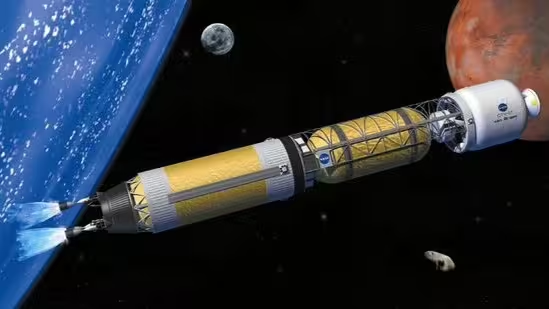
NASA Space Technology This article was originally published atThe Conversation.The publication contributed the article to Space.com'sExpert Voices: Op-Ed & Insights.And Kotlyar is an Associate Professor of Nuclear and Radiological Engineering at the Georgia Institute of Technology.NASA plans to send crewed missions to Mars over the next decade – but the 140 million-mile (225 million-kilometer) journey to the red planet could take several months to years round trip.This relatively long transit time is a result of the use of traditional chemical rocket fuel. An alternative technology to the chemically propelled rockets the agency develops now is called nuclear thermal propulsion, which uses nuclear fission and could one day power a rocket that makes the trip in just half the time.Nuclear fission involves harvesting the incredible amount of energy released when an atom is split by...
Continue reading