News

Voyager 1 returning science data again

NASA Space Technology An illustration of one of the twin Voyager spacecraft now in interstellar space. Credit: NASA/JPL-CaltechWASHINGTON — The four instruments on NASA’s Voyager 1 spacecraft are returning science data for the first time since a computer malfunction last November, as scientists hope to keep the mission operating for up to another decade.NASA’s Jet Propulsion Laboratory announced June 13 that the four instruments on the spacecraft, which measure plasma waves, magnetic fields and particles in interstellar space, have started returning data again. Two of the instruments started up immediately after commands were sent to the spacecraft May 19 while the other two required what JPL called “some additional work” to resume operations.The instruments had been offline since November 2023, when a computer malfunction on board the spacecraft caused it to return garbled data. A...
Continue reading
News

Live coverage: Third time’s the charm for the Boeing Starliner Crew Flight Test

NASA Space Technology Boeing’s CST-100 Starliner launches atop a United Launch Alliance Atlas V rocket on the Crew Flight Test at 10:52 a.m. Eastern time on Wednesday, June 5, from Cape Canaveral Space Force Station in Florida. Image: Boeing/ Joey JettonUpdate June 5, 12:06 p.m.: The Boeing Starliner spacecraft successfully separated from the Centaur upper stage of the Atlas 5 rocket. The spacecraft completed its orbital insertion burn and a subsequent burn to circularize its orbit.The third time was the charm for the first crewed flight of Boeing’s Starliner spacecraft. After two launch attempts on May 6 and June 1 ended with scrubs, the Atlas 5 rocket roared off pad 41 at Cape Canaveral Space Force Station, beginning a more than week-long mission for NASA astronauts Butch Wilmore and Suni Williams.Liftoff took place on June...
Continue reading
NASA detects Earth-size planet compatible 40 light-years away that’s ‘no longer a wicked region’ to hunt for lifestyles
Science & Technology

NASA detects Earth-size planet compatible 40 light-years away that’s ‘no longer a wicked region’ to hunt for lifestyles

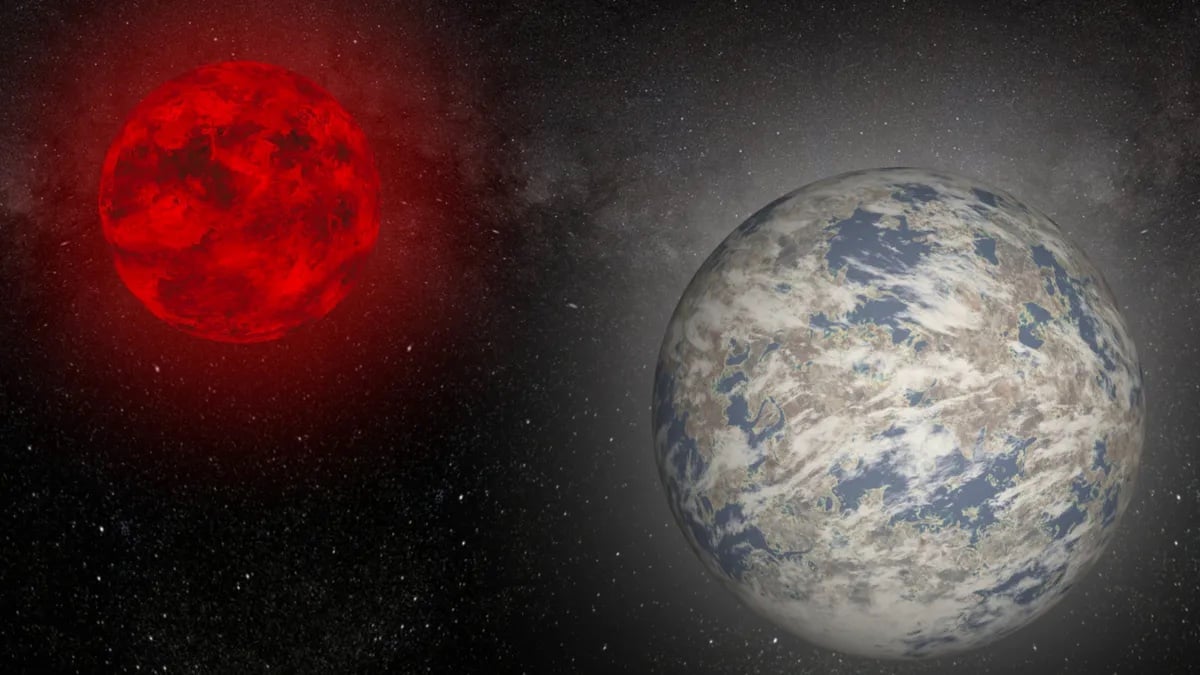
NASA Space Technology An illustration of the newly realized Earth-sized exoplanet Gliese 12 b and its red dwarf parent massive name.(Image credit: Robert Lea (created with Canva))Scientists the use of a NASA space telescope possess realized a interesting world. Or no longer it's about the size of Earth, sits remarkably near our photo voltaic systemand will be chuffed for lifestyles as we comprehend it.The extrasolar planet, or "exoplanet," named Gliese 12 b, orbits a small and funky red dwarf massive name located compatible around 40 light-years fromEarthwithin the constellation Pisces. The exoplanet — which the group realized with NASA's Transiting Exoplanet Look Satellite tv for pc (TESS) — is estimated to possess a width around 1.1 times that of Earth, making it same to our planet to boot to Venuswhich is mostly known as our world's photo voltaic...
Continue reading