NASA Astronauts, SOHO Spacecraft Snap New Images of Comet Tsuchinshan-ATLAS
Science & Technology

NASA Astronauts, SOHO Spacecraft Snap New Images of Comet Tsuchinshan-ATLAS

NASA Space Technology A bright comet from the Oort cloud named C/2023 A3 (Tsuchinshan-ATLAS) is passing by Earth and will be visible through the second half of October 2024.This image, taken by the ESA/NASA Solar and Heliospheric Observatory (SOHO) on October 10, 2024, shows comet Tsuchinshan-ATLAS and its bright tail streaming from the upper left to the right; Mercury appears as a bright dot on the left. Image credit: ESA / NASA.Comet Tsuchinshan-ATLAS was discovered by astronomers at the Purple Mountain Observatory in China on January 9, 2023.Otherwise known as C/2023 A3, the comet was independently spotted by ATLAS in South Africa on February 22, 2023.It orbits the Sun on a retrograde orbit, lying at an inclination of 139°.It had its perihelion on September 27, 2024, at a distance of 0.391 AU; the closest approach...
Continue reading
Europa Clipper Begins Journey to Jupiter’s Icy Moon
Science & Technology

Europa Clipper Begins Journey to Jupiter’s Icy Moon

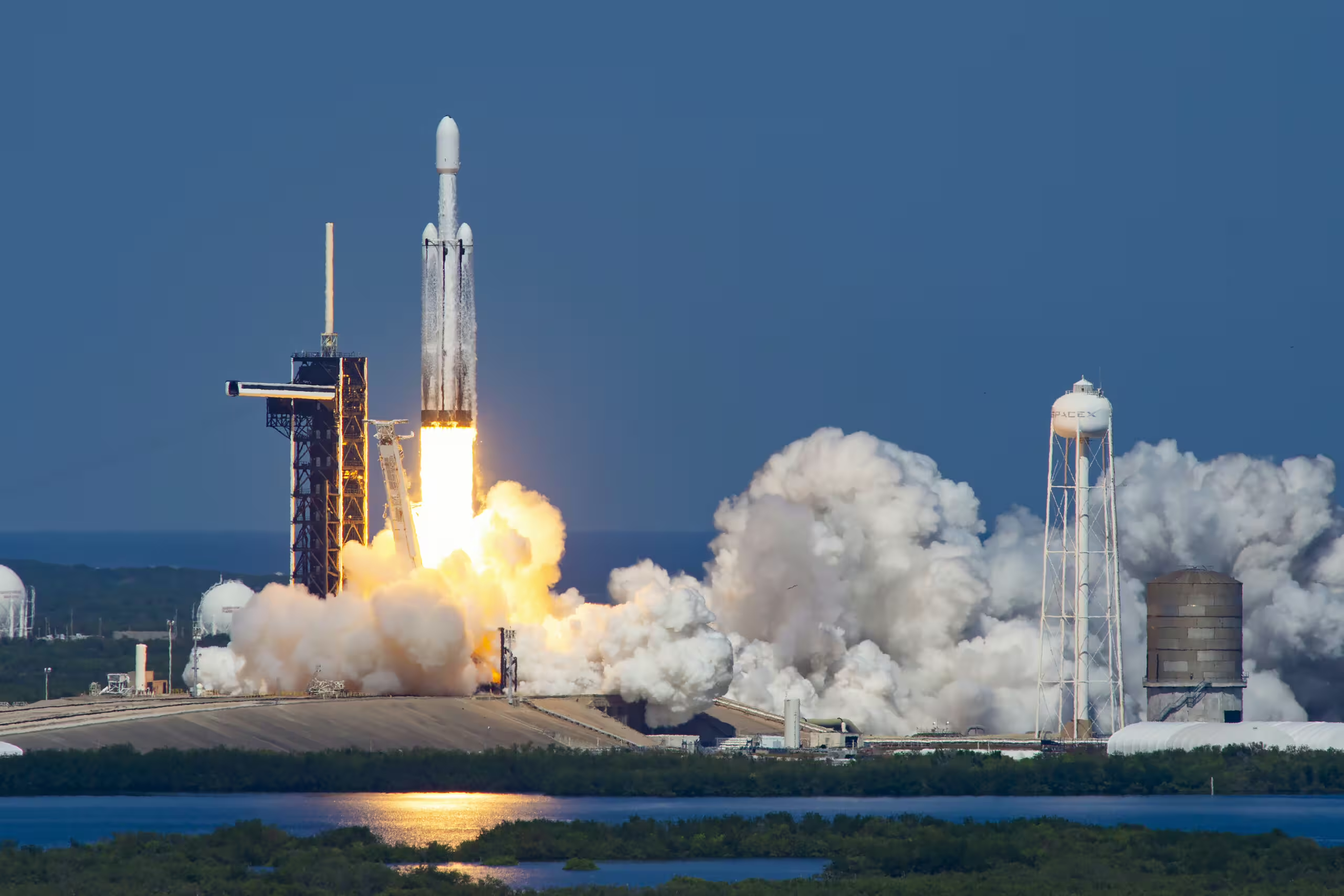
NASA Space Technology Monika LuabeyaOct 15, 2024A SpaceX Falcon Heavy rocket carrying NASA’s Europa Clipper spacecraft lifts off from NASA’s Kennedy Space Center in Florida on Monday, Oct. 14, 2024.Europa Clipper is the first mission designed to conduct a detailed study of Jupiter’s moon Europa to determine if it currently has habitable conditions. The spacecraft will travel 1.8 billion miles (2.9 billion km) to reach Jupiter in April 2030. It will orbit Jupiter and conduct 49 close flybys of Europa.Follow Europa Clipper’s journey in NASA’s Eyes on the Solar System app.Image credit: SpaceX
Continue reading
Cassini Mission: 5 Things to Know About NASA Lewis’ Last Launch
Science & Technology

Cassini Mission: 5 Things to Know About NASA Lewis’ Last Launch

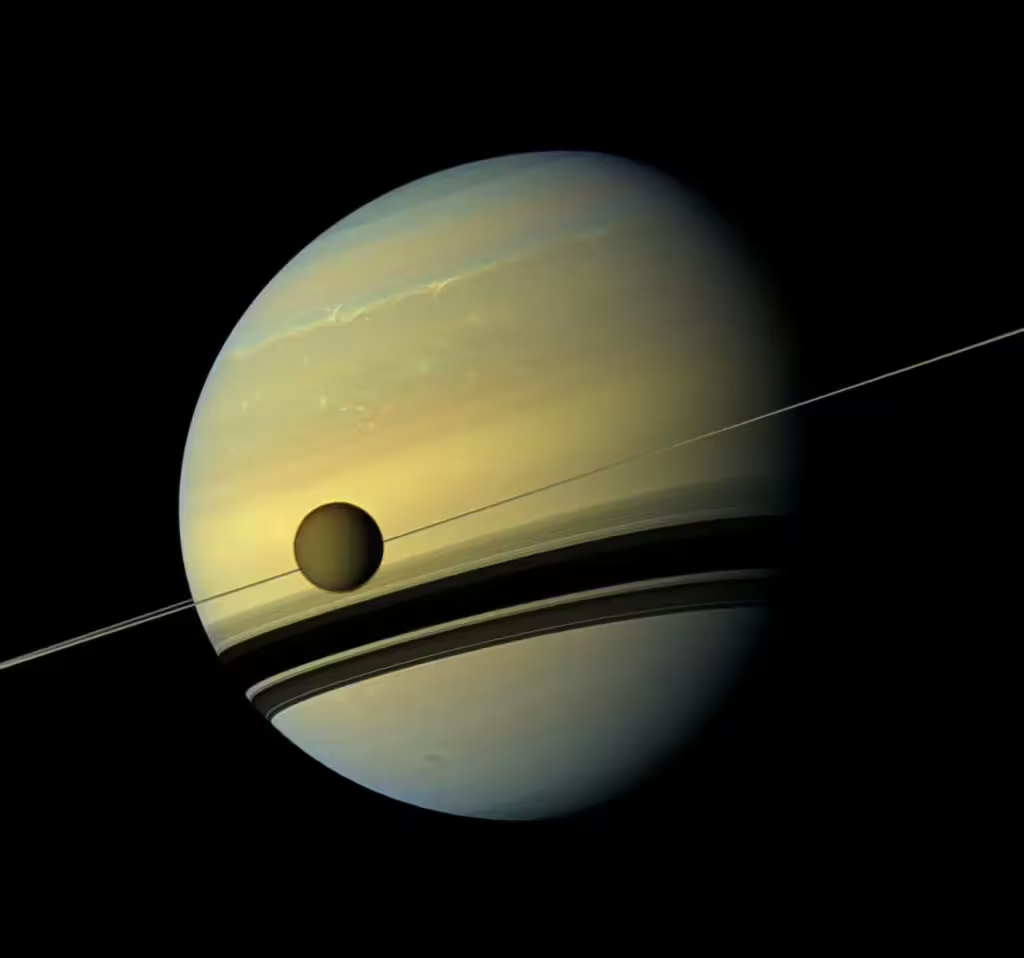
NASA Space Technology NASA’s ambitious Cassini mission to Saturn in the late 1990s was one of the agency’s greatest accomplishments, providing unprecedented revelations about the esoteric outer planet and its moons. The complex undertaking was also a tremendous, yet bittersweet, achievement for the Lewis Research Center (today, NASA’s Glenn Research Center in Cleveland), which oversaw the rockets that propelled Cassini to Saturn. Cassini brought a close to over 35 years of Lewis’ management of NASA’s launch vehicles.In the early 1980s, NASA began planning the first-ever in-depth study of the planet Saturn. The mission would use the Cassini orbiter designed by NASA’s Jet Propulsion Laboratory in Southern California and the European Space Agency’s Huygens lander. It was one of the heaviest and most complex interplanetary spacecraft ever assembled. Cassini’s plutonium power system and intricate flight path...
Continue reading
Snippet of Euclid Mission’s Cosmic Atlas Released by ESA
Science & Technology

Snippet of Euclid Mission’s Cosmic Atlas Released by ESA

NASA Space Technology With contributions from NASA, the mission will map a third of the sky in order to study a cosmic mystery called dark energy.ESA (the European Space Agency) has released a new, 208-gigapixel mosaic of images taken by Euclid, a mission with NASA contributions that launched in 2023 to study why the universe is expanding at an accelerating rate. Astronomers use the term “dark energy” in reference to the unknown cause of this accelerated expansion.The new images were released at the International Astronautical Congress in Milan on Oct. 15.The mosaic contains 260 observations in visible and infrared light made between March 25 and April 8 of this year. In just two weeks, Euclid covered 132 square degrees of the southern sky — more than 500 times the area of the sky covered by...
Continue reading