NASA Awards Launch Services Contract for NOAA’s JPSS-4 Mission
Science & Technology

NASA Awards Launch Services Contract for NOAA’s JPSS-4 Mission

NASA Space Technology NASA, on behalf of the National Oceanic and Atmospheric Administration (NOAA), has selected SpaceX (Space Exploration Technologies Corporation) to provide launch services for NOAA’s JPSS-4 mission. The spacecraft is part of the multi-satellite cooperative Joint Polar Satellite System (JPSS) program, a partnership between NASA and NOAA. This mission is the next satellite in the program, which began with the Suomi National Polar-orbiting Partnership.This is a firm fixed price contract with a value of approximately $112.7 million, which includes launch services and other mission related costs. The JPSS-4 mission currently is targeted to launch in 2027, on a SpaceX Falcon 9 rocket from Space Launch Complex 4 East at Vandenberg Space Force Base in California.The JPSS constellation of satellites collects global multi-spectral radiometry and other specialized meteorologic, oceanographic, and solar-geophysical data via remote...
Continue reading
NASA Rocket Discovers New Energization Process in Upper Atmosphere
Science & Technology

NASA Rocket Discovers New Energization Process in Upper Atmosphere

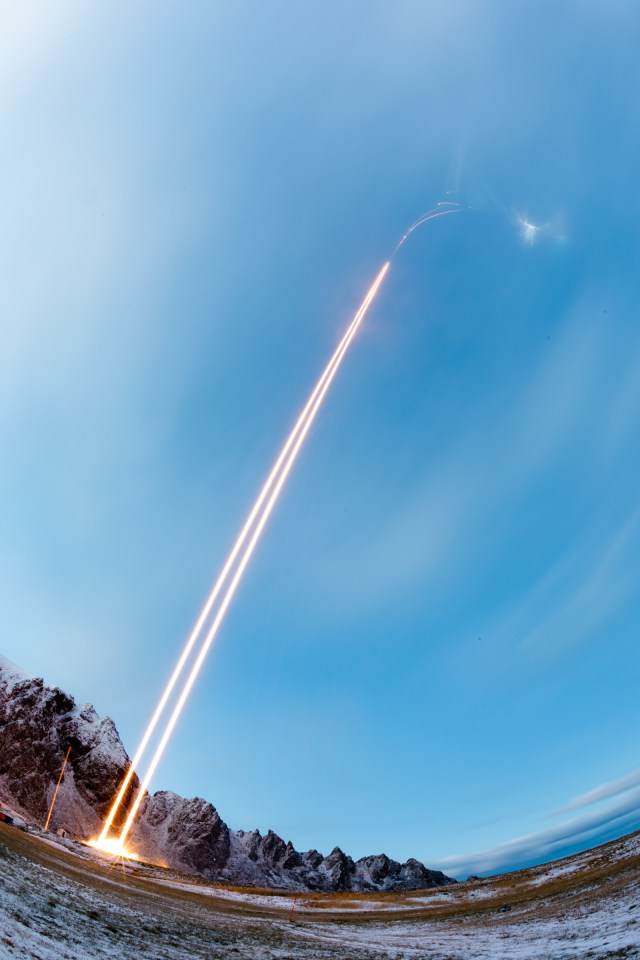
NASA Space Technology When it comes to discoveries about our upper atmosphere, it pays to know your surroundings.Using data from the Twin Rockets to Investigate Cusp Electrodynamics (TRICE-2) rocket launch, NASA scientist Francesca Di Mare and Gregory Howes from the University of Iowa studied waves traveling down Earth’s magnetic field lines into the polar atmosphere. These waves were known to accelerate electrons, which pick up speed as they “surf” along the electric field of the wave. But their effect on ions — a more heterogenous group of positively charged particles, which exist alongside electrons — was unknown.By estimating the ion mixture they were flying through — predominantly protons and singly-charged oxygen ions — the scientists discovered that these waves were accelerating protons as they circle about the Earth’s magnetic field lines as well as electrons...
Continue reading
Chandra Sees the Peacock’s Galaxy
Science & Technology

Chandra Sees the Peacock’s Galaxy

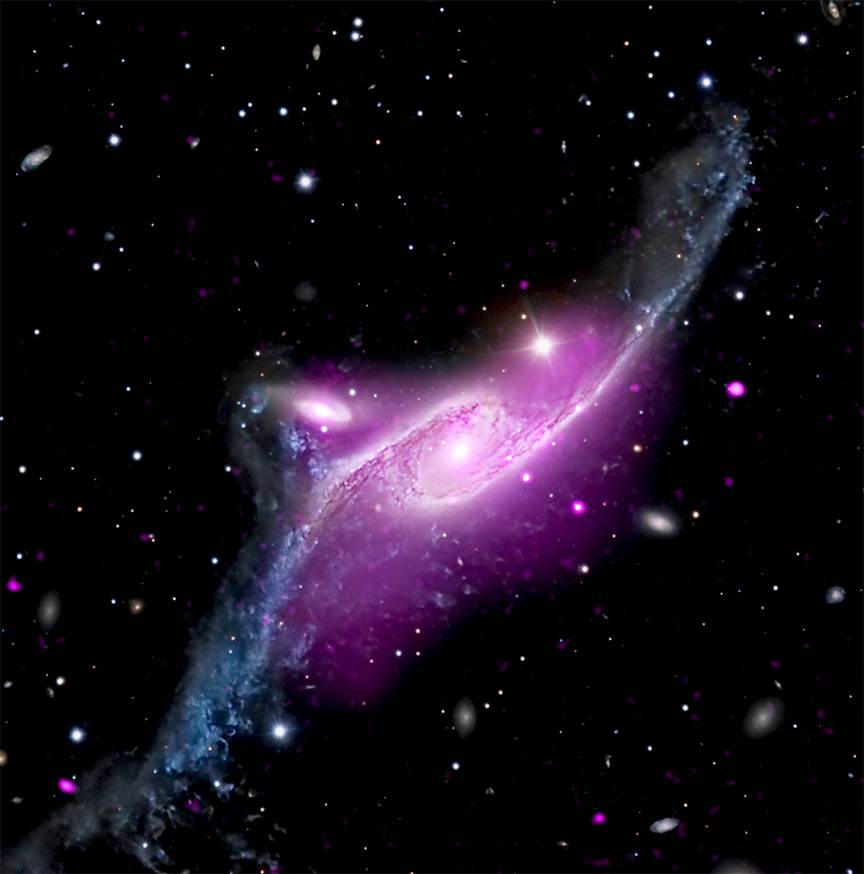
NASA Space Technology Monika LuabeyaJul 22, 2024To commemorate the 25th anniversary of NASA’s Chandra X-ray Observatory launch, the Chandra team released this never-seen-before image of NGC 6872, a spiral galaxy in the Pavo (Peacock) constellation, on July 22, 2024. This image and 24 others, which all include data from Chandra, demonstrate how X-ray astronomy explores all corners of the universe.NGC 6872 is 522,000 light-years across, making it more than five times the size of the Milky Way galaxy; in 2013, astronomers from the United States, Chile, and Brazil found it to be thelargest-known spiral galaxybased on archival data from NASA’s Galaxy Evolution Explorer. This record was surpassed by NGC 262, a galaxy that measures 1.3 million light-years in diameter.See more photos released for this celebration.Image credit: X-ray: NASA/CXC/SAO; Optical: NASA/ESA/STScI; Image Processing: NASA/CXC/SAO/J. Schmidt, L....
Continue reading
Seed Funding Proposals Due November 19 This Year!
Science & Technology

Seed Funding Proposals Due November 19 This Year!

NASA Space Technology Since it began in 2020, NASA’sCitizen Science Seed Funding Program (CSSFP)has helped twenty-four new NASA citizen science projects get off the ground. This one-year funding opportunity aims to expand the pool of professional scientists who use citizen science techniques in their science investigations. We’d like to remind you about two key changes to the CSSFP program this year!First, we heard that researchers could make better use of seed funding if it arrived in time to enable work during the summer — a crucial season for students, faculty, and interns.  To address this need, NASA is shifting the submission and review process to earlier in the year. The planning start date for CSSFP investigations for this next round is now May 1, 2025! Of course, an earlier start date means an earlier due date,...
Continue reading