Tech Today:Flipping NASA Techand StickingtheLanding
Science & Technology

Tech Today:Flipping NASA Techand StickingtheLanding

NASA Space Technology NASA tech adds gecko grip to phone accessory When it comes to innovative technologies, inventors often find inspiration in the most unexpected places. A former salesman, Akeem Shannon, was inspired by his uncle, who worked as an engineer at NASA’s Marshall Space Flight Center in Huntsville, Alabama, to research the agency’s published technologies. He came across a sticky NASA invention that would help him launch his breakout product.In the early 2010s, a team of roboticists at NASA’s Jet Propulsion Laboratory in Southern California were exploring methods to enhance robots’ gripping capabilities. They came across the Van Der Waals force – a weak electrostatic bond that forms at the molecular level when points on two surfaces make contact. This is the same force that geckos use to climb along walls.The microscopic hairs...
Continue reading
NASA Seeks Student Missions to Send to Space in 2026, Beyond
Science & Technology

NASA Seeks Student Missions to Send to Space in 2026, Beyond

NASA Space Technology NASA announced a new round of opportunities for CubeSat, developers to build spacecrafts on that will fly on upcoming launches through the agency’s CSLI (CubeSat Launch Initiative). CubeSats are a class of small spacecraft called nanosatellites.The initiative provides space access to U.S. educational institutions, certain non-profit organizations, and informal educational institutions such as museums and science centers, as well as NASA centers focused on workforce development, including the agency’s Jet Propulsion Laboratory in southern California. It also encourages participation by minority serving institutions.“Working with CubeSats is a way to get students interested in launching a career in the space industry,” said Jeanie Hall, CSLI program executive at NASA Headquarters in Washington. “NASA reviews applications for CubeSat missions every year and selects projects with an educational component that also can benefit the agency in better understanding education, science, exploration,...
Continue reading
Disaster Response Coordination System (DRCS) Formally Launches
Science & Technology

Disaster Response Coordination System (DRCS) Formally Launches

NASA Space Technology Elizabeth BlackwellAug 05, 2024The NASA Disasters Response Coordination System (DRCS) formally launched on 6/13/24 during a ceremony at NASA Headquarters with Administrator Nelson as the keynote speaker. The DRCS is a revamped one NASA approach in how the agency responds to natural hazards and disasters domestically and internationally to support partners and stakeholders The DRCS will be organized by the Program Office located at LaRC. MSFC and Earth Science Branch Disasters team will continue to support the DRCS and events that agency respond too by tapping into expertise and subject matter expertise here at MSFC. MSFC was represented at the DRCS launch by Center Response Coordinators Jordan Bell (ST11), Ronan Lucey (ST11/UAH) and Earth Action Associate Disasters Program Manager Lori Schultz (ST11). Additional information about the DRCS launch can be found here:...
Continue reading
Coming in Hot – NASA’s Chandra Checks Habitability of Exoplanets
Science & Technology

Coming in Hot – NASA’s Chandra Checks Habitability of Exoplanets

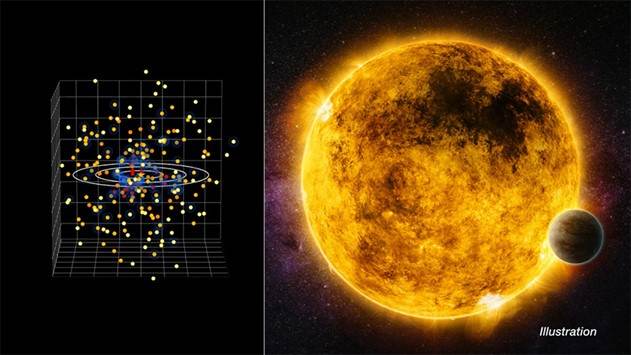
NASA Space Technology Elizabeth BlackwellAug 05, 2024This graphic shows a three-dimensional map of stars near the Sun. The blue haloes represent stars observed with NASA’s Chandra X-ray Observatory and ESA’s XMM-Newton. Astronomers are using these X-ray data to determine how habitable exoplanets may be based on whether they receive lethal radiation from the stars they orbit. This research will help guide observations with the next generation of telescopes aiming to make the first images of planets like Earth. Researchers used almost 10 days of Chandra observations and 26 days of XMM observations to examine the X-ray behavior of 57 nearby stars, some of them with known planets. Results were presented at the 244th meeting of the American Astronomical Society meeting in Madison, Wisconsin, by Breanna Binder (California State Polytechnic University in Pomona). To view the...
Continue reading