NASA’s Roman space telescope gets ready to stare at distant suns to find alien planets
Science & Technology

NASA’s Roman space telescope gets ready to stare at distant suns to find alien planets

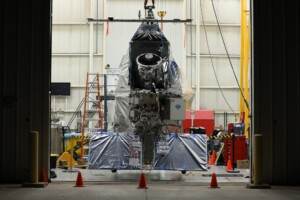
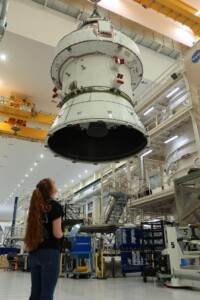
NASA Space Technology The Roman Coronagraph is integrated with the Instrument Carrier for NASA’s Nancy Grace Roman Space Telescope in a clean room at NASA’s Goddard Space Flight Center in Greenbelt, Md., in October 2024.(Image credit: NASA/Sydney Rohde)In a clean room at NASA's Jet Propulsion Laboratory in Southern California, scientists have successfully integrated a crucial component onto the Roman Space Telescope. This device, known as the Roman Coronagraph Instrument, is designed to block starlight, enabling scientists to detect the faint light from planets beyond our solar system.This achievement marks a significant milestone for NASA's Nancy Grace Roman Space Telescope, a next-generation space observatory that will launch around May 2027. With a field of view at least 100 times larger than that of the Hubble Space Telescope, Roman will be used to investigate scientific mysteries related...
Continue reading
Nasa’s Voyager 1 breaks days of silence using device forgotten since 1981
Science & Technology

Nasa’s Voyager 1 breaks days of silence using device forgotten since 1981

NASA Space Technology Nasa's Voyager spacecraft in space is shown in this artist's rendering obtained from Nasa in Washington, DC, US, December 10, 2018. ReutersAt 15.4 billion miles away from Earth, the National Aeronautics and Space Administration's (Nasa) Voyager 1 spacecraft, which faces an uncertain future, fell silent recently leaving scientists unoptimistic about ever hearing back from it.However, the spacecraft did something that no one expected.The 47-year-old probe, which is one of the only spacecrafts ever to reach in interstellar space, was expected to maintain communication with mission control.But the spacecraft experienced a major setback when it plugged into its fault protection system after receiving a...
Continue reading
NASA’s Voyager 1 jumpstarts radio transmitter unused since 1981 to  ‘phone home’ from 15.4 billion miles into space
Science & Technology

NASA’s Voyager 1 jumpstarts radio transmitter unused since 1981 to ‘phone home’ from 15.4 billion miles into space

NASA Space Technology The 47-year-old NASA Voyager 1 fell back on a radio transmitter it hadn’t used since 1981 to ping home base after a technical issue caused a days-long communication stall between Earth and the farthest-ever recorded spacecraft. The Voyager has been floating further and further away since its historic launch in 1977 and along with its twin craft, the Voyager 2, the pair are the only two spacecraft to operate in interstellar space, the region between stars. Together, the pair have explored Jupiter, Saturn, Uranus, and Neptune, and 48 of their moons and even carry a message from Earth on a phonograph record should they encounter any form of life in distant space, according to NASA. The Voyager 1 is the farthest spacecraft from Earth, extending far beyond even Pluto’s orbit...
Continue reading
NASA’s New Edition of Graphic Novel Features Europa Clipper
Science & Technology

NASA’s New Edition of Graphic Novel Features Europa Clipper

NASA Space Technology To celebrate the successful launch of NASA’s Europa Clipper mission, the agency’s Astrobiology program has released a new edition of Issue #4 – Missions to the Outer Solar System – of its graphic history series Astrobiology: The Story of our Search for Life in the Universe.Issue #4 tells the story of the outer solar system, from beyond the asteroid belt to the outer reaches of the Sun's magnetic influence. Gas giants like Jupiter and Saturn are not habitable, but many of their moons raise questions about life’s potential far, far away from the warmth of the Sun.One such body is Jupiter’s moon Europa, which contains an ocean of liquid water beneath its icy surface. The Europa Clipper mission is designed to help scientists understand whether this ocean holds key ingredients that could...
Continue reading