
Long-term moon mission safety depends on sturdy infrastructure
Top Stories

Long-term moon mission safety depends on sturdy infrastructure

Top Stories Tamfitronics GOLDEN, Colorado — A future where the moon serves as a long-term haven for human explorers is within reach but significant challenges like constructing launch and landing facilities, addressing moonquakes, and developing sustainable infrastructure must be overcome.The Lunar Surface Innovation Consortium held a launch and landing facilities workshop on July 23, staged by the Johns Hopkins Applied Physics Laboratory (APL) in Laurel, Maryland. Specialists from NASA, industry and academia took part, all with an eye toward orchestrating an enduring human presence on the lunar landscape.“Landings and launches are incredibly complex endeavors, and an inflection point in any lunar surface exploration activity,” APL’s Sarah Hasnain, the consortium’s co-lead on lunar excavation and construction, told SpaceNews. “Our sustainable future on the moon starts with the ability to revisit sites and reuse infrastructure and assets...
Continue reading
NASA’s Juno Mission Captures the Colorful and Chaotic Clouds of Jupiter
Science & Technology

NASA’s Juno Mission Captures the Colorful and Chaotic Clouds of Jupiter

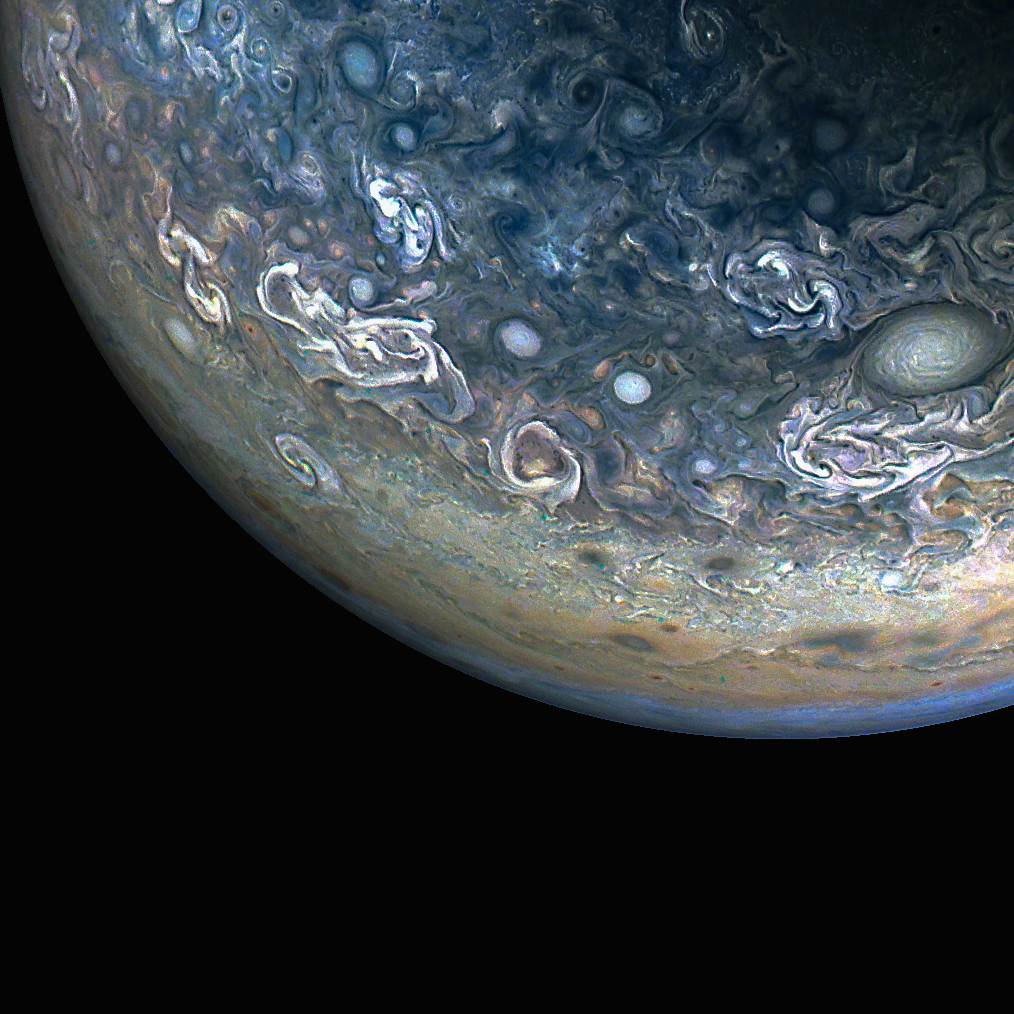
NASA Space Technology Jet Propulsion LaboratoryJul 19, 2024During its 61st close flyby of Jupiter on May 12, 2024, NASA’s Juno spacecraft captured this color-enhanced view of the giant planet’s northern hemisphere. It provides a detailed view of chaotic clouds and cyclonic storms in an area known to scientists as a folded filamentary region. In these regions, the zonal jets that create the familiar banded patterns in Jupiter’s clouds break down, leading to turbulent patterns and cloud structures that rapidly evolve over the course of only a few days.Citizen scientist Gary Eason made this image using raw data from the JunoCam instrument, applying digital processing techniques to enhance color and clarity.At the time the raw image was taken, the Juno spacecraft was about 18,000 miles (29,000 kilometers) above Jupiter’s cloud tops, at a latitude of about...
Continue reading
NASA space mission to launch artificial star into space
Science & Technology

NASA space mission to launch artificial star into space

NASA Space Technology In upcoming years, the twinkle of stars in the night sky might be joined by the glow of laser beams.A new NASA space project, the Landolt Mission, plans to launch an artificial “star” into Earth’s orbit. The project will be used to more accurately determine the absolute flux calibration of stars, also known as their brightness. The mission ground control will be based at George Mason University in the state of Virginia. The mission expands on the work of its inspiration and namesake Arlo Landoltthe late astronomer and pioneer of stellar brightness catalogs.“His last name is famous in the whole astronomy community. The Landolt standard star…everyone knows what that is,” said Daniel Huber, an associate astronomer and professor at the University of Hawaii’s Institute for Astronomy.The new project will compare the brightness...
Continue reading
NASA Mission Strengthens 40-one year Friendship
Science & Technology

NASA Mission Strengthens 40-one year Friendship

NASA Space Technology As a NASA astronaut Butch Wilmore launches aboard Boeing’s Starliner spacecraft to the World Topic Pickle Monday, May per chance well well 6 on its first crewed flight, knowing to be one of his easiest guests can be pleased conducted a key position in getting him there.Billy Stover, chief security officer for NASA’s Industrial Crew Programand Wilmore were guests for bigger than 40 years. The pair’s friendship started within the 1980s at Tennessee Tech College on the football area.“We'd make weight coaching and we might presumably per chance procure paired up,” acknowledged Stover. “If he did 50 sit-ups, I needed to make 55. Or we might presumably per chance uncover how many sit-united states of americawe might presumably per chance procure accomplished in 30 seconds or vice versa – we had been...
Continue reading