How Earth’s climate has changed through the geological past and what it means today

Even before, summers used to be unbearably hot, but then there were no people (and no air conditioning).
In the distant past, the country went through extremely warm “hothouse” periods, when global temperatures were up to 30 °C higher than today. During the Eocene, Cretaceous and Permian-Triassic transitions, there was no ice at the poles, the oceans were almost too hot for life, and mass extinctions followed sharp increases in greenhouse gases. Common the cause of these changes was large emissions of CO₂, most often of volcanic origin. The main takeaway: rapid increases in greenhouse gases have always led to extreme warming in the past – and today’s warming follows the same pattern. Nat Geo
Similar news
05.06.2025. (23:00)
Dim, led i paradoksi — physics, bitch!
Siberian fires: unusual “climate shakers” that (temporarily) cool the planet
A study by the University of Washington reveals a paradoxical effect of the increasingly frequent fires in Siberia and Canada: smoke aerosols reflect the sun’s rays and lighten the clouds, which slows global warming and the melting of arctic ice. By 2060, fires could quadruple, which would reduce global warming by 12%, and Arctic warming by as much as 38%. But that’s no reason to celebrate — fires harm health and ecosystemsand if the noise disappears, the cooling effect also disappears. Fires thus become climatic double agents: they put out heat, but they also lose the ground under their feet. Bug
28.05.2025. (15:00)
We will go for walks before dawn or at night
WMO: Global temperature almost certain to exceed 1.5 °C by 2029.

WMO, the UN Meteorological Organization, predicts that the global temperature between 2025 and 2029 will exceed 1.5 °C compared to the pre-industrial period, with a 70% probability. For the first time there is also a (small) chance of reaching 2 °C in one of the next five year. CO₂ emissions are still not decreasing, and extreme weather events such as heat waves, floods and fires are becoming more frequent. Scientists warn that the goals of the Paris Agreement are increasingly difficult to achieve, and the damage and risks are increasing. 2023 and 2024 were record warm — and it seems they were just the beginning. Index
12.01.2024. (19:00)
Nobody can do anything to them
While the West saves the climate, the growing economies of China and India will continue to fuel demand for coal

China is the world’s largest consumer of energy, India is in third place, and both are the largest consumers of coal. Although both countries have set ambitious goals for the development of renewable energy sources, it seems that they are not getting it right. The lack of reliability of renewable energy sources means that coal is still a critical backup option for these two countries. Global coal consumption in 2023 has reached a record levelsurpassing 8.5 billion tons for the first time, thanks to strong demand in emerging and developing countries such as India and China. India’s coal production rose to 893 million tonnes in the financial year ending March 2023, jumping nearly 15% from a year earlier, and China’s raw coal production from January to November 2023 increased by 2.9% compared to the same period in 2022. In contrast, the USA, the world’s second largest consumer of coal, is seeing a drop in coal use of as much as 62% – from 2.8 million to 1.1 million tons per day. (Tportal)
12.12.2023. (17:12)

Almost a quarter of the world’s freshwater fish are in danger of extinction
26.08.2022. (19:00)
Wonders of nature
Huge fires in Australia caused an anomaly in the stratosphere

Scientists recently discovered that part of this burned biomass contributed to the greatest warming of the stratosphere in the last three decades and affected the ozone hole in Antarctica. As experts explain, these systems and their eddies they emitted smoke to incredibly high heightswhere the sun’s rays heated these dark particles and additionally lifted them up, writes Science Alert. During that period, there was a sharp jump in the global average temperature in the stratosphere of 0.7°C. The anomalous temperatures lasted for four months, and climate models show that these temperatures can only be explained by an additional 0.81 teragrams of smoke particles. It was done about the biggest increase in temperature in the Earth’s stratosphere since the eruption of the Pinatubo volcano in 1991. Index
05.07.2021. (16:00)
Fortunately, there is Mars
The warming of the atmosphere will also threaten Croatia: Half a degree more and part of it will turn into a desert
Research in the scientific journal Nature Climate Change states that in the event of global warming of half a degree more, the Earth will suddenly become a largely desert planet. This outcome directly concerns Croatia, because according to all climate models for our country, it is predicted that in that case the deserts will swallow the entire Pannonian plain, as well as the entire Slavonia and Baranja. On the other hand, practically the entire Mediterranean in that case would suffer great droughts throughout the year and great heat during the summer, which would turn it into a semi-desert, sometimes a desert belt like the semi-desert areas in Spain today. 24 hours
20.06.2021. (23:30)
We cut the branch we are sitting on
The earth has found itself in an energy imbalance, warming twice as fast as in 2005.

Research by NASA and NOAA (oceanographic agency) came to the conclusion that the Earth retained twice as much energy in the last 14 years, which means that the Earth is warming twice as fast as in 2005, when the first measurements were made. In the excessive warming of the Earth, the human factor is important, that is, the release of greenhouse gases, which could cost us huge climate changes in the future, and we are already feeling them now. Bug
22.04.2021. (18:30)
Hot in the house
2020, the hottest year in Europe in history, Siberia warmed by 4 degrees
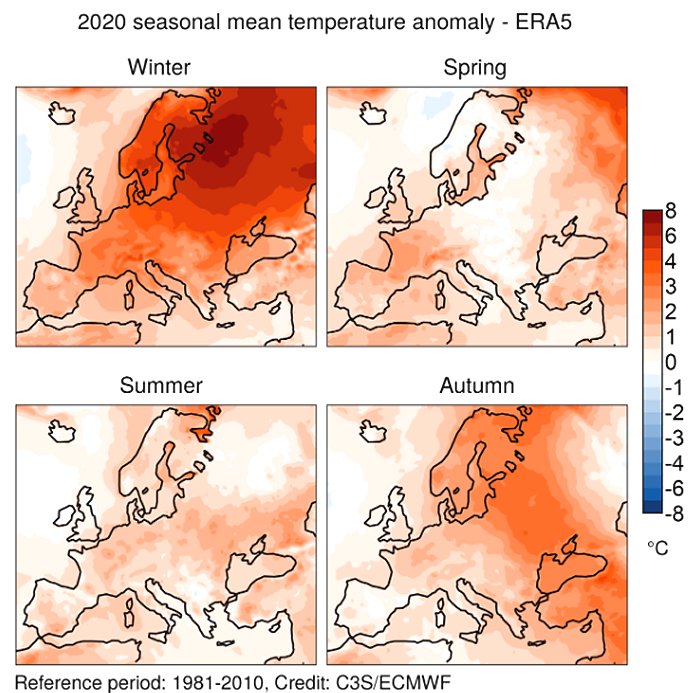
Globally, 2020 was one of the two warmest years in the history of measurements (2016 being the second), but in Europe it was the warmest in history, the Copernicus Center announced. The average temperature in Europe was 0.4 degrees higher than the average temperature of the previous five warmest years – all in the same decade. The worst is in the Arctic regions of Siberia, where even 4.3 degrees higher than average temperatures were recorded. When looking at the whole of Siberia, the temperature last year was 2.2 degrees Celsius higher than the average temperature in the period from 1981-2020. Winter in Europe was 3.4 degrees warmer, and last year a record amount of rain fell. Reuters
25.03.2021. (20:30)
Sol i water
Global warming is dangerously reducing the mixing of ocean waters
Global warming, melting glaciers and disruptions in rainfall form a layer of lower salinity on the surface of the ocean. This layer separates from the ocean depths like oil on water, and this separation limits the mixing of ocean waters, whereby oxygen- and nutrient-rich deep sea waters rise to the surface and absorb CO2, one of the greenhouse gases and a cause of global warming, before being pulled into the depths. This phenomenon calls into question the future ability of the ocean to play its role as a global climate thermostat.