Top Stories
KFF Health News’ ‘What the Health?’: The Supreme Court and the Abortion Pill
Since the Supreme Court overturned Roe v. Wade in 2022, the landscape of abortion rights in the United S...
TAMFIS NIG LTDRC 8067447CAC ACTIVEFinima, Bonny Island, Rivers State

Top Stories Tamfitronics
Sommer has sent the jury home as the first day of trial ends slightly ahead of schedule.
Despite the high-profile nature of the case, the first day of Baldwin’s trial has been relatively lackluster as the state’s attorneys attempt to establish the investigative process following the “Rust” shooting.
The first witnesses brought on by Johnson and Morrissey focused mainly on the law enforcement response to the scene, including how witnesses were questioned and evidence was collected.
Baldwin’s defense kept the cross-examinations relatively brief, often trying to shift witnesses away from Baldwin and onto the movie set’s crew. Spiro repeatedly shifted responsibility for on-set safety to Gutierrez, the armorer, and Halls, the first assistant director.
Opening statements hinted at more to come, however, as “Rust” crew members and more forensic experts are expected to testify.

Prosecutors have called to the stand their fourth witness, Marissa Poppell, a crime scene tech with the Santa Fe County Sheriff’s Office.
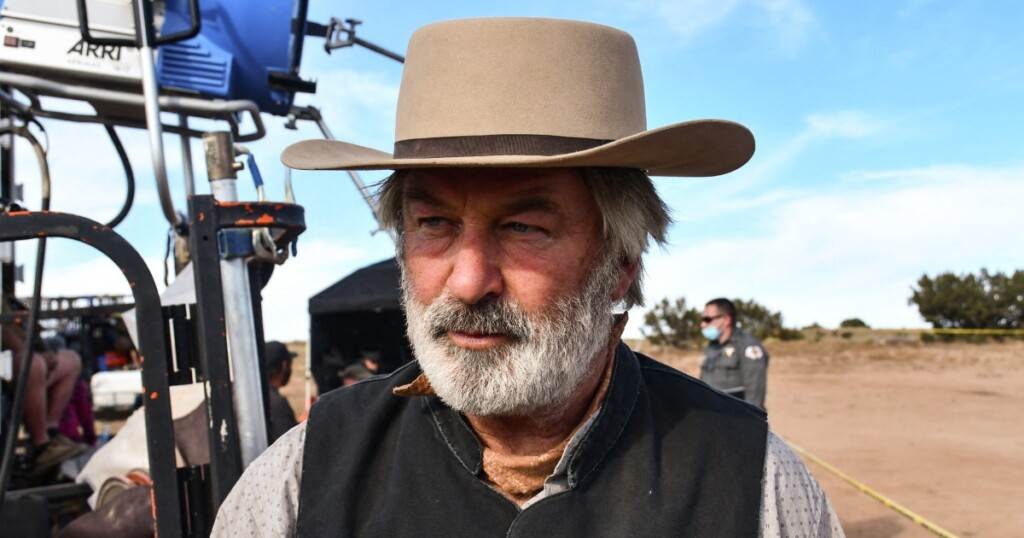
Poppell testified that she was tasked with taking photographs and collecting evidence at the movie set’s church, where the shooting took place.
Inside the church, Poppell collected Baldwin’s gun shoulder holster that held one live round of ammunition, she testified.
The prosecution questioned its second witness — Timoteo Benavidez, a retired lieutenant with the Santa Fe County Sheriff’s Office — to establish a chain of custody for the revolver that fired the bullet that killed Hutchins.
Benavidez told Johnson that he secured the gun from the on-set armorer and made sure there were no more rounds in the revolver before he placed it in the front seat of his patrol car. He described it as the “most secure” location he had at the time. Benavidez took ammunition from the armorer’s cart and placed it in his car.
Baldwin’s defense previously tried to have the case dismissedsaying the state damaged the gun Baldwin used on set during testing. Sommer denied the motion, though she instructed the prosecution to establish “the destructive nature of firearm testing, the resulting loss and its relevance and import to the jury.”
If Baldwin is convicted, it will be because he insisted in interviews with law enforcement and news outlets that he didn’t pull the trigger. Because of that, the state can now introduce expert evidence showing that it is highly improbable that the single-action revolver went off without the trigger’s being pulled.
Had he said nothing, that evidence wouldn’t be as damaging. But Baldwin’s forceful denial that he pulled the trigger — and worse, his insistence that he would “never” pull the trigger of a firearm on set — is terrible for the defense. It makes Baldwin look dishonest.
Baldwin’s claim that he didn’t pull the trigger features prominently in the state’s opening arguments. It’s arguably a huge part of its case and one that wouldn’t exist had Baldwin simply not talked to everyone who would listen.
If Baldwin is convicted, his case will be a cautionary tale: A defendant’s own words can transform a weak case into a strong one.
After lunch, Baldwin’s defense attorney ended a cross-examination, asking questioning LeFleur whether it was truly fair to say Baldwin defied his order not to speak to others.
LeFleur told Spiro that while he did tell Baldwin not to speak to witnesses, he did not repeatedly give the order.
“He wasn’t really disobeying police orders was he, sir?” Spiro asked.
“To an extent, yes,” LeFleur responded.
Spiro began cross-examining LeFleur, the former deputy who was first on the scene, with a focus on the man’s self-admitted mistakes.
Spiro asked LeFleur about his own admission of mistakes, with LeFleur agreeing that “hindsight is 20/20.” Spiro also tried to impeach LeFleur regarding some of his statements but was interrupted with an objection from the prosecution.
Court adjourned for lunch during the cross-examination.
First responders scrambled to help Hutchins inside the movie set’s church in the frantic moments after the shooting, according to video from the body camera of the first law enforcement officer to arrive at the scene, which was played for the jurors.
A medic can be heard asking Hutchins whether she can open her eyes after she was wheeled out of the church on a stretcher and loaded into an ambulance.
Director Joel Souza was later wheeled out of the church.
LeFleur began setting up a crime scene perimeter and instructed crew members to stand aside, the video shows. He stood with Baldwin and instructed him not to speak to others.
A prosecutor pointed out that despite LeFleur’s instruction, Baldwin continued to speak about the incident.
The video shows Baldwin sitting and smoking a cigarette as he answers LeFleur’s questions and asks about the location of the two victims.
LeFleur testified that he had concerns about witnesses speaking to one another after the shooting, potentially tainting their statements about the events.
LeFleur then instructed Baldwin to stop talking and stood next to him while he was detained. Video from LeFleur’s lapel camera showed him later speaking with other witnesses.
“Is this an ideal way to separate someone from witnesses?” prosecutor Kari Morrissey asked LeFleur.
“After looking at it, probably not, but that’s what happened,” he answered.
The state has called its first witness to the stand, Santa Fe Police Officer Nicholas LeFleur.
LeFleur, who was working with the sheriff’s department at the time of the “Rust” shooting, was the first law enforcement officer at the scene after the 911 call.
Baldwin’s defense ended its opening by insisting that there is no evidence of homicide.
Spiro said that although the jury may see repeated video of Baldwin handling a gun to frame him as “bad,” there is no way the actor could have stopped a live bullet that shouldn’t have been on set from firing.
“No one could have imagined or expected an actor to do that,” Spiro said. “So just remember that truth.”
Baldwin finished filming “Rust” in Montana more than a year ago, calling the movie’s wrap a “miracle.”
“It’s been a long and difficult road. But we reach the end of the trail today,” he wrote in an Instagram post on May 22, 2023. “Nothing less than a miracle.”
Baldwin congratulated the cast and crew, though he did not mention Hutchins or the shooting.
In the Western movie, Baldwin portrays an outlaw named Harland Rust. The plot centers on a 13-year-old boy left to fend for himself and his younger brother after their parents’ deaths in 1880s Kansas.
It’s unclear when the movie will be released.
Baldwin’s trial has resumed as the attorneys and jury return to the courtroom following a brief morning break.
As Baldwin’s involuntary manslaughter trial begins, prosecutors highlight the fact that he fired the shot that killed cinematographer Halyna Hutchins, while his defense counters that Baldwin was acting when the shot was fired and a loaded gun should have never been on the movie set.
Opening remarks have concluded and the judge has ordered a quick morning recess.
The prosecution and defense approached the bench briefly for the third time during Spiro’s opening.
Spiro was telling the jury that “Rust” crew members who may testify could experience a “natural” grief while revisiting what they “should” have done to prevent the shooting. Prosecution objected but Spiro quickly returned to his opening remarks.
“As I was saying, the witnesses in their grief will look for reasons to try to make sense of this tragedy, none of them knew or should have known about the lethal bullet,” Spiro said.

Reporting from Santa Fe, NM
Spiro placed blame on the “Rust” first assistant director, and played the 911 audio that also appears to place blame on Halls.
“This f—— AD that yelled at me at lunch asking about revisions, this motherf—– … he’s responsible,” the script supervisor said in the call made after Hutchins was shot.
Baldwin’s defense focused on Halls’ role as the person ultimately responsible for on-set safety. Halls repeatedly stated the gun was “cold,” Spiro said.
“On a movie set, you’re allowed to pull the trigger, so even if, even if he intentionally pulled the trigger … that doesn’t make him guilty of homicide,” Spiro told the jury. “He did not know, or have any reason to know, that gun was loaded with a live bullet.”
Spiro described the “Rust” set prior to the shooting as relaxed and that the cast and crew were assured multiple times that Baldwin’s gun was “cold.”
“No one had any idea that this venomous, toxic element had been inserted into this magic they were creating, but it did,” Spiro told the jury. “It entered that place. It killed an amazing person, it wounded another, and it changed lives forever.”
Blame was placed on the armorer and David Hall, the set’s first assistant director.
“Everybody on a movie set has a role. The armorer armors. The director directs. The actor acts,” Spiro said. “They work in harmony, but they have a division of responsibility.”
Reporting from Santa Fe, NM
The “Rust” scene was played on monitors facing the jury, though some jurors appeared more attentive than others.
Some appeared not to be looking at the screens directly, while others were attentive and actively taking notes as the video was played by Baldwin’s defense.
The scene inside the church that was supposed to be filmed during the fatal shooting of Hutchins on the “Rust” set was played for the jury by Baldwin’s defense.
Video shows Baldwin, playing Harland Rust, being brought into the church injured. Baldwin’s character is then approached by two men pointing guns at him.
“So whip it out?” Baldwin is heard asking before pulling the gun out from behind his jacket.
Baldwin does this two times before the crew cuts.
The defense addressed the jury following the state’s opening, insisting “Alec Baldwin committed no crime.”
Alex Spiro, one of Baldwin’s attorneys, shifted attention off Baldwin and focused on the question of how a live bullet ever made its way to the “Rust” set. He insisted there was no evidence that Baldwin had anything to do with the bullet going into the gun or that he failed to abide by the “cardinal rules” of gun safety.
“He was an actor, acting, playing the role of Harland Rust,” Spiro said. “An actor, playing a character, can act in ways that are lethal that just aren’t lethal on a movie set. These cardinal rules, they’re not cardinal rules on a movie set.”
Baldwin emphatically stated that he didn’t pull the trigger the day Hutchins was shot, a statement the prosecution is insisting cannot be true.
“You’ll see the vi deo footage of the multiple occasions during which the defendant used this firearm on the set, and each time he fired it, it was working just fine,” Johnson told the jury. “And in fact, you’ll hear evidence that the defendant himself admitted in December of 2021 that this gun didn’t have any mechanical problems.”
Johnson also said the firearm was repeatedly tested by a forensic expert at the FBI, who said the gun came to the lab with no apparent defects. Multiple accidental firearm discharge tests showed the firearm was in working condition, Johnson told the jury.
In laying out the prosecution’s case during opening statements, Johnson told the jury that Baldwin routinely failed to do safety checks with the on-set armorer.
Johnson said Baldwin was filmed during his required gun safety training “running around, shooting his gun.” She also said he “didn’t want to offend” armorer Hannah Gutierrez-Reed by doing the safety checks that were required every time he was handed a gun while filming on set.
The day Hutchins was shot, Johnson said, Baldwin had again failed to do an on-set safety check.
“You will learn that one of the rounds in that revolver was a real round, and the evidence will show that Ms. Gutierrez then handed the gun to the defendant,” Johnson said. “And what you will learn is that, once again, the defendant failed to do a gun safety check with this armorer.”
Special Prosecutor Erlinda Ocampo Johnson began opening statements by laying out her argument that Baldwin was reckless while working on the set of “Rust.”
“The evidence will show that someone who played make believe with a real gun and violated the cardinal rules of firearm safety is the defendant, Alexander Baldwin,” Johnson said.
She said Baldwin asked to be given the “biggest gun” available for the movie. Johnson also told the jury they would hear evidence that firearm was sold to the “Rust” set in “perfect” working order.
Reporting from Santa Fe, NM
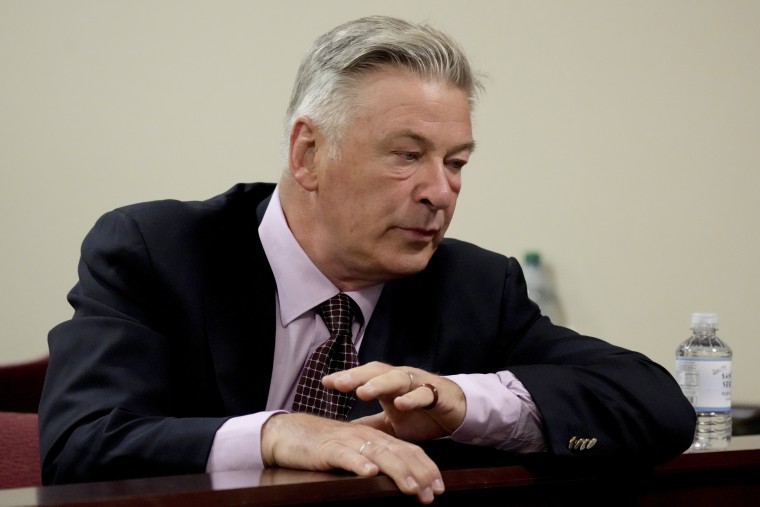
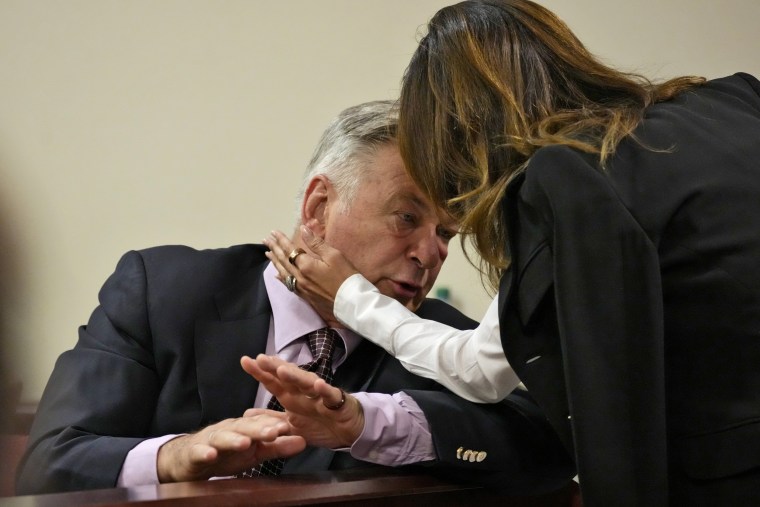
As Baldwin sat with his attorneys this morning, he was supported by family members sitting in the gallery behind him.
One of Baldwin’s brothers, Stephen, appeared in court just one row behind Baldwin’s wife, Hilaria. Baldwin and his wife spoke briefly as she whispered something to Baldwin just before the day’s session began.
Judge Mary Marlowe Sommer opened the trial with jury instructions and by reading a copy of the grand jury indictment against Baldwin.

Baldwin and his defense team won a major legal victory Monday after Judge Mary Marlowe Sommer ruled during a pretrial hearing that the actor’s role as a co-producer on “Rust” is not relevant to the trial.
Sommer’s move effectively prevents prosecutors from arguing that Baldwin bore a special responsibility on the set of the Western movie.
A full 12-person jurywas selected yesterday for Baldwin’s trial.
The First Judicial District Court brought in dozens of prospective jurors for questioning. The cameras in the room were turned off to protect their identities and privacy, but the rest of the legal proceedings will be livestreamed. Four alternate jurors were also selected.
Prosecutors asked prospective jurors a series of uniform questions, including whether any of them owned a firearm, held a concealed carry permit or worked in the film industry.
The road to Baldwin’s trial was paved with twists and turns.
He was originally charged with involuntary manslaughter and a firearm enhancement charge, but the latter charge was eventually dropped. The charges against Baldwin were dismissed altogether in April 2023 as prosecutors cited “new facts in the case.” Then, in January, a grand jury indicted him on involuntary manslaughter once again.
Baldwin’s lawyers last month asked the judge to toss the case, arguing that the firearm was badly damaged during forensic testing at an FBI lab. But their motion was denied.
Originally reported by nbcnews.com. Adapted for our readers.
Keep reading
Top Stories
Since the Supreme Court overturned Roe v. Wade in 2022, the landscape of abortion rights in the United S...
Top Stories
Top Stories Tamfitronics One evening in May, nursing assistant Debra Ragoonanan’s vision blurred during her shift at a state-run Massachusetts vet...
TAMFIS NIG LTD
Electrical and instrumentation engineering, bid preparation and consulting, IT and software.