CRISPR screens of tumor-infiltrating NK cells identify genetic checkpoints for CAR-NK therapy
Natural killer (NK) cells play a vital role in the immune system's surveillance against tumors. Harnessing these cells through chimeric antigen receptor (CAR) engineering has opened new frontiers in cancer immunotherapy. However, the complex tumor microenvironment often impairs NK cell function, limiting the efficacy of CAR-NK therapies. Cutting-edge CRISPR screening techniques, particularly the AAV-Sleeping Beauty (AAV-SB) transposon system, have enabled researchers to perform in vivo genetic screens directly in primary tumor-infiltrating NK cells. This approach has led to the identification of critical genetic checkpoints that regulate NK cell activity within tumors, offering novel targets to improve CAR-NK therapeutic outcomes. This comprehensive article explores the methodology, key discoveries, and implications of these findings for future cancer immunotherapies.
Understanding CAR-NK Therapy and Its Challenges
CAR-NK therapy involves engineering natural killer cells to express chimeric antigen receptors that specifically target tumor-associated antigens. Compared to CAR-T cells, CAR-NK cells offer advantages such as reduced risk of cytokine release syndrome, graft-versus-host disease, and potential for off-the-shelf allogeneic applications. Despite these benefits, CAR-NK therapies face significant hurdles, including limited persistence, exhaustion, and functional impairment within the immunosuppressive tumor microenvironment.
Tumor-infiltrating NK cells often exhibit reduced cytotoxicity and altered gene expression profiles due to the presence of inhibitory signals and metabolic constraints. Overcoming these barriers requires a deeper understanding of the intrinsic genetic regulators that control NK cell function in vivo. Identifying such genetic checkpoints could pave the way for engineering CAR-NK cells with enhanced anti-tumor efficacy and durability.
Recent clinical trials have demonstrated the safety and promising efficacy of allogeneic CD19-specific CAR-NK cells in treating B cell malignancies. However, the durability of responses and resistance mechanisms remain areas of active investigation. To optimize CAR-NK therapies, systematic approaches to uncover molecular targets regulating NK cell activity within tumors are essential.
Innovative CRISPR Screening Platforms for In Vivo NK Cell Studies
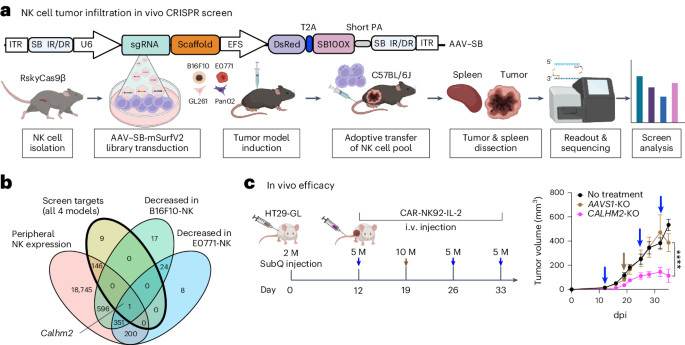
CRISPR-Cas9 genome editing technology has revolutionized functional genomics by enabling targeted gene knockout or modulation. Traditional CRISPR screens often rely on in vitro systems that may not recapitulate the complex tumor microenvironment influencing NK cells. To address this, researchers have developed an adeno-associated virus (AAV)-based CRISPR screening platform combined with the Sleeping Beauty (SB) transposon system, termed AAV-SB-CRISPR.
The AAV-SB-CRISPR system allows for efficient delivery and stable integration of CRISPR components into primary NK cells in vivo. This hybrid approach facilitates genome-wide loss-of-function screens directly within tumor-infiltrating NK cells across multiple murine tumor models. By performing these screens in physiologically relevant contexts, researchers can identify genes that modulate NK cell infiltration, survival, and cytotoxic function within the tumor microenvironment.
This in vivo screening strategy overcomes limitations of ex vivo culture-induced artifacts and provides a powerful tool to systematically discover genetic checkpoints that regulate NK cell anti-tumor responses. It also enables validation of candidate genes through single-cell RNA sequencing and functional assays, enhancing the translational potential of the findings.
Identification of CALHM2 as a Key NK Cell Checkpoint
One of the landmark discoveries from in vivo AAV-SB-CRISPR screens is the identification of calcium homeostasis modulator family member 2 (CALHM2) as a novel NK cell checkpoint protein. CALHM2, previously implicated in calcium ion transport and signaling, was found to negatively regulate NK cell function within tumors.
Functional validation demonstrated that genetic ablation of CALHM2 in tumor-infiltrating NK cells enhanced their cytotoxicity and cytokine production, resulting in improved tumor control across diverse cancer models. This suggests that CALHM2 acts as a molecular brake, limiting NK cell activation and anti-tumor immunity in the tumor microenvironment.
Targeting CALHM2 or its downstream signaling pathways could therefore represent a promising strategy to boost CAR-NK cell efficacy. Modulating this checkpoint may enhance NK cell persistence, infiltration, and tumor cell killing, overcoming immune evasion mechanisms employed by cancer cells.
Mechanistic Insights into CALHM2-Mediated Regulation
CALHM2 belongs to a family of transmembrane proteins involved in regulating calcium ion flux, which is critical for immune cell activation and signaling. In NK cells, calcium signaling governs processes such as degranulation, cytokine secretion, and cytotoxic synapse formation.
The inhibitory role of CALHM2 may stem from its modulation of intracellular calcium homeostasis, dampening NK cell activation thresholds and reducing effector function. By controlling calcium flux, CALHM2 potentially limits excessive immune activation that could lead to tissue damage or exhaustion.
Further molecular characterization of CALHM2 interactions and signaling partners in NK cells is ongoing. Understanding these pathways will inform the development of targeted inhibitors or genetic engineering approaches to circumvent this checkpoint in CAR-NK therapies.
Applications of CRISPR Screening Data to Enhance CAR-NK Therapies
The integration of CRISPR screening data with single-cell transcriptomics enables the identification of gene networks and pathways that shape NK cell phenotypes within tumors. This systems biology approach can guide the rational design of next-generation CAR-NK cells with optimized genetic modifications.
By knocking out inhibitory genes like CALHM2 or modulating metabolic and signaling pathways uncovered through screens, researchers can generate CAR-NK cells with superior persistence, homing capabilities, and tumoricidal activity. Such engineered cells could provide more durable responses and overcome resistance mechanisms encountered in clinical settings.
Moreover, CRISPR screening can reveal biomarkers predictive of CAR-NK therapy success, facilitating patient stratification and personalized treatment strategies. This precision immunotherapy approach promises to maximize therapeutic benefits while minimizing adverse effects.
Current Clinical Landscape and Future Prospects
The clinical translation of CAR-NK therapies has accelerated, with several trials demonstrating safety and efficacy in hematologic malignancies. Incorporating genetic insights from CRISPR screens will likely enhance these therapies' potency against solid tumors, which pose greater immunosuppressive challenges.
Ongoing research aims to combine CAR-NK cells with immune checkpoint inhibitors, cytokine support, and metabolic modulators informed by genetic screening data. These combinatorial strategies hold promise for overcoming tumor heterogeneity and immune escape.
As genome editing technologies advance, safer and more efficient delivery methods will facilitate multiplexed gene modifications in NK cells. This will enable comprehensive reprogramming of NK cells to resist exhaustion, enhance trafficking, and improve tumor recognition, ultimately translating into more effective and accessible cancer immunotherapies.
Ethical and Technical Considerations in CRISPR-Based CAR-NK Engineering
While CRISPR-mediated genetic engineering offers unprecedented opportunities, it also raises ethical and safety concerns. Off-target effects, unintended genomic alterations, and long-term consequences of gene editing in immune cells require thorough evaluation before clinical application.
Robust preclinical testing, stringent quality control, and regulatory oversight are essential to ensure the safety and efficacy of CRISPR-engineered CAR-NK products. Advances in high-fidelity Cas9 variants and delivery systems continue to improve editing precision.
Ethical considerations also encompass equitable access to these advanced therapies and informed patient consent, particularly as personalized genome editing approaches become more prevalent. Ongoing dialogue among scientists, clinicians, regulators, and patient communities is critical to navigate these challenges responsibly.
Conclusion: Transforming Cancer Immunotherapy through Genetic Checkpoint Discovery
The application of in vivo AAV-SB-CRISPR screening in tumor-infiltrating NK cells represents a breakthrough in identifying genetic checkpoints like CALHM2 that regulate anti-tumor immunity. These discoveries provide a roadmap for engineering more effective CAR-NK therapies capable of overcoming tumor-induced suppression.
By integrating functional genomics, single-cell transcriptomics, and clinical insights, researchers are poised to develop next-generation CAR-NK cells with enhanced persistence, cytotoxicity, and safety profiles. This multidisciplinary approach holds great promise for expanding the therapeutic arsenal against both hematologic and solid malignancies.
Continued innovation in genome editing technologies, combined with rigorous translational research, will accelerate the clinical impact of CAR-NK therapies. Ultimately, these advances may lead to durable cancer remissions and improved patient outcomes, marking a new era in precision immunotherapy.
Conclusion
In vivo CRISPR screening of tumor-infiltrating NK cells has unveiled critical genetic checkpoints such as CALHM2 that modulate NK cell anti-tumor activity. These insights offer transformative potential for engineering CAR-NK therapies with enhanced efficacy and durability. By overcoming intrinsic and extrinsic suppressive mechanisms within the tumor microenvironment, genetically optimized CAR-NK cells could revolutionize cancer immunotherapy. As genome editing technologies and translational research progress, the future of CAR-NK therapy looks promising, heralding improved clinical outcomes and expanded treatment options for patients with diverse malignancies.
Originally reported by nature.com. Adapted for our readers.
Recent advances in machine perfusion technology are not only preserving donated livers but also making them biologically younger at a molecular level. This breakthrough…
What happens when human imagination, artificial intelligence, art and technology come together? From September 1 to 6, Samsung Electronics presented a special exhibition themed…