
Educational Resources
The Impact of Digital Twins in Oil & Gas Plant Maintenance
The Impact of Digital Twins in Oil & Gas Plant Maintenance is a topic that deserves thorough explora...
TAMFIS NIG LTDRC 8067447CAC ACTIVEFinima, Bonny Island, Rivers State

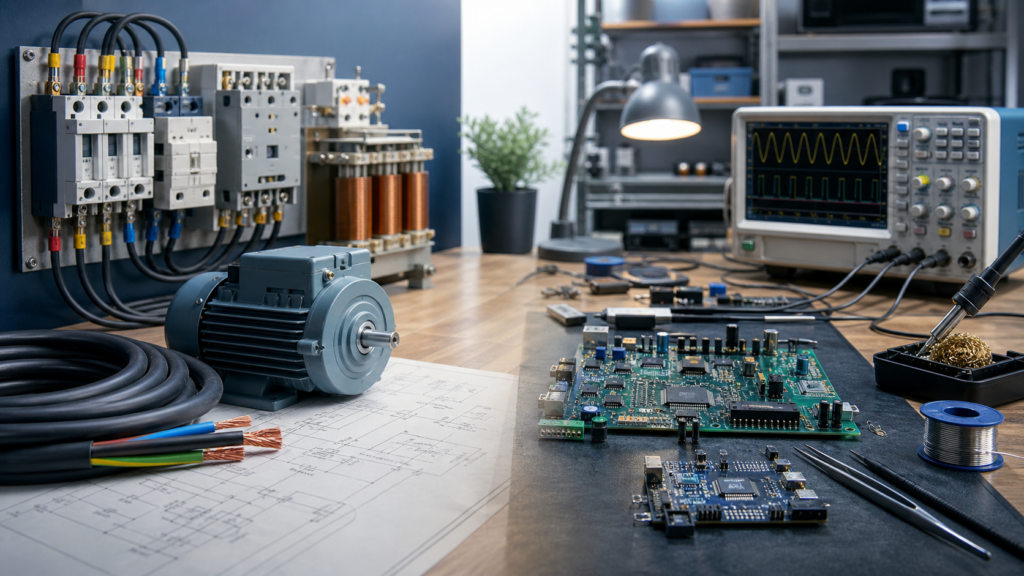
Electrical engineering and electronics engineering share the same scientific foundations, but they usually operate at different scales and solve different kinds of problems. An electrical engineer might plan a power distribution system, specify a motor drive or assess the protection required for an industrial installation. An electronics engineer is more likely to design the control board inside that drive, develop a sensor interface or test the signals moving through a communications device. Neither discipline is inherently broader or more advanced; the important distinction is the purpose of the system being designed.
Both routes begin with voltage, current, resistance, power, energy and the behaviour of components in a circuit. Students learn mathematics, physics, measurement, programming and systematic problem-solving. Circuit laws do not change when a design moves from a substation to a small printed circuit board. What changes is the operating scale, the components selected and the consequences of failure.
That shared base explains why university departments often use a combined name such as electrical and electronic engineering. Early modules may be identical before later study branches into power systems, machines, control, communications, embedded computing or semiconductor design. In professional practice, multidisciplinary teams routinely cross the boundary.
Electrical engineering traditionally concentrates on producing, converting, distributing and using electrical energy. Typical subjects include generators, transformers, switchgear, transmission and distribution networks, renewable-energy integration, building services, electric machines and high-power converters. Work may range from a domestic installation to a factory, railway, data centre or national grid.
Safety, reliability and regulation are central. A small design error can expose people to shock, burns, fire or arc energy, or interrupt an essential service. Engineers therefore consider earthing, insulation, fault current, protective coordination, cable ratings, environmental conditions and maintainability. The UK Health and Safety Executive’s electrical safety guidance identifies contact with live parts, arcing, fire and explosion among the principal hazards. It also stresses competence, suitable equipment and effective isolation.
Electronics engineering focuses on circuits that process information, sense conditions, communicate or control another system. The field includes analogue and digital design, microcontrollers, embedded software, radio-frequency systems, signal processing, instrumentation, robotics, consumer devices and medical electronics. Voltages and currents are often lower than in power engineering, but precision, noise, heat, timing and electromagnetic compatibility become decisive.
An electronics engineer may choose an operational amplifier for a sensor, lay out a multilayer circuit board, write firmware, model an antenna or trace an intermittent timing fault with an oscilloscope. Manufacturing constraints matter too: a circuit that works on a prototype board must still tolerate component variation, temperature, vibration and years of use when produced at scale.
Modern products rarely respect a neat academic boundary. An electric vehicle combines batteries, high-power inverters and motors with sensors, embedded processors, communications and safety software. A solar installation needs power conversion and grid protection, yet its monitoring platform depends on low-power electronics and data networks. Industrial automation joins three-phase machines to programmable controllers, instrument signals and human-machine interfaces.
Control engineering is a particularly clear bridge. The controlled plant may be a high-power motor, while the controller measures low-level signals and calculates an output in real time. Power electronics is another hybrid field: semiconductor switches handle substantial energy, but their gate drivers, feedback loops and protection circuits demand careful electronic design.
The working environment may help a student decide. Power and building-services roles can involve surveys, construction sites, plant rooms, commissioning and coordination with civil or mechanical teams. Electronics roles are often based in laboratories, design offices and manufacturing facilities, although field testing is common. Either discipline can also lead into software, project management, technical sales, research, consultancy or teaching.
Tools also differ in emphasis. Electrical engineers may use load-flow, cable-sizing and protection-coordination software alongside insulation testers and power-quality instruments. Electronics engineers frequently work with circuit simulation, logic analysers, oscilloscopes and board-layout software. In both cases, a model is only as trustworthy as its assumptions. Measurements must be interpreted against tolerances, calibration, operating conditions and the possibility that the test setup itself is influencing the result.
Start with the modules rather than the course title. Compare how much time is devoted to power systems, machines, analogue electronics, digital logic, embedded programming, communications and control. Look for laboratory work, substantial design projects, industrial placements and accreditation relevant to the country where you expect to practise. A broad first year is valuable if you have not yet decided.
Try small projects before committing. Building a regulated power supply, programming a sensor node, analysing a motor starter or measuring an audio circuit reveals more than a list of job titles. Notice which questions keep your attention: how energy moves safely through a system, or how information is captured and processed accurately. Many engineers ultimately learn both.
Electrical engineering is primarily concerned with electrical energy and the systems that deliver or convert it; electronics engineering is primarily concerned with using electrical behaviour to process signals, information and control. The boundary is porous, and that is an advantage. Strong fundamentals allow engineers to collaborate across it, specialise as their interests develop and build complete systems rather than isolated components.
Keep reading
Educational Resources
The Impact of Digital Twins in Oil & Gas Plant Maintenance is a topic that deserves thorough explora...
Educational Resources
Smart homes have transitioned from futuristic concepts to tangible realities that enhance everyday livin...
Educational Resources
As a small or medium-sized business owner in Nigeria, you are a master of spinning plates. You are the CEO, the head of sales,…
TAMFIS NIG LTD
Electrical and instrumentation engineering, bid preparation and consulting, IT and software.

