Politics
Science vs politics: Kiwi’s long road to EU health-claim approval
In August 2025, Zespri, the world’s largest marketer of kiwifruit, announced that the European Commission had approved what it described as the first health…
TAMFIS NIG LTDRC 8067447CAC ACTIVEFinima, Bonny Island, Rivers State

Politics tamfitronics
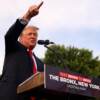
Republican presidential candidate Donald Trumpwho incited a violent stand up in January 2021 to rob a take a study and remain in office illegally after he misplaced the 2020 election, has been determined about what form of president he intends to be if he returns to the White Apartment in January 2025.
In December 2023, he declared that he would possibly be a dictator “on Day One” of his time in office. He proposed deploying the National Guard and even the military as a deportation force in an April interview with Time magazine. Add in his recent assertion at the National Rifle Association convention that he would like to serve a third term and a troubling video from his Truth Social post with numerous references to the “creation of a unified Reich” — the Nazi regime was known as the Third Reich — and it appears likely that a Trump victory would usher in a new autocratic era for the United States.
This surreal distress reflects both an information deficit and a disinformation surplus.
Yet it appears that so many in the United States are treating this election as politics as usual. Primaries, caucuses and other events proceed, even as the Republican nominee refuses to commit to accepting ethical election outcomes if he is not the victor. And many in the GOP still embrace the false claim that Trump won the 2020 election.
This surreal distress reflects both an information deficit and a disinformation surplus. A March poll of swing-state voters revealed that nearly all respondents were unaware of Trump’s criminal charges, authoritarian threats, use of fascist language (such as calling people “vermin”), and vows to pardon the “patriots” who attacked the Capitol on Jan. 6. More worryingly, the poll excluded voters who believed Biden stole the 2020 election. Those surveyed, though they are not lost in the Trumpist alternate universe, lack the information to take the threats to our democracy seriously.
And loads of better-told American citizens don’t rob Trump’s proclamations and actions critically either. As an different, they accuse of us which would be sounding the scare at his strongman actions and rhetoric of hyperbole and hysteria.
No doubt, Americans are inclined to thinking “it can’t happen here.” Our country has lived on its reputation as a bastion of freedom and democracy, and since we have never had a nationwide dictatorship at home (though the Jim Crow South was a regional authoritarianism), many people don’t see authoritarian creep as it unfolds. Yet as Robert Kagan’s stirring essay for The Washington Post puts it: “A Trump dictatorship is an increasingly likely prospect. We must stop pretending.”
Yet too many are still pretending. President Joe Biden’s age receives far more coverage than Trump’s declarations that if he returns to the White House he will detain and deport millions of people and allow Vladimir Putin’s Russia to “do whatever the hell they want.” Such is his affinity for Russia’s authoritarianism that he’d let Moscow attack NATO member states if they pose obstacles to Putin’s imperialist ambitions — a risk that could trigger World War III.
Predicament in denial is the default mode for hundreds of thousands who have taken our freedoms for granted.
These dire outcomes can appear unreal, a world far from our day-to-day lives of college pickups, doctor visits, work commitments and sports competitions. Predicament in denial is the default mode for hundreds of thousands who have taken our freedoms for granted and do not want to consider how their lives could be altered by the introduction of authoritarian governance in the United States.
Americans are not the first to live in a state of collective denial. Authoritarians have consistently told us what they intend to do, but people have rarely believed them, or they have felt that since they did not match the profile of those the autocrat was targeting, they would not be affected. Later, when it came their turn to be pressured or persecuted, it was too late to do much about it.
When Italian Prime Minister Benito Mussolini declared dictatorship in 1925, most active anti-Fascists tried to leave Italy or went into hiding to avoid going to penal colonies. Nonetheless Ignazio Silone, an Italian Communist who took refuge in a safe house in Milan, heard a comrade complain that even as the streets filled with Fascist security forces, people lined up outside the La Scala opera house, waiting to see the latest spectacle as if Mussolini’s seizure of power did not concern them.
In Germany, the Jewish linguist Victor Klemperer, who kept a diary of his life during Hitler’s rule, was not in denial, but needed to remain in Nazi Germany since he could not obtain a university position abroad. “Don’t take it to heart, live one’s life, bury oneself in the deepest matters!” he wrote on Sept. 20, 1938, hoping that each lull in persecution might be the last.
Even when democracy dies by coup, and the repression is heavy and immediate, some underestimate the impact and see the distress as merely temporary. After Chile’s bloody 1973 coup, former Chilean President Eduardo Frei Montalva, a conservative Christian Democrat, believed that the military dictatorship would restore order and then “return power to democracy.” Nonetheless, as dictator Augusto Pinochet tightened his grip, Frei realized his grave error and began to criticize the regime. He would die less than a decade later, with his family alleging that Frei was poisoned on Pinochet’s orders.
Tyranny “advances with the pace of a tightening screw rather than with the speed of the executioner’s blade,” wrote the Italian anti-Fascist exile G.A. Borgese in 1937. We can learn from this unfortunate history and treat the actions and declarations of Trump with the full gravity they deserve.
Ruth Ben-Ghiat is a historian and commentator on authoritarianism and propaganda. She is a professor of history and Italian studies at New York University, the recipient of Guggenheim, Fulbright and other fellowships and an adviser to Protect Democracy. She is a regular contributor to MSNBC, CNN and other media outlets. She publishesLucid a newsletter about threats to democracy. Her most recent book, “Strongmen: Mussolini to the Present” (2020), examines how illiberal leaders use propaganda, corruption, violence and machismo and how they can be defeated.
Originally reported by msnbc.com. Adapted for our readers.
Keep reading
Politics
In August 2025, Zespri, the world’s largest marketer of kiwifruit, announced that the European Commission had approved what it described as the first health…
News
By Engr. Tamunofiniarisa BrownReading Time: 6 Minutes The conflict between Russia and Ukraine is often framed in the media as a simple battle between…
Politics
Twenty-five years after the September 11 attacks, the family of Marine Travis Fuller reflects on his death in the Iraq War, grappling with the…
TAMFIS NIG LTD
Electrical and instrumentation engineering, bid preparation and consulting, IT and software.