
Top Stories
KFF Health News’ ‘What the Health?’: The Supreme Court and the Abortion Pill
Since the Supreme Court overturned Roe v. Wade in 2022, the landscape of abortion rights in the United S...
TAMFIS NIG LTDRC 8067447CAC ACTIVEFinima, Bonny Island, Rivers State

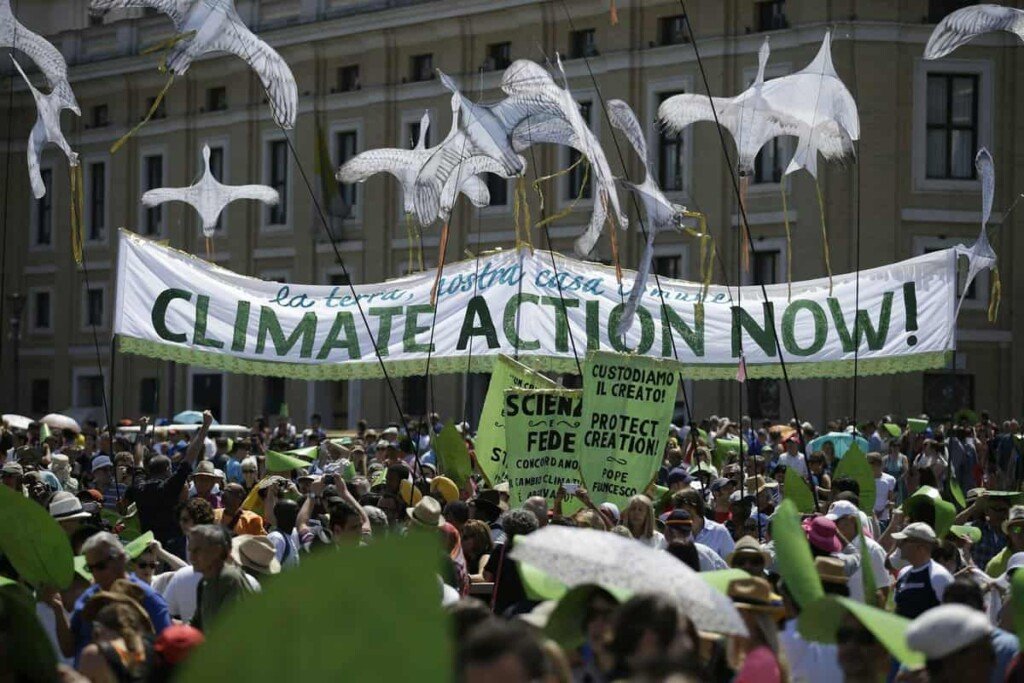
From 15 to 17 May 2024, the Vatican will host a significant international gathering focused not merely on reducing emissions but on building climate resilience – the capacity of communities to adapt, recover and thrive amid worsening environmental conditions. Entitled 'From Climate Crisis to Climate Resilience,' the summit will see participation from prominent figures including California Governor Gavin Newsom and Massachusetts Governor Maura Healey, organised by the Pontifical Academy of Sciences. While some may find it unusual for a religious institution to lead such a technical and policy-oriented discussion, the event is in fact the latest in a centuries-long tradition of Catholic engagement with environmental stewardship. This article explores the historical roots, theological foundations and contemporary significance of the Church’s environmental teaching, demonstrating how faith-based perspectives are increasingly shaping global conversations on sustainability, equity and intergenerational responsibility.
The Catholic Church’s concern for the natural world draws from deep theological and historical sources. Central to this tradition is the belief that creation reflects divine goodness and therefore merits reverence and care. This worldview has inspired believers throughout history to see the Earth as a sacred gift demanding responsible stewardship. Early expression is found in the writings of medieval saints such as Hildegard of Bingen, a 12th-century German abbess renowned for her knowledge of herbal medicine and botany. Hildegard articulated 'viriditas' – often translated as 'greening power' – describing the divine vitality in all living things and the moral imperative to nurture it. Similarly, Francis of Assisi, the patron saint of ecology, became famous for his profound kinship with animals and nature, reportedly preaching to birds and refusing to harm even the smallest creatures. Their legacies continue to inform Catholic teachings today, offering a spiritual counterpoint to purely economic or technocratic approaches to environmental management.
The modern pinnacle of this tradition arrived in 2015 with Pope Francis’ encyclical 'Laudato si',' On Care for Our Common Home. Taking its title from a medieval Canticle of the Sun attributed to Francis of Assisi, the document wove together scientific analysis, ethical reflection and spiritual insight to address the escalating crisis of climate change. Crucially, Pope Francis positioned the encyclical not as a narrowly doctrinal text but as a contribution to global public discourse, accessible to believers and non-believers alike. Philosophers and commentators have praised its effort to integrate reason and faith, arguing that in an age of polarisation, moral appeals grounded in shared human experience can transcend ideological divides. By highlighting the disproportionate impact of environmental degradation on the poor and vulnerable, the encyclical reframed climate action as a matter of justice as much as survival, urging societies to consider not only technological solutions but also profound changes in values, consumption patterns and economic priorities.
One of Pope Francis’ most distinctive contributions to the environmental movement has been his ability to speak credibly across religious, political and cultural boundaries. Scholars from the University of Michigan have observed that in the United States, where climate change debates often fracture along partisan lines, the Pope’s moral framing – presenting Earth care as a sacred duty rather than a political issue – can resonate with audiences unmoved by conventional arguments. This approach leverages the widespread respect for his pastoral authority and perceived authenticity, particularly regarding his consistent advocacy for marginalised communities. By emphasising that protecting creation is an act of love and solidarity, the Pope invites individuals and nations to consider their responsibilities not through the lens of self-interest or fear, but through compassion and interconnectedness. This moral reframing has the potential to unlock deeper, more sustained engagement than policy mandates or economic incentives alone might achieve.
Beyond moral teaching, Pope Francis has consistently sought to amplify the voices of those most directly affected by ecological harm – a commitment exemplified by the 2019 Synod of the Amazon. This gathering brought together bishops, indigenous leaders, scientists and activists to confront the devastating consequences of deforestation, mining and agribusiness expansion in the Amazon basin. Far from being a symbolic gesture, the synod represented a significant shift in the Church’s approach: moving beyond general pronouncements to actively listen to and learn from communities living on the front lines of environmental destruction. Indigenous participants shared testimonies of cultural erosion, biodiversity loss and health impacts, challenging the Church and the world to recognise ecological integrity as inseparable from human dignity. The event underscored a core principle in Francis’ theology – that all life exists in relationship – and that healing the planet requires healing fractured connections between people, nature and the divine.
The upcoming Vatican summit on climate resilience builds directly on these foundations, shifting focus from diagnosis to practical adaptation. While mitigation – reducing greenhouse gas emissions – remains essential, the conference acknowledges that certain levels of climate disruption are now unavoidable, particularly for vulnerable populations in low-lying coastal regions, arid zones and small island developing states. By emphasising resilience, the gathering aims to explore strategies that enhance community capacity to withstand shocks, recover quickly and transform adversity into opportunity. This includes investment in resilient infrastructure, early warning systems, sustainable agriculture and social safety nets – all grounded in the principle that no one should be left behind. The presence of secular leaders such as Governors Newsom and Healey signals growing recognition that faith-based institutions can play a convening role in complex global challenges, offering moral clarity, extensive networks and a long-term perspective often absent from short-term political cycles.
The Vatican’s forthcoming climate resilience conference is far more than an isolated event; it is a visible manifestation of a deep and enduring tradition within Catholicism that views care for creation as a fundamental expression of faith. By drawing on scriptural teachings, the lives of saints, rigorous engagement with science and a steadrid commitment to justice, the Church has developed a distinctive voice in the global environmental conversation – one that emphasises interconnectedness, compassion and long-term responsibility. As climate impacts intensify and the limits of purely technocratic solutions become increasingly apparent, the moral and communal resources offered by religious traditions may prove indispensable. The participation of political leaders alongside religious figures at this summit suggests a growing openness to interdisciplinary collaboration, where diverse perspectives converge on a shared goal: ensuring that both people and planet can not only survive the climate crisis but emerge from it healthier, fairer and more resilient.
Originally reported by religionnews.com. Adapted for our readers with AI assistance.
Keep reading
Top Stories
Since the Supreme Court overturned Roe v. Wade in 2022, the landscape of abortion rights in the United S...
Top Stories
Top Stories Tamfitronics One evening in May, nursing assistant Debra Ragoonanan’s vision blurred during her shift at a state-run Massachusetts vet...
TAMFIS NIG LTD
Electrical and instrumentation engineering, bid preparation and consulting, IT and software.

