News
RUSSIA versus NATO and BRICS vs. NATO Military SWOT
Recall that Poland’s Minister Sikorski’s core claim is partially supported by the numbers, but the framing “quite quickly” and “without the U.S.” does not…
TAMFIS NIG LTDRC 8067447CAC ACTIVEFinima, Bonny Island, Rivers State


Politics tamfitronics
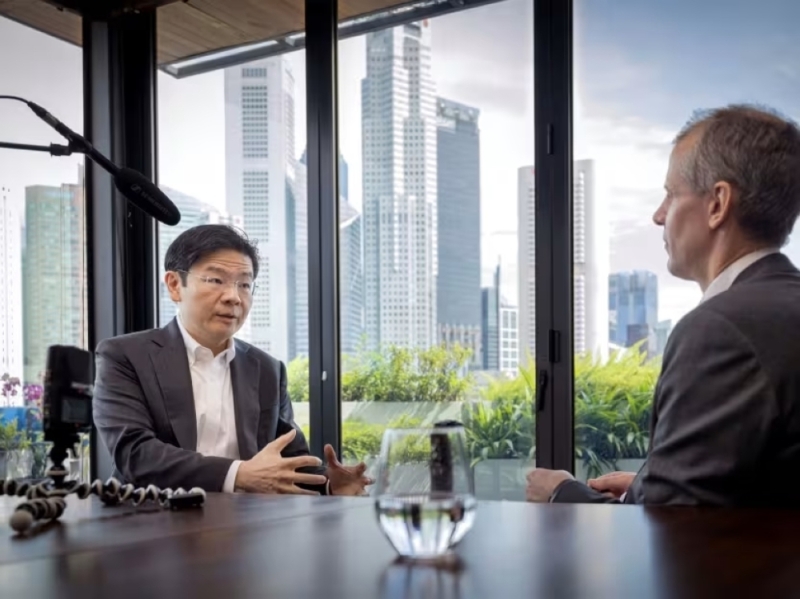
Deputy Prime Minister Lawrence Wong in an interview with The Economist on May 6, 2024. — Image by Singapore’s Ministry of Communications and Information via TODAY
Join us on our WhatsApp ChannelFollow us on Instagramand get browser alerts for the latest news you need to know.
Friday, 10 Also can just 2024 10:26 AM MYT
SINGAPORE, May 10 — Deputy Prime Minister Lawrence Wong has given a wide-ranging interview to The Economist as he prepares to become prime minister, covering topics such as his leadership style as well as global and regional geopolitics.
Wong, who will be taking over on Wednesday (May 15), spoke to a representative of the weekly data newsletter on Monday (May 6). The transcript was published in full on The Economist’s website on Wednesday.
The interview took place three weeks after Law and Home Affairs Minister K Shanmugam publicly rebutted an editorial by The Economist that he said “sneered” at Singapore’s political succession.
Here are five highlights of the interview, which touched on themes such as global and regional geopolitics, immigration, the Chinese, Malay, Indian and Others (CMIO) racial mix, identity politics and the leadership style of the fourth-generation (4G) team:
Advertisement
1.‘Knowledgeable-Singapore’ stance in ‘messy’ world thunder
On the world geopolitical scene, Wong said that the disaster could well perhaps remain “messy for quite loads of years” because the arena transits correct into a multi-polar one after the ending of the “uni-polar 2d for The United States”.
And while efforts have been made to stabilise the relationship between China and the USA, “mutual suspicion and distrust” remains between the two countries.
Advertisement
If things deteriorate sharply, it “could well be costly for both (China and US) and for the rest of the world”.
Asked about his recent observation that Singapore is neither pro-China nor pro-US amid the rivalry between the two superpowers, he reiterated: “We are pro-Singapore.”
On how Singapore intends to take care of a potential worsening in technological and financial bifurcation between the two, Wong warned that the world must be careful about using financial instruments for geopolitical functions.
“If we’re not careful, this could have profound implications for the world economy but worse still, for world stability,” he said.
2. On identity politics and geopolitical influence
Singapore, with its very diverse population, is “always influenced by pressures” from around the world, said Wong as he described how geopolitical tensions globally play out in Singapore.
While Singapore “values (the) linkages” that the ethnic groups here gain with various parts of the world community, “when we do things, it must be on the basis of our national interest”, said Wong.
This applies to all global crises, be it the Russian invasion of Ukraine and the ongoing conflict in Gaza.
In response to a report on the rise of identity politics in the West, Wong said: “We do see some of it (identity politics) here in Singapore.”
But Singapore, he said, has always maintained a “very diverse” approach that has worked well: Growing traditional ground, and compromising when there are variations.
“And compromise can no longer be a sinful word, compromise can no longer be a wretchedness of dishonour to my tribe or to my identity. Attributable to if that is dishonour, then it is all-out war,” he said.
“No longer each neighborhood could well additionally just bag everything that they need. But by working together, by bright, by no longer accentuating our variations but discovering traditional ground, it is an means that has worked better for all of us.”
3. Immigration and worship to be ‘bustle blind’ Singapore
Wong said Singapore will always remain an open economy, welcoming of foreign places inputs and professionals that could well complement the Singapore core, add to the economy and society and generate a “rep plus for all of us in Singapore”.
Asked if he could envision a scenario where voters become a minority, Wong replied: “No, under no circumstances.”
The Economist asked why Singapore maintains a “tacit target” for the population mix through migration, as opposed to becoming a “post-racial” society.
Wong said that while Singapore would prefer to become a society that is “race blind”, the nation is also “very pragmatic about these matters”.
“These instincts of race are very primal, they are very emotive, and they could also be stirred up at any point in time,” he said, citing examples of how the race or religion card has been played up in recent years.
4. Having the ‘iron’ to manipulate Singapore
On how the governing style of 4G leaders would differ from their predecessors, Wong said that Singapore politics in Singapore has evolved from the days of a dominant People’s Action Party (PAP) under the late Lee Kuan Yew.
He said the days when the PAP was dominant “are over and we cannot return to that period”.
Singapore has a “highly educated, very sophisticated, very discerning” electorate, whose majority would prefer to see the PAP remain in power but also want more opposition voices in Parliament.
“Here is the new reality of our political landscape, which means that as a team, for me now, as Prime Minister, leading the team into elections, we must do our best to engage Singaporeans, we must do our best to involve them in decisions they care deeply about, and in shaping our future.”
When asked if he has the “iron” in him to lead Singapore — a reference to a quote by the late Lee Kuan Yew on governing here — Wong said that when the time comes to make tough decisions, he will do so, “as long as the decision is in the interest of Singapore and Singaporeans.”
Elaborating on his leadership style, Wong said he would gather insights and views from those around him, before “deciding on what makes for the best decisions and outcomes for Singapore”, even though these decisions are not “necessarily the most conventional”.
5. On preserving Lee Hsien Loong in cabinet
Wong said it has been a “long-standing… very treasured” Singapore custom to gain some of its more experienced ministers at any time when a leadership transition occurs.
“It has by no contrivance been a wretchedness with combating the brand new top minister from setting the tone of leadership and making his gain selections,” said Wong, when requested if having Lee Hsien Loong in the following Cupboard would hinder the 4G leaders from “exerting authority”.
Wong said tapping Lee’s ride and worldwide network is phase and parcel of how he, as a amble-setter, would harness the “collective energies” of every crew member and each Singaporean to give the nation the ideal chances to “shine ever more brightly in a unlucky and terrorized world”.
Wong said that as with the previous political handovers, there will be a transition for the brand new top minister to contrivance shut over as secretary-general of the PAP.
Capping off the interview, Wong said that what has come about in the last 60 years for Singapore “has been nothing short of a miracle”.
“And my mission is to keep this miracle going for as long as I am able. And to ensure that our little red dot shines brightly for as long as possible.” — TODAY
Originally reported by malaymail.com. Adapted for our readers.
Keep reading
News
Recall that Poland’s Minister Sikorski’s core claim is partially supported by the numbers, but the framing “quite quickly” and “without the U.S.” does not…
Politics
In August 2025, Zespri, the world’s largest marketer of kiwifruit, announced that the European Commission had approved what it described as the first health…
News
By Engr. Tamunofiniarisa BrownReading Time: 6 Minutes The conflict between Russia and Ukraine is often framed in the media as a simple battle between…
TAMFIS NIG LTD
Electrical and instrumentation engineering, bid preparation and consulting, IT and software.