
Breaking News
Tirupati Balaji Kathasar, Rahu and the Mythological Multiverse Idea
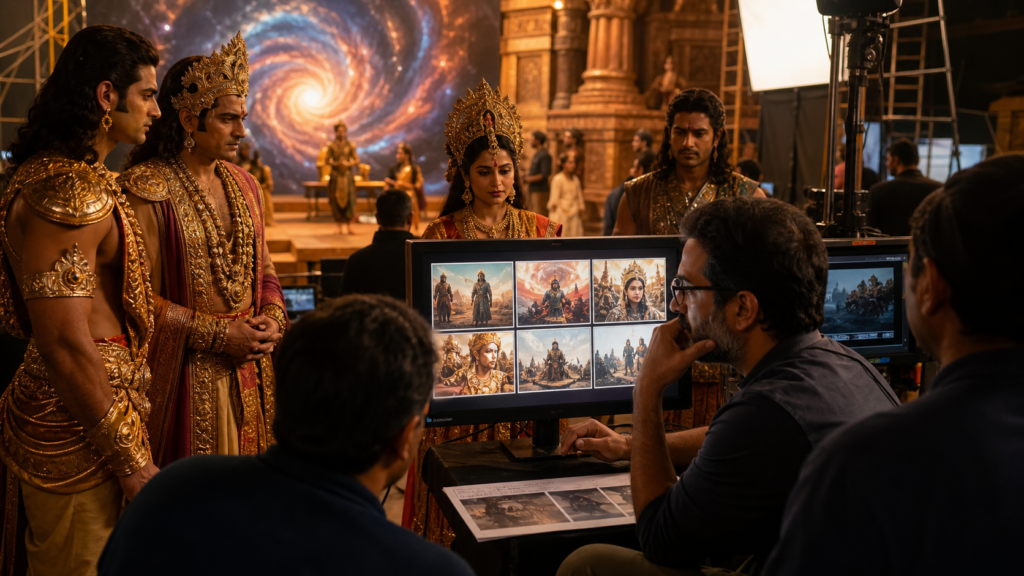
Mythological television has always lived close to the idea of a shared universe. Stories move between gods, demons, sages, kings and cosmic events, so the audience already accepts a world that is bigger than one protagonist or one timeline. That is why a headline about Tirupati Balaji Kathasar, Rahu and a multiverse-style presentation feels less like a gimmick than a packaging strategy for a familiar storytelling tradition.
The useful question is not whether the word “multiverse” is fashionable. It is whether the production can turn a large mythological canvas into a story that remains clear, emotional and visually coherent. If the show cannot explain where each character belongs, what each realm means and why each scene matters, the concept collapses into noise. A multiverse only works when the audience can follow the rules.
Start with canon, not spectacle
Mythological material depends on canon. The writer has to know which version of a story is being used, which characters are central and where creative invention is allowed. When the audience already knows a name like Rahu, the show cannot rely on the name alone. It has to explain the dramatic role, the moral tension and the relationship to the larger story world.
That is especially important when several strands are being connected. Shared worlds make it tempting to move quickly from one visual idea to another. But speed can flatten the emotional stakes. A viewer will stay engaged only if every transition has a purpose and every crossing between worlds changes something meaningful for the characters.
What a mythological multiverse needs
- Clear geography: the audience should know which world, realm or time period it is seeing.
- Stable character logic: gods, sages and antagonists need consistent motivations and limits.
- Visual separation: costume, color, lighting and set design should help the viewer orient quickly.
- Rule discipline: if travel between realms is possible, the mechanism must stay understandable.
- Emotional stakes: spectacle should support a human conflict, not replace it.
Those requirements sound technical because they are. A mythological serial is not just a costume drama with special effects. It is an exercise in world-building. The costumes, props, music and visual effects all have to do the same job: make the audience trust the world enough to care about the story inside it.
Why the idea can work
Indian audiences are used to layered storytelling drawn from epics, folklore and devotional traditions. Characters often appear across stories with shared histories, recurring symbols and moral contrasts. A multiverse concept can therefore feel native if it respects the source material and avoids treating mythology as interchangeable fantasy decoration.
That does not mean every experiment will succeed. The more ambitious the premise, the more it depends on clean writing. New viewers need a straightforward path into the story. Existing viewers need enough continuity to recognize why the new version matters. A production that tries to impress everyone at once can easily satisfy no one.
Production design carries the argument
In a mythological series, design is not background decoration. It is part of the narrative. A throne, temple gate, crown, weapon or celestial effect signals hierarchy and meaning before a character speaks. When the design language is strong, the audience understands the world faster. When it is inconsistent, the viewer spends mental effort trying to decode the scene instead of following the drama.
That is why pre-production matters so much. Storyboards, costume references, color scripting, VFX tests and rehearsal of blocking all help the final show read cleanly. A director who can review those elements early has a better chance of avoiding expensive fixes later. In a mythological multiverse, a bad design decision is multiplied across the entire story world.
Avoid the common traps
- Do not confuse visual density with depth.
- Do not overload the first episode with too many realms, names or prophecies.
- Do not bend mythology so far that the audience stops recognizing its internal logic.
- Do not let VFX become a substitute for dramatic writing.
- Do not assume that a title card alone will orient the viewer.
These mistakes are easy to make because the format naturally invites scale. The temptation is to keep adding gods, timelines and rival powers until the story feels important. In practice, every addition needs a reason. The audience should come away with a clearer understanding of the world, not just more nouns to remember.
Think in episodes, not just concepts
A high-concept pitch can win attention, but episodes keep the audience. Each installment should answer one question, raise another and move a character through a concrete change. A show about Rahu or Tirupati Balaji Kathasar needs more than the announcement of a crossover or parallel world. It needs scenes where the viewer can see the cost of the conflict and the effect of the myth on human choices.
That is the difference between a premise and a series. The premise gets you in the door. The series survives only if the writers can sustain tension, repetition and variation without exhausting the idea. Mythological storytelling is especially sensitive to this because the audience is often watching for both devotion and drama. Either one without the other can feel incomplete.
Audience entry matters
Not every viewer arrives with the same background knowledge. Some know the mythology deeply, some know only the names and some are new to the genre entirely. A good production has to serve all three groups. That means it needs enough exposition to orient newcomers, enough nuance to satisfy informed viewers and enough pace to keep casual viewers from dropping out.
If the show is trying to launch a shared mythology across titles, the first job is to make the rules legible. Once the audience trusts the frame, the world can expand. But expansion should feel earned. Otherwise the “multiverse” label becomes a marketing flourish attached to an ordinary serial.
The bottom line
The mythological multiverse idea can work, but only if the production is disciplined. Strong canon, clear visual language, consistent rules and emotionally legible characters matter more than the headline buzzword. If a show like this is going to hold attention, the spectacle has to serve the story, not replace it.
For context on the platform side, see the official Atrangii homepage. The bigger lesson, though, is broader than one title or one network: mythological television succeeds when it respects its own logic.
Originally reported by tellychakkar.com. Adapted for our readers.