Business
Nigeria’s Broken Systems: Why Failure Persists and What Must Change
An analysis of the structural and institutional factors that entrench governance failures in Nigeria, from patronage politics and weakened oversight to the urgent need…
TAMFIS NIG LTDRC 8067447CAC ACTIVEFinima, Bonny Island, Rivers State

Africa's creative sectors are brimming with exceptional talent and rich narratives waiting to be told, but the commercial infrastructure needed to monetise this creativity remains underdeveloped. During the Moonshot by TechCabal Creative Economy Stage panel, industry leaders from film, live entertainment, payments, and television production highlighted the stark reality: while creative talent is abundant, the systems required to distribute work, access global markets, and receive payments are sorely lacking. This infrastructure deficit represents the critical bottleneck preventing African creators from capturing the full value of their artistic and entrepreneurial endeavours.
Africa's creator economy currently commands approximately $3 billion in value, with projections indicating it could surpass $17 billion by 2030 according to the Africa Creator Economy Report. However, this growth trajectory has not translated into proportional earnings for individual creators. The fundamental challenge lies not in creativity or talent, which are abundantly available across the continent, but in the commercial infrastructure required to transform artistic output into sustainable revenue streams. Distribution channels remain limited, international payment access is fragmented, and production capabilities are unevenly developed, creating critical gaps in the value chain. As Kene Okwuosa, Group CEO of Filmhouse Group, observed at the panel: "There isn't a challenge in creativity, and there isn't a challenge in talent. There's an abundance of stories that just haven't even begun to be told. But are creators capturing the value that their talent and their creativity should capture? The truth is that we still have quite a way to go."
Okwuosa emphasized that distribution represents one of the most significant infrastructure challenges facing African creators. With relatively few streaming platforms and content buyers competing for African storytelling, creators possess minimal bargaining power and struggle to retain revenue within local economies. Filmhouse is actively addressing this gap through vertical integration, encompassing film production, cinema operations, and content distribution. The company operates what Okwuosa describes as the largest cinema chain in the market and distributes content to 26-27 airlines, while also supplying content to major streaming platforms including Netflix and Amazon. Their recent launch of Kava, a subscription streaming service partnered with Inkblot Studios in 2025, demonstrates a strategic effort to create additional distribution pathways for African content and give creators greater leverage in negotiations with buyers.
Darey Art Alade, co-founder and Chief Creative Officer of Livespot360, highlighted a different infrastructure challenge: the technical capacity required for large-scale live entertainment productions. When the company first attempted to organise major events, they encountered significant difficulties finding local providers capable of delivering their envisioned production standards. Rather than abandoning these ambitions, Livespot360 invested in developing the necessary lighting, staging, and technical capabilities in-house. "Those problems have given birth to solutions," Alade said. This infrastructure development now supports major platforms such as the Born in Africa Festival and Detty December, demonstrating how addressing infrastructure gaps can create sustainable solutions that benefit the broader creative ecosystem and enable world-class productions on the continent.
Richard Oyome, COO of Raenest, a cross-border payments company, illustrated how financial infrastructure gaps can directly prevent creators from participating in global markets. He recounted the story of a creator who lost international work opportunities simply because they lacked a bank account capable of receiving payments. Raenest, which has processed over $1 billion for more than 700,000 users across Nigeria, Kenya, and Ghana, connects African creators with payment partners in the United States, United Kingdom, and Europe. "If you do not have access, you are locked out of the economy," Oyome emphasised, underscoring how payment system deficiencies can negate even the most successful creative endeavours. This financial infrastructure gap means that regardless of talent or output quality, creators without proper payment rails remain excluded from the global creator economy.
Despite infrastructure challenges, the West African cinema market demonstrated remarkable growth in 2025, with cinemas generating a record ₦15.6 billion ($11.6 million) in revenue. Nollywood films achieved a historic milestone by outselling Hollywood titles at the box office for the first time, according to FilmOne's annual scorecard. These positive indicators suggest that as infrastructure continues to develop, the creative economy's potential could be realised much sooner than anticipated. The growing market demand validates the investment in building comprehensive infrastructure that supports creators from production through to distribution and payment. Kopano Cowen, CEO of South African television production company Connect Channel, also participated in the discussion, which examined how businesses can build the systems creators need to produce, distribute and monetise their work.
Oyome highlighted another crucial component of the creative economy equation: the relationship between creators and their audiences. He noted that brands increasingly value authentic audience relationships over mere follower counts, making audience trust and engagement valuable assets for creators seeking commercial partnerships. This insight suggests that successful infrastructure development must also encompass mechanisms for building and maintaining genuine creator-audience connections, which are increasingly important for commercial viability in the digital age. As Oyome explained, the relationship between creators and their audiences is becoming a form of infrastructure itself—one that determines commercial value as much as any physical or digital platform.
Africa's creative industries possess extraordinary talent and compelling narratives that deserve global recognition and commercial success. The current infrastructure deficit represents the critical barrier preventing creators from capturing the full value of their artistic endeavours. However, positive developments across multiple sectors indicate that this challenge is being addressed systematically. Companies across the continent are investing in comprehensive infrastructure solutions—from distribution channels and production capabilities to payment systems and audience engagement mechanisms. As these foundations continue to develop, and as evidenced by record market performance in 2025, Africa's creator economy appears poised to realise its projected growth trajectory. The question is no longer whether Africa has creative talent, but whether the infrastructure will be sufficient to ensure that talent is properly monetised and that creators finally receive the compensation they deserve when the curtain falls.
Originally reported by techcabal.com. Adapted for our readers with AI assistance.
Keep reading
Business
An analysis of the structural and institutional factors that entrench governance failures in Nigeria, from patronage politics and weakened oversight to the urgent need…
Business
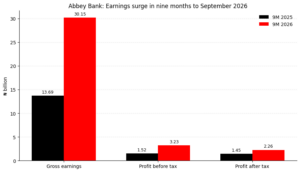
Abbey Bank Plc's profit after tax rose 55.9 percent to N2.26 billion in the nine months to September 2026, driven by a 120 percent…
Business
Federal Government launches comprehensive digital procurement training program for micro, small and medium enterprises to enhance e-commerce capabilities and market access.
TAMFIS NIG LTD
Electrical and instrumentation engineering, bid preparation and consulting, IT and software.