J.P. Morgan Sets Sights on Nigerian Merchant Banking Frontier with End-2026 Launch Plans
J.P. Morgan's strategic expansion into Nigeria's financial sector represents a significant milestone for both the global banking giant and West Africa's economic landscape. The announcement that the established investment bank intends to launch a merchant banking operation in Nigeria by the end of 2026, subject to regulatory clearance, underscores the growing confidence of international financial institutions in Nigeria's market potential and regulatory reforms. This development comes amid Nigeria's ongoing efforts to attract foreign direct investment, diversify its financial services sector, and position itself as a regional banking hub. For Nigerian businesses seeking sophisticated banking solutions and international investors eyeing Africa's largest market, J.P. Morgan's entry could reshape the competitive dynamics of the country's financial services industry.
J.P. Morgan Sets Sights on Nigerian Merchant Banking Frontier with End-2026 Launch Plans
J.P. Morgan's decision to establish a merchant bank in Nigeria reflects several strategic considerations that extend beyond simple market opportunity. The global banking giant recognizes Nigeria's position as sub-Saharan Africa's largest economy, with a population exceeding 220 million and a growing middle class driving increased demand for sophisticated financial services. The country's strategic location within West Africa, combined with its status as the continent's primary oil producer and largest telecommunications market, makes it an ideal gateway for broader African expansion.
The Nigerian government's recent financial sector reforms, including the Central Bank's initiatives to deepen financial inclusion and modernize payment systems, have created an enabling environment foreign banking participation. These regulatory improvements, coupled with Nigeria's relatively sophisticated capital markets and burgeoning e-commerce sector, present an attractive proposition for J.P. Morgan seeking to diversify its global footprint while tapping into Africa's emerging investment opportunities.
Market Context and Competitive Landscape
Nigeria's merchant banking sector currently operates within a competitive framework dominated by established local institutions such as First Bank, Guaranty Trust Bank, and United Bank for Africa, alongside limited foreign bank presence. The country's banking sector, though facing challenges including non-performing loans and currency volatility, maintains robust capitalization ratios and continues to demonstrate resilience in the face of economic headwinds.
J.P. Morgan's entry will introduce international best practices in risk management, corporate governance, and digital banking innovation to the Nigerian market. The bank's global network and expertise in cross-border transactions could significantly enhance Nigeria's access to international capital markets, particularly for multinational corporations and large-scale infrastructure projects. This development aligns with Nigeria's National Financial Inclusion Strategy and its Vision 2050 economic blueprint, which emphasize financial sector deepening and enhanced access to capital for businesses of all sizes.
Potential Impact on Nigerian Businesses and Investment Climate
For Nigerian merchants and small to medium enterprises, J.P. Morgan's merchant banking presence could translate into improved access to working capital, enhanced trade finance solutions, and greater exposure to international markets. The bank's expertise in structured finance and treasury management may provide Nigerian corporations with sophisticated tools to optimize their cash management and mitigate foreign exchange risks. Additionally, J.P. Morgan's reputation for rigorous credit assessment could help strengthen lending standards across the Nigerian banking sector through healthy competition.
The announcement also signals broader investor confidence in Nigeria's economic recovery trajectory. Following years of economic restructuring and policy adjustments, including the controversial currency unification and multiple exchange rate regime, international financial institutions are increasingly viewing Nigeria as a destination for strategic investment. J.P. Morgan's move may encourage other global banks to follow suit, potentially leading to increased competition, innovation, and service quality in the Nigerian financial sector.
Regulatory Considerations and Timeline
The Nigerian Securities and Exchange Commission (SEC) and Central Bank of Nigeria (CBN) will play crucial roles in approving and regulating J.P. Morgan's merchant banking operations. The regulatory approval process typically involves rigorous scrutiny of the bank's ownership structure, capital adequacy, and compliance frameworks. Nigeria's regulatory environment, while sometimes perceived as complex, has shown willingness to accommodate well-established international financial institutions that bring significant expertise and investment.
The end-2026 target date suggests J.P. Morgan has already made substantial progress in securing necessary approvals and establishing operational infrastructure. This timeline indicates the bank has likely completed detailed due diligence, engaged with key stakeholders, and prepared the necessary regulatory submissions. For Nigerian businesses interested in partnering with J.P. Morgan, this timeline provides a clear benchmark for when to expect the bank's services to become available.
Broader Implications for West African Financial Integration
J.P. Morgan's Nigerian merchant banking venture extends beyond national boundaries, potentially serving as a catalyst for broader West African financial integration. The bank's experience in cross-border transactions and regional expertise could facilitate increased capital flows within the Economic Community of West African States (ECOWAS) region. This development aligns with Nigeria's role as a regional financial hub and may contribute to the advancement of the African Continental Free Trade Area (AfCFTA) objectives.
The entry of such a prestigious global banking institution into Nigeria's merchant banking sector may also influence the strategic decisions of other international banks operating in Africa. Competitors such as Standard Chartered, HSBC, and French banking groups may reassess their regional strategies in light of J.P. Morgan's move, potentially leading to increased competition and innovation across the African financial services landscape.
What this means
J.P. Morgan's planned merchant banking launch in Nigeria represents a significant development for the country's financial sector and broader economic landscape. The global banking giant's strategic move underscores international confidence in Nigeria's market potential, recent regulatory reforms, and its position as West Africa's economic powerhouse. For Nigerian businesses, this development promises enhanced access to sophisticated banking solutions, improved international market exposure, and increased competition that could drive innovation and service quality improvements. As J.P. Morgan navigates the regulatory approval process toward its end-2026 target, the financial services sector stands on the cusp of transformation that could position Nigeria more competitively within both African and global financial markets. This expansion aligns with Nigeria's efforts to attract foreign direct investment and advance its vision of becoming a major global economic player, suggesting that the country's financial sector reforms are yielding tangible results in terms of international institutional interest.
Originally reported by nairametrics.com. Adapted for our readers with AI assistance.
Federal Government unveils comprehensive Nutrition 774 Initiative, leveraging schools as primary platforms for tackling child malnutrition through expanded feeding programs, health services, and nutrition…
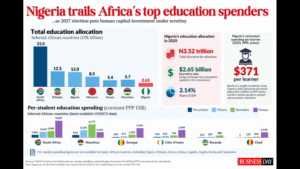
Analysis shows Nigeria’s federal education allocation lags regional peers, affecting workforce development and creating opportunities for private sector involvement in training, technology and infrastructure.
As Nigeria commemorates 66 years of independence, the organised private sector urges the government to shift from macroeconomic stabilisation to tangible productivity gains, warning…