Nigeria’s Education Spending Gap: Implications for Business and Procurement Opportunities
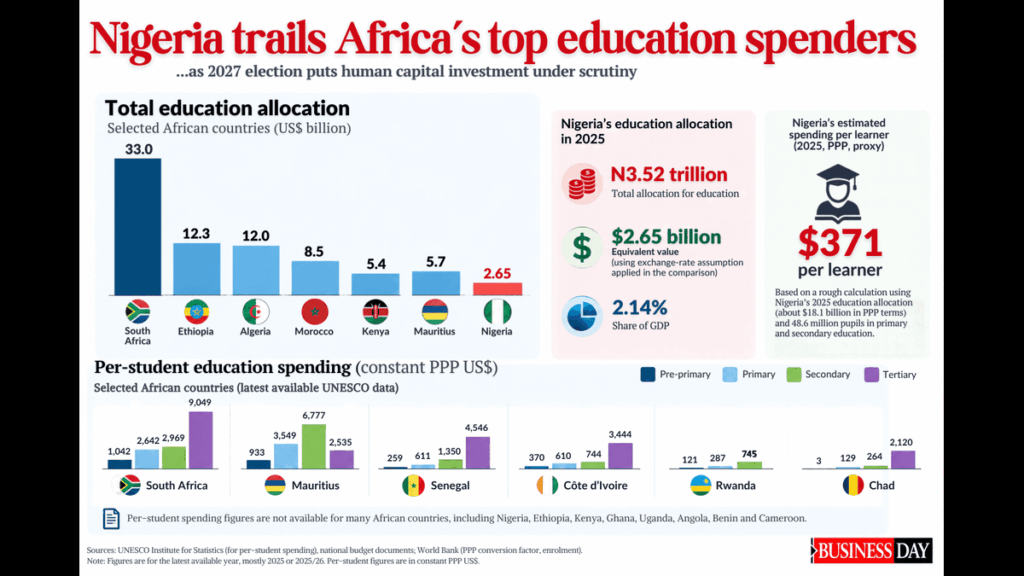
Nigeria’s 2025 federal budget allocates N3.52 trillion (~$2.65 billion) to education, just 2.14 % of GDP. This trails South Africa (~$33 billion), Ethiopia (~$12.3 billion), Algeria (~$12 billion), Morocco (~$8.5 billion) and Kenya (~$5.4 billion). With 48.6 million primary‑secondary pupils, the spend equals about $371 per learner. As the 2027 election nears, human‑capital investment is a key policy gauge. Experts cite misplaced priorities, poor funding and weak reward systems as barriers, while noting that education financing is shared across federal, state and local governments.
Nigeria’s Education Spending Gap: Implications for Business and Procurement Opportunities
Regional Comparison
South Africa leads the continent with an education budget of about $33 billion for the 2025/26 fiscal cycle, allocating nearly 24 % of total government expenditure to the sector. Ethiopia follows with roughly $12.3 billion, Algeria’s commitment stands at approximately $12 billion. Morocco and Kenya allocate $8.5 billion and $5.4 billion respectively, with Kenya’s spend representing about 16.6 % of its national budget. These figures, drawn from national treasury documents and UNESCO Institute for Statistics data, illustrate a stark contrast to Nigeria’s $2.65 billion federal allocation. Even when adjusting for purchasing‑power‑parity, Nigeria’s education spend remains modest relative to the scale of its school‑age population.
Per‑Learner Spending and Data Limits
Dividing the federal amount by the 48.6 million pupils enrolled in primary and secondary education yields roughly $371 per learner. This calculation relies solely on enrolment figures for basic education and does not capture tertiary enrolment. UNESCO‑linked data show that comparable per‑student spending figures are unavailable for many African nations, including Nigeria, Ethiopia, Kenya, Ghana, Uganda, Angola, Benin and Cameroon. Where data exist, the disparities are pronounced: South Africa reports $2,642 for primary and $2,969 for secondary pupils in constant purchasing‑power‑parity dollars; Mauritius records $3,549 at primary and $6,777 at secondary level; Senegal’s per‑student spend is $611 for primary and $1,350 for secondary; Côte d’Ivoire records $610 and $744 respectively. The absence of detailed Nigerian data limits precise assessments of spending efficiency or adequacy.
Education and Economic Development
Experts emphasise that a strong socio‑economic system is closely linked to the strength of a nation’s education framework. Kingsley Moghalu, president of the Institute for Governance and Economic Transformation, argues that education must prioritise access, quality, literacy, skills and national values. He contends that Nigeria has experienced a prolonged decline in national values and that purpose must sit at the heart of any education system. Mojeed Alabi, president of the Education Writers Association of Nigeria, adds that misplaced priorities, poor funding and a weak reward system are eroding sector development. He notes that public school conditions have deteriorated to the extent that some teachers are reluctant to enrol their own children in the institutions where they work, signalling a loss of confidence in the public offering.
Workforce Readiness Implications
The source notes highlight that large school‑age populations demand substantial investment in schools, teachers and tertiary education to equip young people with skills needed in evolving labour markets. Without adequate funding, the pipeline of skilled labour may be constrained, affecting sectors that rely on technical and vocational expertise. Businesses seeking to expand operations in Nigeria may encounter challenges in finding locally trained talent, potentially increasing reliance on expatriate staff or costly upskilling programmes. Conversely, this gap creates a market for private training providers, e‑learning platforms and corporate‑social‑responsibility initiatives aimed at bridging the skills divide.
Procurement Opportunities
Education financing in Nigeria operates on a concurrent legislative list, meaning federal, state and local governments share responsibility. While the federal government primarily funds tertiary institutions and about 115 unity schools, states and local governments manage the bulk of primary and secondary education. This layered structure generates multiple procurement streams for goods and services ranging from classroom infrastructure and learning materials to digital tools and teacher‑training programmes. Companies that specialise in educational technology, school construction, furniture supply or curriculum development can monitor tender notices across the three tiers of government to identify relevant bids.
Technology‑Driven Trends
The source material references ongoing reforms that integrate artificial intelligence and technology into classrooms, signalling a growing appetite for digital learning solutions. As the federal government deepens teacher reforms amid AI‑driven classroom reshaping, there is likely to be increased demand for hardware, software and connectivity services that support blended learning models. Businesses operating in the ed‑tech space may find opportunities to partner with state ministries or private school chains seeking scalable platforms for content delivery, assessment and performance tracking. Moreover, the push for patriotism and skills‑based learning mentioned in related coverage could stimulate demand for locally relevant digital content.
Financing Models and Incentives
Mojeed Alabi criticises Nigeria’s current reward system, stating that ‘nobody rewards quality, nobody rewards merit. What we reward is noise, what we reward is mediocrity.’ This observation points to a need for reformed incentive mechanisms that recognise and compensate effective teaching and learning outcomes. From a business perspective, such reforms could open avenues for performance‑based contracting, where private providers receive payments linked to demonstrable improvements in learner achievement. Additionally, the expert’s call for a change in attitude towards education by both government and citizens suggests a potential market for advocacy campaigns, stakeholder‑engagement services and public‑private partnership models that align financing with measurable results.
What this means
Nigeria’s current education spending position highlights a critical mismatch between the scale of its youth population and the resources devoted to their development. While the federal allocation falls short of regional benchmarks, the concurrent nature of education financing means that state and local budgets, together with private sector participation, are essential to closing the gap. For businesses, the situation creates a dual narrative: on one hand, a potential constraint on the availability of locally skilled labour; on the other, a growing market for training solutions, educational technology, infrastructure projects and performance‑linked service contracts. As the country moves towards the 2027 election, human capital investment will remain a key metric for evaluating governmental effectiveness. Stakeholders that align their offerings with the stated priorities of access, quality, literacy, skills and national values are likely to find receptive partners across government tiers and within the private sector, contributing to a more robust and competitive Nigerian economy.
Originally reported by businessday.ng. Adapted for our readers with AI assistance.
As Nigeria commemorates 66 years of independence, the organised private sector urges the government to shift from macroeconomic stabilisation to tangible productivity gains, warning…
Etihad Airways is considering legal steps against the Premier League after an independent commission found Manchester City guilty of 114 financial rule breaches. The…