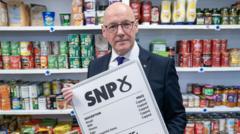
Business Groups Challenge Scottish Government’s Proposed Food Price Cap
In response to rising living costs, the Scottish Government has proposed a legal cap on the prices of essential food items such as milk, eggs, cheese, and rice. This policy, pledged in the Scottish National Party’s (SNP) election manifesto, is intended to make basic groceries more affordable for consumers struggling with inflation. However, the proposal has drawn sharp criticism from a coalition of 23 business organizations representing retail, manufacturing, and food production sectors. These groups argue the price cap would not tackle the underlying causes of high food prices and could lead to unintended negative consequences for both businesses and consumers.
Scottish Government’s Proposed Food Price Cap Faces Strong Opposition from Business Groups
The Scottish Government’s Rationale for a Food Price Cap
The SNP government, led by Deputy First Minister John Swinney, has emphasized the urgent need to address the cost-of-living crisis affecting many Scottish households. Swinney has highlighted that many people are struggling to afford a basic shopping basket, which prompted the government to pledge a cap on prices for essential food items. The policy aims to ensure access to affordable, nutritious food as a matter of public health responsibility.
The manifesto commitment focuses on large supermarkets, compelling them to limit the cost of staple products such as milk, eggs, cheese, and rice. The government views this as a direct intervention to shield consumers from inflationary pressures in the food sector, which have been exacerbated by rising production, refrigeration, and distribution costs.
Business Groups Warn of Ineffectiveness and Risks
In a joint letter to John Swinney, 23 organizations including the Scottish Retail Consortium (SRC), Food and Drink Federation Scotland, Scottish Bakers, and Dairy UK, have urged the government to abandon the price cap plan. They argue that a statutory price cap would fail to address the root causes of elevated food prices, such as increased production and supply chain costs.
Ewan MacDonald-Russell, deputy head of the SRC, described the proposal as an “appallingly terrible idea” during an interview on BBC Radio Scotland. He warned that price caps do not solve inflation but merely shift costs elsewhere in the supply chain. MacDonald-Russell cited Hungary’s experience with food price caps, which reportedly resulted in product shortages, the replacement of domestic goods with cheaper imports, and strained relations between retailers and customers.
The SRC also expressed concerns that the policy could make small shops, which would not be covered by the legislation, less competitive. This could distort the market and potentially reduce consumer choice.
Economic and Regulatory Challenges
Implementing a food price cap in Scotland may require changes to the UK Internal Markets Act 2020, legislation designed to prevent trade barriers and regulatory divergence across the United Kingdom post-Brexit. This adds a layer of complexity to the government’s plan, as it must navigate legal and political challenges to enforce such a cap effectively.
Moreover, business groups caution that the scheme’s costs would ultimately be absorbed by companies, potentially leading to higher overall prices for consumers. The administrative burden of enforcing price controls could increase operational expenses for retailers and producers, which may be passed on in other ways.
The Scottish Government has indicated it will launch a consultation to gather further views from stakeholders, including retailers, food producers, and farmers. This engagement process suggests the government is open to dialogue but remains committed to prioritizing cost-of-living support.
Balancing Consumer Protection and Market Realities
The debate over the food price cap highlights a broader tension between consumer protection policies and market dynamics. While the government’s goal is to make essential food items more affordable, critics argue that market interventions like price caps can distort supply and demand, leading to unintended consequences such as shortages or reduced product quality.
Scottish consumers currently benefit from some of the most affordable food prices in Western Europe, according to the SRC. Business representatives suggest that existing market mechanisms and competition among retailers are better suited to managing price inflation than statutory caps.
However, the government’s position underscores a public health perspective, emphasizing the importance of ensuring all citizens can access nutritious food despite economic pressures. This reflects a growing trend among governments worldwide to consider food affordability as a critical social issue.
International Examples and Lessons Learned
The experience of other countries with food price controls offers cautionary lessons. Hungary’s attempt to impose price caps reportedly led to supply shortages and the displacement of domestic products by cheaper imports. Such outcomes suggest that price controls can disrupt normal market functioning and harm local producers.
These international examples inform the skepticism expressed by Scottish business groups, who fear similar problems could arise if the government proceeds with its plan without addressing underlying cost drivers.
Experts emphasize that tackling food price inflation effectively requires a comprehensive approach, including addressing production efficiencies, supply chain logistics, and energy costs, rather than relying solely on price controls.
What this means
The Scottish Government’s proposed food price cap reflects a well-intentioned effort to protect consumers amid rising living costs. However, the strong opposition from business groups highlights significant concerns about the policy’s practicality and potential unintended effects. While ensuring affordable access to essential food remains a critical priority, the debate underscores the complexity of balancing consumer needs with market realities. Moving forward, a collaborative approach involving government, industry stakeholders, and consumers will be essential to develop sustainable solutions that address the root causes of food price inflation without compromising market stability or product availability.
Originally reported by bbc.co.uk. Adapted for our readers with AI assistance.
Global investment banking giant J.P. Morgan is preparing to establish its first merchant banking operation in Nigeria, targeting a pre-year-end 2026 commencement pending regulatory…
Federal Government unveils comprehensive Nutrition 774 Initiative, leveraging schools as primary platforms for tackling child malnutrition through expanded feeding programs, health services, and nutrition…
Analysis shows Nigeria’s federal education allocation lags regional peers, affecting workforce development and creating opportunities for private sector involvement in training, technology and infrastructure.