
Business News
NDLEA Intensifies Operations Against Narcotic Trade and Illegal Trafficking
The National Drug Law Enforcement Agency has arrested multiple suspects and seized significant drug consignments in recent operations across Nigeria.
TAMFIS NIG LTDRC 8067447CAC ACTIVEFinima, Bonny Island, Rivers State

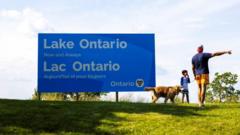
The longstanding name of Lake Ontario, one of North America’s Great Lakes shared between Canada and the United States, has become the center of a surprising diplomatic and cultural dispute. Following an executive order by US President Donald Trump to rename the lake as “Lake America,” Ontario Premier Doug Ford unveiled a prominent sign on the Canadian shoreline reaffirming the traditional name. This episode reflects deeper tensions in US-Canada relations, especially amid recent trade conflicts, and raises broader questions about the authority and symbolism behind naming shared natural landmarks.
On Thursday, US President Donald Trump signed an executive order to officially rename Lake Ontario as “Lake America.” The order directs the US Department of the Interior to update the Geographic Names Information Service, the official US repository for domestic geographic names, within 30 days. Trump’s decision follows a pattern of unilateral renaming of shared bodies of water, echoing a similar 2025 order that renamed the Gulf of Mexico to the Gulf of America within US jurisdiction.
While the US has broad discretion over geographic names within its borders, other countries are not obligated to recognize such changes. The renaming order was issued amid escalating trade tensions, including the US imposing 50% tariffs on $20 billion worth of Canadian goods, prompting Canada to prepare counter-tariffs. The timing suggests the renaming is part of a broader political strategy rather than a purely administrative update.
In a direct rebuttal to the US move, Ontario Premier Doug Ford unveiled a large sign on the Canadian shoreline bearing the message: “Lake Ontario. Now and Always.” Ford emphasized the lake’s historical name predates Trump’s presidency and will remain unchanged long after. The sign serves as a symbolic reminder of Canada’s sovereignty and resistance to unilateral US actions.
Ford criticized Trump’s renaming as a reaction to Canada standing up for itself amid trade disputes, framing it as a political jab rather than a legitimate geographical revision. The gesture echoes earlier statements by Canadian Prime Minister Mark Carney, who insisted that the lake must be called by its true name, “Lake Ontario,” both now and forever.
The sign installation is more than a local statement; it is a calculated diplomatic message reinforcing Canadian identity and territorial integrity in the face of provocative US policies.
Adding a modern twist to the dispute, President Trump shared several AI-generated videos on social media mocking the lake’s traditional name. One video depicted Trump physically kicking over a Lake Ontario sign and replacing it with one labeled “Welcome to Lake America.” Another showed Canada geese with Trump’s hairstyle and rifles patrolling the shoreline of the renamed lake.
These videos, blending humor and political messaging, have amplified public attention and stirred reactions on both sides of the border. While some Americans viewed the renaming as a humorous assertion of national pride, many Canadians saw it as an unnecessary provocation.
The use of AI-generated content in this context highlights how digital tools can escalate diplomatic disputes, turning them into viral cultural moments that complicate traditional diplomatic channels.
Lake Ontario is the smallest of the five Great Lakes and shares its shoreline with the Canadian province of Ontario and the US state of New York. The lake’s name has indigenous origins, consistent with the naming of four other Great Lakes—Ontario, Huron, Michigan, and Erie—while Lake Superior’s name derives from an anglicized French term.
The lake’s name carries deep historical and cultural significance for both countries, reflecting centuries of indigenous heritage and cross-border cooperation. Changing the name unilaterally disregards this shared history and the symbolic importance of geographic names in national identity.
Canada’s insistence on retaining the name Lake Ontario underscores the importance of respecting indigenous and historical place names, especially in contexts involving international borders and shared natural resources.
The renaming dispute is symptomatic of wider tensions between the US and Canada, particularly in trade relations. The US’s imposition of steep tariffs on Canadian goods and Canada’s promise of equivalent countermeasures have strained the longstanding economic partnership.
Naming disputes over shared natural landmarks, while symbolic, can exacerbate diplomatic friction and complicate negotiations on more substantive issues. The Lake Ontario episode follows a similar conflict over the Gulf of Mexico’s renaming, which also sparked legal and commercial disputes, including with major technology companies like Google.
Resolving such disputes requires diplomatic tact and mutual respect, as unilateral actions risk undermining trust and cooperation between neighboring countries with deeply intertwined economies and histories.
The Lake Ontario renaming dispute is more than a quarrel over a name; it symbolizes the complexities of US-Canada relations amid political and economic challenges. While the US asserts its authority to rename geographic features within its borders, Canada’s resolute response reaffirms the importance of shared history, indigenous heritage, and mutual respect in managing transnational landmarks. As trade tensions continue, both nations face the challenge of balancing national pride with the practical necessity of cooperation. Ultimately, resolving such symbolic disputes through dialogue rather than unilateral actions will be crucial to maintaining the strong partnership that has long defined the US-Canada relationship.
Originally reported by bbc.co.uk. Adapted for our readers with AI assistance.
Keep reading
Business News
The National Drug Law Enforcement Agency has arrested multiple suspects and seized significant drug consignments in recent operations across Nigeria.
Business
Nigerian shoppers are increasingly turning to AI assistants like ChatGPT, Claude and Gemini for product ...
Business
The global developer workforce has undergone a transformative expansion over the past five years, fundam...
TAMFIS NIG LTD
Electrical and instrumentation engineering, bid preparation and consulting, IT and software.