Siege and Settler Violence in Qusra: A Microcosm of West Bank Tensions
The occupied West Bank has long been a flashpoint in the Israeli-Palestinian conflict, with frequent clashes between settlers and Palestinian residents. Recently, the village of Qusra near Nablus has become a focal point of this ongoing struggle. Two Palestinian families have been besieged by Israeli settlers, cutting off their access to essential supplies and restricting their movement. This situation underscores the complex dynamics of settler violence, military involvement, and international responses in the region. This article examines the details of the Qusra siege, the broader pattern of settler violence, and the implications for peace and security in the West Bank.
Siege and Settler Violence in Qusra: A Microcosm of West Bank Tensions
The Siege of Qusra: Events and Immediate Impact
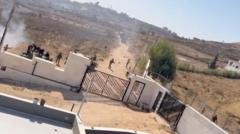
Since Sunday, the Abu Ridi and Hassan families in Qusra have been trapped in their homes by a group of Israeli settlers who established an unauthorized outpost nearby. Palestinian security footage shows settlers dismantling a wall outside the Abu Ridi home and using the stones to block the road, effectively isolating seven residents, including two young girls, from leaving their homes or receiving outside assistance.
The siege led to a critical shortage of water, electricity, and food supplies for the families. Social media posts from the residents highlighted their desperation and isolation, with Qusay Abu Ridi emphasizing their desire to live safely and with dignity on their own land. The situation escalated as Israeli security forces initially appeared passive, with footage showing soldiers praying alongside settlers rather than intervening to protect the Palestinian families.
Israeli journalists from the Haaretz newspaper were also blocked by settlers from accessing the area, and despite the presence of soldiers, no assistance was provided to lift the blockade. It was only after urgent appeals from human rights groups and international attention that a Palestinian ambulance was permitted to deliver food and evacuate a child for medical treatment.
Military Response and Settler Outpost Evacuation
On Wednesday, Israeli security forces withdrew from the settler outpost following confrontations with extremist settlers. While about a dozen settlers remained, the military condemned the establishment of the outpost and the seizure of Palestinian homes, describing these actions as illegal and unacceptable.
The head of the Israeli military's Central Command, Maj Gen Avi Bluth, along with senior officers, visited the site and expressed serious concern about the situation. Clashes between Israeli forces and settlers ensued, with the military using tear gas and stun grenades to disperse the crowd. The Israeli Border Police confiscated the settlers’ canopy shelter but left other equipment behind.
The Israeli Defense Forces (IDF) announced that disciplinary measures would be taken against security personnel who were documented at the site during the initial days of the siege, indicating some accountability within the military ranks. However, the ongoing presence of settlers and the partial evacuation highlight the challenges in fully resolving such incidents.
Broader Context: Settler Violence and Displacement in the West Bank
The Qusra siege is not an isolated case but part of a broader pattern of settler violence in the West Bank, particularly in the Nablus Governorate. The Palestinian village mayor, Abdel Azim Wadi, described a sustained pattern of targeting Qusra, including recent attacks such as the arson of a newly completed mosque accompanied by Hebrew graffiti.
This violence often follows escalations triggered by settler attacks in nearby villages, as seen in the recent incident in Tal, which led to multiple deaths, including Palestinians and Israeli soldiers. Similar sieges have occurred, such as the two-week encirclement of a Palestinian home in Jalud, after which the owners fled and settlers occupied the property.
According to the United Nations, settler violence has reached unprecedented levels in 2023. The Nablus area has been particularly affected, with 76 Palestinians, including 18 children, killed this year by Israeli forces or settlers. At the same time, three Israelis have died in related confrontations. The UN also reports significant displacement, with over 6,390 Palestinians affected by demolitions, evictions, and violence, including nearly 3,800 displaced by settler actions alone.
International and Israeli Responses
The United Nations has repeatedly warned that the West Bank is approaching a breaking point due to escalating violence and displacement. Ramiz Alakbarov, the UN Deputy Special Coordinator for the Middle East Peace Process, highlighted the severe human toll and called for urgent action to protect Palestinian communities.
In contrast, Israel’s Ambassador to the UN, Danny Danon, defended the expansion of settlements, asserting Israel’s biblical, historic, and legal claims to the land. He rejected the notion that settlements obstruct peace and emphasized that Israel intends to maintain and grow these communities.
Human rights organizations within Israel, such as Yesh Din, have called on the Israeli military to intervene more decisively to protect Palestinians and hold settlers accountable for illegal actions. However, the military’s mixed responses and the persistence of settler violence illustrate the complexity of enforcing law and order in contested areas.
Humanitarian Implications and the Path Forward
The siege of Palestinian homes by settlers not only threatens the immediate safety and wellbeing of families but also exacerbates the broader humanitarian crisis in the West Bank. Restricted access to essential services, displacement, and ongoing violence contribute to a deteriorating living environment for many Palestinians.
The partial withdrawal of Israeli forces and condemnation of settler actions by the military signal some recognition of the problem, but the continued presence of settlers and recurring incidents suggest that more comprehensive measures are necessary.
Efforts to protect vulnerable Palestinian communities require coordinated action by Israeli authorities, international bodies, and local stakeholders. Without addressing the root causes of settler violence and ensuring accountability, the cycle of attacks and retaliation is likely to continue, undermining prospects for peace and stability.
What this means
The siege of Palestinian families in Qusra by Israeli settlers is a stark illustration of the escalating tensions and violence in the West Bank. While Israeli military condemnation of the settlers’ actions and partial intervention offer some hope for accountability, the persistence of such incidents underscores the fragile and volatile nature of the region. The humanitarian impact on Palestinian communities is severe, with restricted access to basic needs and increasing displacement. Moving forward, meaningful progress requires a concerted effort to protect vulnerable populations, enforce legal standards impartially, and address the underlying political disputes that fuel this cycle of violence. Without such measures, the West Bank risks further deterioration, complicating efforts toward a lasting peace.
Originally reported by bbc.co.uk. Adapted for our readers with AI assistance.
An in-depth look at the world's leading developer communities reveals shifting growth patterns, with emerging economies outpacing traditional tech hubs in expansion rates, presenting…
The company formerly known as Bed Bath & Beyond is restructuring its partnership with Fathom to leverage digital assets like tZero, Medici, and GrainChain,…
Recall that Poland’s Minister Sikorski’s core claim is partially supported by the numbers, but the framing “quite quickly” and “without the U.S.” does not…