
News
RUSSIA versus NATO and BRICS vs. NATO Military SWOT
Recall that Poland’s Minister Sikorski’s core claim is partially supported by the numbers, but the framing “quite quickly” and “without the U.S.” does not…
TAMFIS NIG LTDRC 8067447CAC ACTIVEFinima, Bonny Island, Rivers State

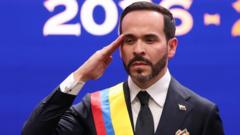
Colombia has entered a new political chapter with the swearing-in of Abelardo de la Espriella, a right-wing leader endorsed by former US President Donald Trump. His inauguration not only represents a sharp ideological shift from his predecessor but also ushers in a strengthened security alliance with the United States. In a statement coinciding with the transition, the US government announced a $1 billion assistance package aimed at supporting Colombia’s efforts to tackle organized crime, narcotics trafficking, and illegal immigration. This article explores the implications of this development, the new president’s agenda, and what it means for US-Colombia relations moving forward.
The US State Department’s announcement of a $1 billion security package underscores a renewed commitment to Colombia under President Abelardo de la Espriella’s administration. This financial support is intended to bolster Colombia’s capacity to combat organized crime, particularly narcotics trafficking and armed insurgent groups, which have long challenged the country’s stability.
This move also signals a departure from the previous administration led by Gustavo Petro, a left-wing leader known for his critical stance toward the US and former President Trump. De la Espriella’s presidency, backed by Trump, promises a more collaborative and aligned relationship with Washington, especially in security and economic matters.
The US delegation's presence at the inauguration, led by then-acting Attorney General Todd Blanche, further highlights the importance Washington places on this partnership. The administration’s readiness to support Colombia’s crackdown on crime and illegal immigration reflects shared strategic priorities.
De la Espriella’s inaugural speech was marked by a resolute commitment to wage an “all-out war” on what he termed “narco-terrorism.” His decision to take the oath of office in Cali, a city plagued by violence and illegal armed groups, was a deliberate signal of his administration’s hardline approach.
Addressing troops at a military base near Cali, he vowed to leave no safe haven for criminals within Colombian territory. His pledge to defend democracy “by reason or by force” reflects a confrontational style aimed at dismantling armed insurgencies and organized crime networks.
Unlike his predecessor, who pursued peace talks with armed groups, de la Espriella has rejected negotiations in favor of a crackdown that includes constructing mega-prisons to detain criminals. This approach has raised concerns among critics who fear it could exacerbate divisions in a country already marked by political polarization.
His background as a lawyer representing controversial figures, including drug traffickers and paramilitaries, adds complexity to his leadership profile. While some view his experience as an asset in navigating Colombia’s legal and security challenges, others worry about the implications of his confrontational tactics.
One of de la Espriella’s early actions as president was Colombia’s decision to join the “Shield of the Americas,” a security partnership initially established under the Trump administration. This move aligns Colombia more closely with US-led regional security efforts aimed at combating transnational crime and enhancing border security.
The new president has also expressed intentions to deepen military cooperation not only with the United States but also with Israel, marking a stark contrast to the previous administration’s more critical stance toward Israel’s leadership.
The US State Department emphasized that shared goals extend beyond security to include economic growth and trade expansion. Washington views de la Espriella’s “pro-growth agenda” as an opportunity to strengthen bilateral economic ties, potentially benefiting both countries.
In addition to security cooperation, the US highlighted the importance of coordinated efforts to curb illegal immigration, which remains a significant concern for both nations. Enhanced border security measures and intelligence sharing are expected to be key components of this collaboration.
De la Espriella’s presidency represents a pivot toward conservative policies and a more militarized approach to internal security. This shift may bring short-term gains in combating crime but also risks inflaming social tensions and political divides.
His rejection of peace negotiations with armed groups could stall or reverse progress made under previous administrations toward reconciliation and conflict resolution. The emphasis on forceful measures might provoke resistance from insurgent factions and civil society organizations advocating for dialogue.
Internationally, Colombia’s closer alignment with the US and Israel may reshape its diplomatic posture in Latin America, where leftist governments have often challenged US influence. This realignment could affect regional dynamics and Colombia’s role within multilateral organizations.
For the United States, supporting de la Espriella’s administration offers a strategic foothold in a key partner country grappling with narcotics trafficking and migration issues. However, Washington must balance its security interests with concerns about human rights and democratic governance in Colombia.
The inauguration of Abelardo de la Espriella as Colombia’s president and the accompanying $1 billion US support package mark a pivotal moment in the country’s political and security trajectory. This new era promises intensified efforts to dismantle organized crime and curb illegal immigration through a robust partnership with the United States. However, the administration’s hardline stance also presents challenges, including potential social unrest and setbacks in peacebuilding initiatives. As Colombia navigates this transition, the balance between security imperatives and democratic stability will be critical for its future. For the United States, the relationship offers strategic advantages but also demands careful attention to human rights and governance issues to ensure sustainable progress.
Originally reported by bbc.co.uk. Adapted for our readers with AI assistance.
Keep reading
News
Recall that Poland’s Minister Sikorski’s core claim is partially supported by the numbers, but the framing “quite quickly” and “without the U.S.” does not…
Politics
In August 2025, Zespri, the world’s largest marketer of kiwifruit, announced that the European Commission had approved what it described as the first health…
News
By Engr. Tamunofiniarisa BrownReading Time: 6 Minutes The conflict between Russia and Ukraine is often framed in the media as a simple battle between…
TAMFIS NIG LTD
Electrical and instrumentation engineering, bid preparation and consulting, IT and software.