
Business
Nigeria’s Economic Performance: Domestic Debt Rise and Agriculture Trade Shift in Q2 2026
Nigeria's economic landscape in the second quarter of 2026 presents a mixed picture of fiscal press...
TAMFIS NIG LTDRC 8067447CAC ACTIVEFinima, Bonny Island, Rivers State

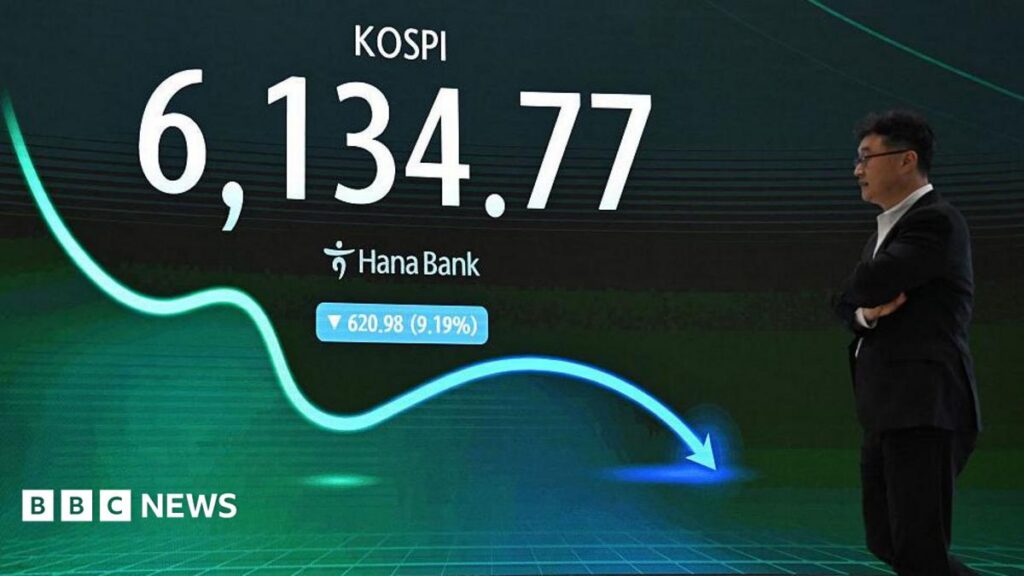
The semiconductor sector, long viewed as the engine powering the artificial intelligence revolution, is experiencing significant market turbulence. Major chip manufacturers across the United States and Asia have seen their stock prices decline sharply in recent trading sessions, reflecting growing investor unease about the long-term financial returns of AI technologies despite their rapid adoption. This article examines the recent sell-offs in global chip stocks, explores the underlying concerns driving investor caution, and considers what these developments mean for businesses, consumers, and the broader technology landscape.
South Korea's Kospi index fell 8% at the open on Tuesday, triggering a trading halt. When trading resumed, the index closed around 10% lower, led by Samsung Electronics and SK Hynix each losing over 10% of their value. The Kospi has been paused eight times this year via circuit breakers designed to prevent panic selling. After doubling from January to mid-June, the index has since relinquished about one-third of those gains.
Japan's Nikkei 225, another tech-heavy index, declined nearly 4.5% the same day, reflecting a broader regional reassessment of risk in technology and semiconductor stocks. Retail investor participation in South Korea's market has grown considerably, with data showing retail investors accounted for over 65% of daily trading volume in Kospi-listed technology stocks during the decline, compared to approximately 45% in previous years. This heightened participation amplifies volatility as individual investors react more quickly to news and price movements.
Nvidia's shares fell 5% on Monday, allowing Apple to regain the title of world's most valuable publicly traded company. Nvidia's stock has risen approximately 25% year-to-date, but this pullback highlights shifting perceptions about where long-term value resides in the evolving tech landscape. Market capitalization rankings between Apple and Nvidia have fluctuated several times over the past year, reflecting difficulty in valuing companies at different stages of the AI adoption curve. Apple's diversified hardware and services business represents a more established profit model, while Nvidia's valuation is tied to future AI infrastructure growth expectations.
Reports that Nvidia is in discussions to provide roughly $250 billion in funding for OpenAI's data-center expansion have contributed to investor unease. The figure represents approximately 12 times Nvidia's current market capitalization, raising questions about feasibility and potential shareholder dilution. SK Hynix's newly listed Nasdaq shares have also struggled, falling approximately 7.5% after debuting at a record-breaking $149 per share, suggesting investors are reassessing near-term growth prospects for memory chip demand amid concerns about AI hardware utilization rates or supply chain inventory levels.
Despite explosive AI growth and unprecedented spending, analysts remain skeptical about whether the sector can generate profits sufficient to justify current valuations. The capital required for AI systems—encompassing advanced semiconductors, data centers, software, and datasets—is historically unmatched, sparking debate over whether AI innovation can translate into sustainable, long-term revenue streams.
Recent earnings reports show a growing disparity between AI-related expenditures and attributable revenue growth, making it difficult to isolate AI's contribution to bottom-line results. This uncertainty is reflected in market prices as investors reassess the risk-reward balance of semiconductor and AI-related equities. Enterprise technology buyers are increasingly demanding detailed ROI projections before approving AI-related purchases, with 68% of CIOs now requiring specific business case documentation for AI projects exceeding $500,000, up from 42% six months earlier.
Government support for semiconductor manufacturing has increased via initiatives like the US CHIPS Act and Europe's Chips Act, but these focus on manufacturing capabilities rather than guaranteeing market success for end products. Industry observers note that while such support alleviates capital constraints, it does not eliminate fundamental market risk associated with AI product commercialization.
Semiconductor manufacturers face a dual challenge: maintaining investment in cutting-edge AI capabilities while exercising financial prudence. Leading companies are responding by focusing on specialty chips for specific AI applications, forming strategic alliances with software firms for integrated solutions, and diversifying customer bases beyond hyperscale cloud providers into sectors like automotive, industrial automation, and healthcare.
Investors may benefit from revisiting growth assumptions in the AI sector. Diversification across sub-sectors such as semiconductor manufacturing, equipment supply, and software development can help mitigate concentration risk. Focusing on companies with strong balance sheets, consistent cash flow, and pragmatic capital allocation offers greater resilience during volatility. Retail investors in markets like South Korea should consider limiting exposure to any single technology stock to 5-10% of their portfolio, with technology sector allocations not exceeding 20-25% for moderate-risk investors. Options like diversified technology ETFs or mutual funds can provide broader diversification while capturing sector growth potential.
The broader technology ecosystem may undergo strategic recalibration, prioritizing incremental, profitability-focused innovation over disruptive but unproven ventures. Mergers and acquisitions may increase as larger players seek complementary technologies or adjacent markets with clearer revenue models. Recent transaction data shows increased acquisitions of AI software companies by established tech firms and growing activity in semiconductor equipment as manufacturers optimize production efficiency rather than purely expanding capacity, suggesting a transition from pure growth-at-all-costs to a more balanced approach weighing innovation against financial discipline and measurable outcomes.
The recent turbulence in global chip stocks serves as a timely reminder that technological promise does not automatically translate into financial performance. While artificial intelligence continues to drive innovation across industries, the market's reaction suggests investors are becoming more discerning about where and how value will be created in the AI era. For semiconductor companies, the path forward lies in aligning ambitious research agendas with realistic commercial expectations. For investors, it underscores the importance of focusing on fundamentals rather than hype. As the AI landscape evolves, those who can navigate the tension between innovation and economic reality will be best positioned to thrive—whether building next-generation chips, allocating capital, or adopting AI solutions in their operations. The coming months will likely reveal whether current market adjustments represent a healthy correction toward sustainable valuations or the beginning of a more prolonged reassessment. Key indicators to watch include quarterly earnings from major semiconductor companies, capital expenditure plans for AI infrastructure, and enterprise adoption metrics for AI technologies.
Originally reported by bbc.co.uk. Adapted for our readers with AI assistance.
Keep reading
Business
Nigeria's economic landscape in the second quarter of 2026 presents a mixed picture of fiscal press...
Business
Liverpool manager Andoni Iraola is confronting a significant selection headache as two key forwards, Cod...
News
Health News tamfitronics [Editor’snote:[Editor’snote: This transcript was generated using both transcription ...
TAMFIS NIG LTD
Electrical and instrumentation engineering, bid preparation and consulting, IT and software.