
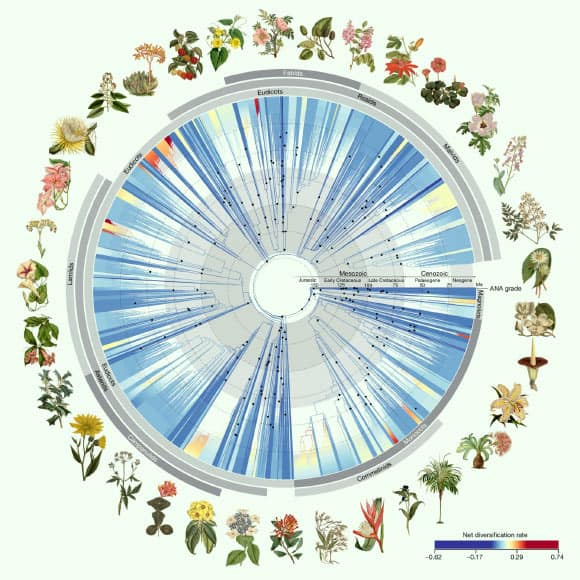
Flowering plants, or angiosperms, represent approximately 90% of all known terrestrial plant species and have a ubiquitous presence from tropical rainforests to polar regions. Despite their abundance and ecological importance, the evolutionary pathways that led to their dominance have long baffled scientists, including Charles Darwin. Recently, an international team of researchers has achieved a major milestone by developing a comprehensive, time-calibrated phylogenetic tree covering nearly 60% of all flowering plant genera. Using cutting-edge genomic sequencing and sophisticated analytical methods, this new 'tree of life' sheds unprecedented light on the evolutionary history of angiosperms, offering a deeper understanding of how these plants diversified and thrived over more than 140 million years.
The Significance of Flowering Plants in Earth's Ecosystems
Flowering plants, or angiosperms, dominate terrestrial ecosystems worldwide, accounting for roughly 90% of all known plant species on land. Their diversity spans from dense tropical forests to arid deserts and even the rocky terrains of the Antarctic Peninsula. This vast distribution highlights their remarkable adaptability and evolutionary success.
Angiosperms provide essential ecological services, including oxygen production, carbon sequestration, soil stabilization, and serving as primary producers in food webs. They also underpin agriculture and horticulture, supplying food, fiber, medicine, and ornamental plants vital to human survival and culture.
Understanding the evolutionary history of flowering plants is crucial not only for botanical science but also for conservation efforts and ecosystem management. Unraveling their lineage helps predict how plants might respond to environmental changes and guides strategies to preserve biodiversity.
The Challenge of Decoding Angiosperm Evolution
Despite their ecological prominence, the evolutionary origins and diversification of flowering plants have remained a scientific enigma for centuries. Early naturalists, including Darwin, referred to this puzzle as the 'abominable mystery' due to the sudden appearance and rapid diversification of angiosperms in the fossil record.
One major challenge has been the complexity of genetic data and the vast diversity among flowering plants. Different genes can tell different evolutionary stories, leading to conflicting phylogenetic signals. Additionally, the enormous number of species and genera requires large-scale, high-throughput genetic sequencing and sophisticated computational methods.
Previous phylogenetic studies were limited in scope, often focusing on a few species or specific families. To fully resolve the angiosperm tree of life, comprehensive genetic sampling across orders, families, and genera is essential, along with time calibration to relate genetic divergence to geological time.
A Breakthrough: Constructing the Household Tree for Flowering Plants
The recent international research collaboration has successfully constructed a time-calibrated phylogenetic tree representing almost 8,000 genera of flowering plants, covering about 60% of known genera worldwide. This represents an unprecedented scale in plant evolutionary studies.
The team analyzed approximately 1.8 billion base pairs of genetic code from over 9,500 species, including more than 800 species sequenced for the first time. This vast dataset allowed for a robust reconstruction of evolutionary relationships and timelines across all 64 orders and 416 families of angiosperms.
The phylogenetic tree reveals detailed branching patterns and evolutionary connections, clarifying how different groups of flowering plants are related and how they diversified over millions of years. This comprehensive framework serves as a foundation for future research in plant biology, ecology, and evolution.
Innovative Genomic Techniques Powering the Research
A key element of this research was the development and application of novel genomic methodologies capable of capturing hundreds of nuclear genes from each specimen. These techniques vastly outperformed previous sequencing methods in both scale and resolution.
The approach allowed scientists to sequence DNA from a wide variety of plant materials, including fragile and ancient herbarium specimens. By tapping into collections dating back to the early 19th century, researchers accessed genetic information previously locked away in dried samples.
These advances also addressed challenges posed by gene regions exhibiting conflicting evolutionary histories. New computational tools were created to analyze complex patterns across multiple genes simultaneously, enabling the resolution of intricate phylogenetic relationships.
Implications for Evolutionary Biology and Ecology
The comprehensive flowering plant tree of life offers profound insights into the mechanisms driving plant diversification and ecological dominance. It helps pinpoint when major evolutionary events occurred, such as the rise of key traits that facilitated angiosperm success.
By understanding the timing and sequence of diversification, scientists can infer how flowering plants adapted to changing climates, geological events, and interactions with pollinators and herbivores throughout history.
Moreover, the phylogenetic framework informs studies on co-evolution with animals, biogeography, and the origins of economically important crops. It serves as an essential tool for conservation biology by identifying evolutionary distinct lineages that may require protection.
Bridging Past and Present Botanical Knowledge
This research bridges historical botanical knowledge with cutting-edge genomics. By sequencing DNA from herbarium specimens collected centuries ago, the study connects classical taxonomy and morphology with modern molecular data.
Herbaria worldwide house nearly 400 million plant specimens, representing an invaluable archive of biodiversity. Unlocking their genetic secrets allows scientists to revisit and refine plant classifications, verify species identities, and uncover hidden evolutionary relationships.
This integration of past and present data exemplifies how modern technology can revitalize traditional scientific collections, expanding their relevance and utility in contemporary research.
Future Directions and Potential Applications
The newly established angiosperm tree of life paves the way for numerous future research endeavors, including more detailed studies of specific plant groups, functional trait evolution, and responses to environmental stressors.
It also opens opportunities for applied sciences such as agriculture, forestry, and pharmacology, where understanding evolutionary relationships can guide crop improvement, sustainable management, and discovery of novel bioactive compounds.
Furthermore, ongoing improvements in sequencing technology and computational methods promise to eventually achieve a near-complete phylogeny of all flowering plant species, deepening our understanding of plant biodiversity and evolution.
Conclusion
The creation of an extensive, time-calibrated phylogenetic tree for flowering plants marks a transformative achievement in botanical science. By harnessing vast genetic datasets and pioneering genomic techniques, researchers have unveiled the evolutionary tapestry of angiosperms with unprecedented clarity. This breakthrough not only resolves long-standing mysteries about the origin and diversification of flowering plants but also equips scientists with a powerful tool to explore their ecological roles and evolutionary innovations. As the tree of life for angiosperms continues to expand and refine, it promises to deepen our understanding of plant biodiversity and inform conservation, agriculture, and environmental stewardship for generations to come.