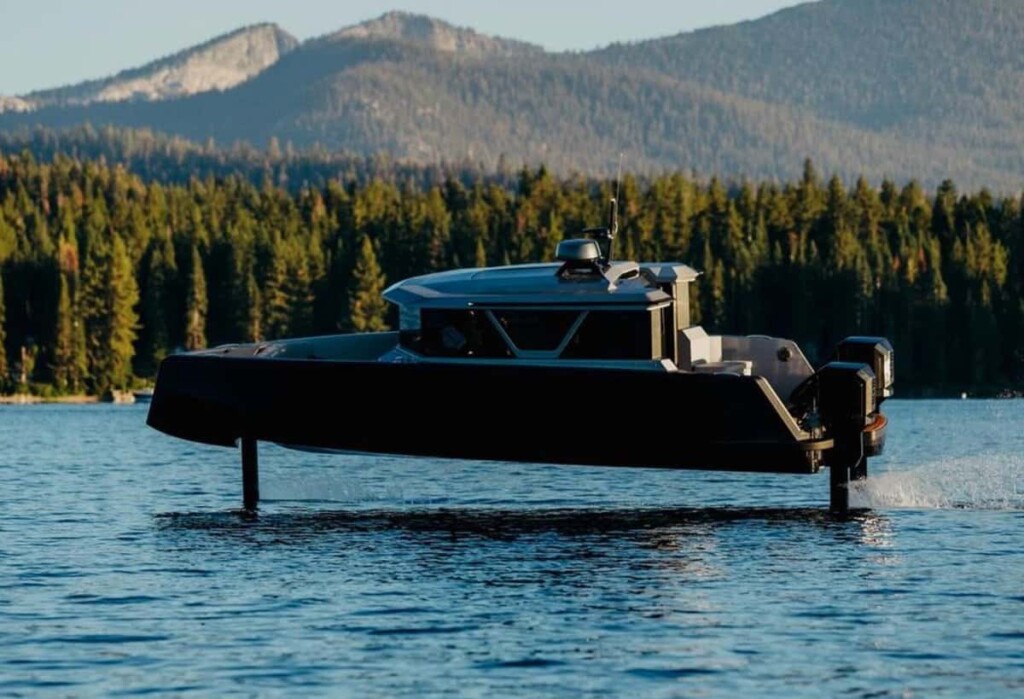
Rejected From More Than 500 Internships To Raising $7.2M To Manufacture Flying Boats: Meet Sampriti Bhattacharyya
The path to innovation is rarely linear, and few stories illustrate this better than that of Sampriti Bhattacharyya. Growing up in Kolkata, India, she nurtured a fascination with space and technology despite numerous setbacks. After enduring hundreds of internship rejections, her persistence led her to NASA and eventually to founding Navier, a company dedicated to creating sustainable maritime vessels and advancing ocean exploration. This article explores Bhattacharyya’s inspiring journey, the technological breakthroughs her company is achieving, and the broader implications for maritime transport and ocean conservation.
Early Challenges and a Passion for Space
Sampriti Bhattacharyya’s early life was marked by personal and familial challenges that shaped her introspective nature. Growing up in a chaotic household in Kolkata, she often felt withdrawn, finding solace in the mysteries of the cosmos. At the age of 12, watching the Apollo Moon missions profoundly influenced her, igniting a lifelong curiosity about space exploration and the possibilities beyond Earth.
Driven by this passion, Bhattacharyya embarked on a largely self-directed education in space technology. Without formal access to specialized training, she relied on documentaries, online videos, and channels like the Discovery Channel to build her knowledge. Her dedication was evident in her proactive approach: she sent over 540 emails to potential employers, often including hand-drawn sketches of solar panel designs, in pursuit of internships abroad. This relentless outreach highlighted her determination to break into the aerospace field despite numerous rejections.
Breaking Through: From Fermilab to NASA
Bhattacharyya’s persistence eventually paid off when she secured an internship at Fermilab, the United States’ premier particle physics and accelerator laboratory. This opportunity expanded her scientific expertise and deepened her understanding of advanced technologies, reinforcing her commitment to innovation and research.
After completing her internship, she returned to India to finish her undergraduate studies in electrical engineering. Still driven by her aerospace ambitions, she earned a scholarship to Ohio State University in the US, where her exceptional academic performance caught the attention of NASA recruiters. This led to a coveted employment offer, fulfilling her dream of working at the space agency.
Continuing her academic journey, Bhattacharyya was accepted into a PhD program at the Massachusetts Institute of Technology (MIT), one of the world’s leading institutions for aerospace engineering. Her time at MIT further honed her technical skills and prepared her for a career at the intersection of cutting-edge science and practical innovation.
A Shift in Focus: From Space to the Oceans
In 2014, the disappearance of Malaysia Airlines flight MH370 over the Indian Ocean marked a pivotal moment in Bhattacharyya’s career. The tragedy underscored the vastness and mystery of the oceans and highlighted the limitations of current maritime search technologies. It raised a critical question for her: why can’t robotic systems be used to monitor and map the oceans as effectively as satellites and probes explore space?
This realization inspired Bhattacharyya to pivot her focus from aerospace to maritime technology. She recognized that humanity knows more about the moon’s surface than the depths of Earth’s oceans, a fact that both fascinated and troubled her. Motivated by this knowledge gap, she committed herself to advancing ocean conservation and developing innovative maritime technologies that could transform how we understand and interact with the marine environment.
Innovating Maritime Transport: The Navier Vessel
In late 2020, Bhattacharyya founded Navier with the ambitious goal of revolutionizing maritime transportation. Leveraging her combined expertise in aerospace engineering and electrical engineering, she designed Navier’s first prototype vessel. This vessel employs electric momentum propulsion, allowing it to glide above the water’s surface, drastically reducing energy consumption and environmental impact compared to conventional boats.
The innovative design prioritizes efficiency and sustainability, aligning with Navier’s mission to protect the oceans while advancing maritime transport. Unlike traditional vessels that rely heavily on fossil fuels and disrupt marine ecosystems, the Navier vessel’s propulsion system minimizes emissions and noise pollution, making it a pioneering solution in green maritime technology.
Bhattacharyya’s leadership was crucial in assembling a multidisciplinary team of scientists, engineers, and electricians, whose diverse skills contributed to refining the vessel’s design and performance. This collaborative approach fostered a culture of innovation and problem-solving, enabling Navier to rapidly progress from concept to prototype and attract significant funding.
Advancing Ocean Mapping and Conservation
Beyond transportation, Navier is actively engaged in developing detailed ocean mapping technologies. These initiatives aim to create comprehensive maps of the world’s oceans, enhancing navigability and accessibility for both commercial and environmental purposes. Accurate ocean mapping is essential for safe maritime travel, resource management, and ecological preservation.
Bhattacharyya envisions a future where waterways function as efficient highways, seamlessly connecting humanity beyond terrestrial borders without compromising the health of marine ecosystems. By enabling precise monitoring and navigation, Navier’s technologies could transform how we utilize ocean spaces, promoting sustainable use and expanding human presence responsibly.
This vision reflects a broader commitment to expanding humanity’s horizons—not just in space, but also beneath the waves. Bhattacharyya sees her work as a way to bridge the gap between land and sea, turning oceans from obstacles into vital pathways that support economic growth, environmental stewardship, and scientific discovery.
What this means
Sampriti Bhattacharyya’s journey exemplifies how resilience, interdisciplinary knowledge, and visionary leadership can drive meaningful innovation. Transforming setbacks into opportunities, she has positioned Navier at the forefront of maritime technology, addressing critical challenges in ocean exploration and sustainability. As Navier continues to develop cutting-edge solutions, its work promises to reshape humanity’s relationship with the oceans, making them more accessible and environmentally responsible. Bhattacharyya’s story is a powerful reminder that perseverance and creativity can unlock new frontiers—whether in space or beneath the waves.
Recent advances in machine perfusion technology are not only preserving donated livers but also making them biologically younger at a molecular level. This breakthrough…
What happens when human imagination, artificial intelligence, art and technology come together? From September 1 to 6, Samsung Electronics presented a special exhibition themed…