
Top Stories
KFF Health News’ ‘What the Health?’: The Supreme Court and the Abortion Pill
Since the Supreme Court overturned Roe v. Wade in 2022, the landscape of abortion rights in the United S...
TAMFIS NIG LTDRC 8067447CAC ACTIVEFinima, Bonny Island, Rivers State

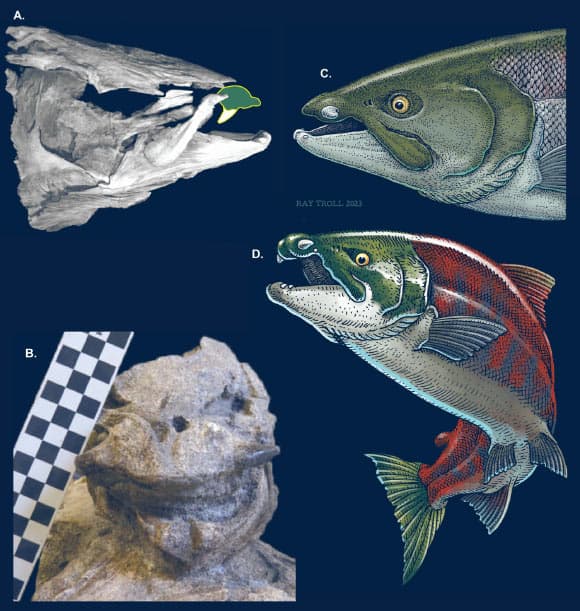
The discovery of Oncorhynchus rastrosus, a massive prehistoric salmon species, has long intrigued paleontologists and marine biologists alike. Initially dubbed the “saber-toothed salmon” due to the fossilized remains of its elongated teeth, this species lived along the Pacific coast of North America between 11 and 5 million years ago. Recent advances in imaging technology, particularly CT scanning, have shed new light on the true nature and function of these enigmatic teeth. This article delves into the latest findings, exploring the anatomy, behavior, and ecological role of this ancient fish, while revisiting its place in the evolutionary history of salmonids.
Oncorhynchus rastrosus was first described in the 1970s based on fossils uncovered in the freshwater Gateway Locality of the Madras Formation in Oregon. These fossils revealed a salmon species unlike any known today, notable for its impressive size and the presence of elongated front teeth resembling saber-like projections.
Early paleontologists hypothesized that these sharp teeth pointed backward into the mouth, similar to the fangs of saber-toothed cats. This interpretation led to the species being popularly called the “saber-toothed salmon,” sparking curiosity about its feeding habits and ecological niche.
The fish was estimated to reach lengths between 2.4 to 2.7 meters (7.9 to 8.9 feet), with weights approaching 177 kilograms (about 400 pounds). This made it the largest known member of the Salmonidae family to have ever lived, emphasizing its significance in prehistoric aquatic ecosystems.
Recent studies led by Professor Kerin Claeson at the Philadelphia College of Osteopathic Medicine utilized advanced CT scanning to analyze the fossilized skulls of Oncorhynchus rastrosus. These scans provided unprecedented detail, allowing researchers to reconstruct the precise orientation of the fish’s distinctive teeth.
Contrary to earlier beliefs, the CT models revealed that the two prominent teeth projected sideways from the upper jaw rather than backward. This sideways orientation is more comparable to the tusks of a warthog than the saber-like fangs of predatory mammals.
This new understanding prompted scientists to reconsider the functional role of these teeth, leading to the suggestion that the species be renamed the “spike-toothed salmon” to reflect their actual morphology.
The purpose of the tusk-like teeth remains a subject of scientific debate. Given that Oncorhynchus rastrosus is believed to have been a planktivore—feeding primarily on plankton using specialized gill rakers—the teeth were unlikely used for capturing prey.
One prevailing hypothesis proposes that these spikes served as weapons for intraspecific combat, such as fighting between males during spawning seasons or territorial disputes. They may have also provided defense against predators in a competitive environment.
Another possibility is that the teeth functioned as tools for nest-building activities, helping the fish to dig or manipulate riverbed substrates while preparing spawning grounds. It is also plausible that the teeth had multiple uses, combining social and ecological functions.
Oncorhynchus rastrosus inhabited the Pacific coast of what is now the western United States, including California, Oregon, and Washington. Its range spanned both marine and freshwater environments, as it migrated from the ocean to rivers to reproduce, much like modern salmon species.
The species’ large size and specialized anatomy suggest it occupied a unique ecological niche. Its filter-feeding habits indicate a diet relying on plankton, differentiating it from many contemporary salmon that consume smaller fish and invertebrates.
By migrating to freshwater spawning grounds, Oncorhynchus rastrosus likely played an important role in nutrient cycling between marine and river ecosystems. Its presence would have influenced predator-prey dynamics and shaped the aquatic communities of its time.
Interestingly, fossil evidence shows that both male and female Oncorhynchus rastrosus possessed the prominent tusk-like teeth. This suggests that the spikes were not a sexually dimorphic feature solely used by males for competition or display.
The presence of these teeth in both sexes implies that the spikes had broader functions, possibly related to defense or cooperative behaviors during nesting. This challenges assumptions about sexual selection in prehistoric salmonids and opens new avenues for behavioral research.
Understanding the social dynamics of Oncorhynchus rastrosus can illuminate how evolutionary pressures shaped morphological traits in extinct species, offering parallels to modern salmonid behavior and adaptation.
Oncorhynchus rastrosus represents a fascinating evolutionary branch within the Salmonidae family. Its enormous size and distinctive dental features highlight the diversity of forms that salmonids have exhibited over millions of years.
The species’ adaptations, including its tusk-like teeth and filter-feeding strategy, underscore the plasticity of salmonid feeding mechanisms and ecological roles. These traits illustrate how evolutionary pressures can drive unique morphological innovations.
Studying Oncorhynchus rastrosus enhances our understanding of salmonid evolution and helps contextualize how extinct species may have influenced the development of modern fish lineages along the Pacific coast.
The reexamination of Oncorhynchus rastrosus using cutting-edge technology exemplifies how modern methods can refine or overturn long-held scientific interpretations. It highlights the importance of revisiting fossil specimens with new tools to gain deeper insights.
Future research may focus on uncovering additional fossil material, particularly more complete skulls or soft tissue impressions, to better understand the species’ anatomy and behavior. Comparative studies with present-day salmonids could also elucidate evolutionary trends.
Moreover, interdisciplinary collaboration among paleontologists, ichthyologists, and evolutionary biologists will be critical in reconstructing the life history of this enigmatic species and its role within ancient ecosystems.
The story of the 'spike-toothed salmon' captures public imagination by blending prehistoric mystery with modern scientific discovery. Museums and educational institutions can leverage this narrative to engage audiences in paleontology and evolutionary biology.
Exhibits featuring life-sized reconstructions, interactive CT scan visualizations, and ecological context foster awareness of the diversity of prehistoric life that once thrived along the Pacific coast.
Highlighting such discoveries also emphasizes the dynamic nature of science, where new evidence can reshape our understanding of the natural world, inspiring curiosity and critical thinking among students and enthusiasts alike.
The reevaluation of Oncorhynchus rastrosus challenges previous assumptions about this giant extinct salmon’s anatomy and behavior. Far from being a mere 'saber-toothed' predator, the species exhibited remarkable adaptations that likely served complex ecological and social functions. As research continues to unfold, Oncorhynchus rastrosus stands as a testament to the evolutionary ingenuity of prehistoric aquatic life and the power of modern technology to illuminate the past. This fascinating fish not only enriches our understanding of salmonid evolution but also inspires ongoing exploration into the mysteries of ancient ecosystems.
Originally reported by sci.news. Adapted for our readers.
Keep reading
Top Stories
Since the Supreme Court overturned Roe v. Wade in 2022, the landscape of abortion rights in the United S...
Top Stories
Top Stories Tamfitronics One evening in May, nursing assistant Debra Ragoonanan’s vision blurred during her shift at a state-run Massachusetts vet...
Top Stories
2:54 PM Saudi Arabia shouldn’t be part of Iran-U.S. war, Turkish foreign minister says Turkish Foreign Minister Hakan Fidan spoke out Saturday about…
TAMFIS NIG LTD
Electrical and instrumentation engineering, bid preparation and consulting, IT and software.