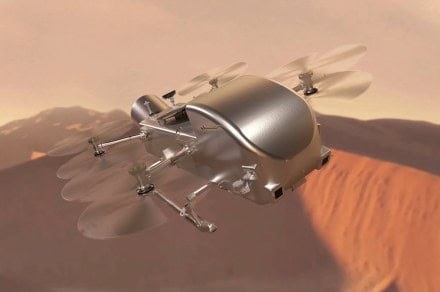
NASA inexperienced-lights mission to ship vehicle-sized drone to Saturn moon
NASA’s innovative Dragonfly mission is set to revolutionize our understanding of the solar system by delivering a vehicle-sized drone to Titan, Saturn’s largest moon. Building on the legacy of the Mars helicopter Ingenuity, Dragonfly is an advanced rotorcraft designed to navigate Titan’s dense atmosphere and low gravity. Scheduled for launch in 2028 and arrival in 2034, this mission aims to explore diverse terrains, analyze complex organic chemistry, and search for clues about the early conditions that may have led to life on Earth. This article provides an in-depth look at the Dragonfly mission, its technology, scientific objectives, and the challenges it faces on this extraordinary journey.
The Genesis of the Dragonfly Mission
The Dragonfly mission originated from NASA’s desire to expand the capabilities of rotorcraft beyond Mars. Following the success of the Mars helicopter Ingenuity, which demonstrated powered flight in another world’s atmosphere, NASA sought to deploy a more robust and ambitious rotorcraft. Titan’s thick, nitrogen-rich atmosphere and low gravitational pull provide an ideal environment for rotorcraft flight, far more conducive than Mars’s thin atmosphere.
In 2019, NASA selected Dragonfly as part of its New Frontiers program, aimed at exploring the solar system with medium-class missions. The mission was designed to capitalize on Titan’s unique environment to conduct in situ scientific investigations. The concept evolved to include an eight-rotor drone roughly the size of a small car, capable of traveling tens of miles in a single flight, a feat unprecedented in planetary exploration.
The mission team, led by the Johns Hopkins Applied Physics Laboratory, began the detailed design, development, and testing phases immediately after NASA’s greenlight. The approval signaled the transition from concept to construction, with a focus on integrating advanced scientific instruments and ensuring the drone’s resilience in Titan’s extreme conditions.
Design and Technology Behind Dragonfly
Dragonfly is an eight-rotor rotorcraft, designed to be highly mobile and capable of vertical takeoff and landing. Measuring approximately the size of a compact car, it weighs about 450 pounds (200 kilograms), equipped with scientific instruments and systems to endure Titan’s cold temperatures and dense atmosphere. The rotors provide lift and maneuverability, allowing the drone to hop across the moon’s surface to multiple locations.
The drone employs a Multi-Mission Radioisotope Thermoelectric Generator (MMRTG) for power, converting heat from radioactive decay into electricity. This power system not only sustains flight operations but also keeps the instruments and electronics warm in Titan’s frigid environment, where surface temperatures average around -179 degrees Celsius (-290 degrees Fahrenheit).
Dragonfly’s onboard instruments include mass spectrometers, meteorology sensors, cameras, and a gamma-ray spectrometer. These tools enable the drone to analyze surface composition, atmospheric conditions, and organic molecules. The vehicle’s autonomy systems allow it to make complex flight decisions, navigate challenging terrain, and conduct scientific experiments with minimal intervention from Earth.
Titan: A Unique Destination for Exploration
Titan, Saturn’s largest moon, is one of the most intriguing bodies in our solar system. It possesses a dense, nitrogen-rich atmosphere thicker than Earth’s, with a surface pressure about 1.5 times that of Earth. This atmosphere supports methane and ethane lakes, rivers, and possibly cryovolcanoes, creating an active environment with complex organic chemistry.
Unlike most moons, Titan has a weather cycle similar to Earth’s, with methane rain and winds shaping its landscape. Its surface features dunes, impact craters, and vast hydrocarbon seas, making it a compelling target for astrobiology and planetary science. Scientists speculate that Titan’s chemical environment could mirror conditions on early Earth before life emerged.
The moon’s low gravity, approximately 14% of Earth’s, combined with its dense atmosphere, creates ideal conditions for the Dragonfly drone to fly efficiently. This unique combination allows the rotorcraft to travel farther and faster than any rover has on another planetary body, enabling unprecedented exploration of diverse terrains.
Scientific Objectives of the Dragonfly Mission
Dragonfly’s primary scientific goal is to investigate prebiotic chemistry and assess Titan’s habitability. By sampling surface materials and analyzing organic compounds, the mission aims to understand the moon’s chemical processes that could resemble those leading to life on Earth billions of years ago. This research could provide critical insights into the origins of life in the universe.
The mission will examine Titan’s atmospheric and surface conditions in detail, measuring wind patterns, temperature variations, and chemical compositions. These data will help scientists model Titan’s climate and geological history, shedding light on its evolution and potential for sustaining life.
Additionally, Dragonfly will explore multiple sites across Titan, including dunes, impact craters, and possible cryovolcanic regions. This mobility allows the mission to study diverse geological settings, enhancing our understanding of the moon’s surface processes and internal dynamics. The data collected will be transmitted back to Earth for comprehensive analysis.
Flight and Mission Timeline
The Dragonfly mission is planned for launch in 2028 atop a powerful rocket, with an expected arrival at Titan in 2034 after a six-year interplanetary journey. Upon arrival, the drone will descend via parachute to a pre-selected landing site near the equator, chosen for its scientific interest and safety for initial operations.
Once on Titan’s surface, Dragonfly will begin its flight operations, conducting ‘hops’ that can cover tens of miles in a single flight. Each hop is expected to occur roughly once every 16 Earth days, corresponding to one Titan day, allowing the drone to recharge, transmit data, and perform surface experiments between flights.
The mission is designed to last approximately two Earth years, during which Dragonfly will visit dozens of sites, gathering diverse data sets. Its ability to traverse large distances and varied terrain marks a significant advancement over previous rover missions, opening new frontiers for planetary exploration.
Challenges and Innovations in the Dragonfly Mission
Operating on Titan presents unique challenges including extreme cold, communication delays, and the need for autonomous navigation. Titan’s low temperatures can affect electronic systems and battery performance, necessitating robust thermal control and power management solutions. Dragonfly’s MMRTG helps mitigate these issues by providing consistent power and heat.
Communication between Dragonfly and Earth involves a delay of over an hour each way, requiring the drone to operate independently for most tasks. Advanced onboard autonomy allows Dragonfly to plan flights, avoid hazards, and conduct scientific measurements without real-time control from mission operators.
The mission also involves rigorous testing on Earth to simulate Titan’s conditions. Engineers use wind tunnels, cold chambers, and other facilities to validate the drone’s flight capabilities and instrument performance. This comprehensive testing ensures Dragonfly can meet its ambitious goals despite the hostile environment.
The Broader Impact of the Dragonfly Mission
Dragonfly represents a significant milestone in space exploration technology and science. Its success could pave the way for future rotorcraft missions to other planetary bodies with atmospheres, such as Venus or exoplanets, expanding our reach beyond traditional landers and rovers.
The mission’s findings will enhance our understanding of prebiotic chemistry and the potential for life in the solar system, informing astrobiology and planetary science for decades. Insights gained from Titan’s environment may also influence theories about Earth’s own origins and habitability.
Moreover, Dragonfly’s development stimulates innovation in aerospace engineering, robotics, and autonomous systems. The mission inspires the next generation of scientists and engineers, demonstrating the possibilities of human ingenuity in exploring the cosmos.
Conclusion
NASA’s Dragonfly mission embodies a pioneering step in extraterrestrial exploration, combining advanced rotorcraft technology with ambitious scientific inquiry. By delivering a vehicle-sized drone to Titan, Dragonfly will traverse an alien world’s diverse landscapes, unlocking mysteries about organic chemistry and the potential for life beyond Earth. Its innovative design and autonomous capabilities set new standards for planetary missions, promising discoveries that could reshape our understanding of the solar system and life’s beginnings. As preparations continue toward its 2028 launch, Dragonfly stands poised to inspire humanity’s quest to explore the unknown.
Recent advances in machine perfusion technology are not only preserving donated livers but also making them biologically younger at a molecular level. This breakthrough…
What happens when human imagination, artificial intelligence, art and technology come together? From September 1 to 6, Samsung Electronics presented a special exhibition themed…