
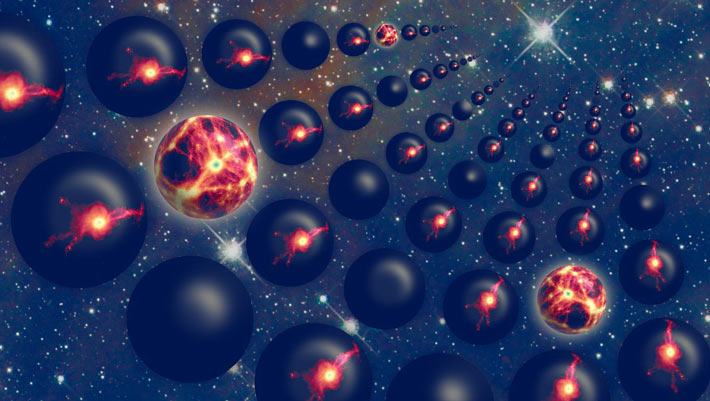
The quest to understand the existence and prevalence of intelligent life beyond Earth has long captivated scientists and philosophers alike. Traditionally, models like the Drake Equation have been used to estimate the number of communicative civilizations within our Milky Way galaxy. However, new research spearheaded by astrophysicists is reshaping this conversation by introducing a model that considers the accelerating expansion of the universe, driven by dark energy, and its influence on star formation—the foundational prerequisite for life as we know it. This article delves into this innovative theoretical framework, exploring its implications for cosmology, astrobiology, and our understanding of life’s place in the cosmos.
From Drake’s Equation to Dark Energy: Evolving Models of Cosmic Life Probability
In 1961, Dr. Frank Drake formulated an equation that multiplied several astrophysical and biological factors to estimate the number of intelligent civilizations detectable in our galaxy. This pioneering approach focused primarily on parameters such as star formation rates, planetary environments, and the likelihood of life developing and communicating.
While the Drake Equation remains influential, its scope is limited to the Milky Way and relies heavily on assumptions that are difficult to verify. As cosmological understanding has advanced, scientists have sought models that incorporate broader universal properties, including the fundamental forces and constants shaping our cosmos.
The latest theoretical model shifts focus toward the impact of dark energy—the mysterious force accelerating the universe’s expansion—and how it governs star formation rates across cosmic time. This paradigm recognizes that star formation, essential for life, is intricately linked to the universe’s expansion history and underlying energy densities.
Understanding Dark Energy and Its Cosmic Significance
Dark energy constitutes approximately 70% of the total energy content of the universe, driving its accelerated expansion. Unlike gravity, which pulls matter together, dark energy pushes space apart, influencing the large-scale structure and evolution of the cosmos.
The density of dark energy determines the balance between expansion and gravitational collapse, directly affecting the ability of matter to clump into stars and galaxies. If dark energy density is too high, the universe expands too rapidly for structures to form; if too low, gravitational collapse dominates, potentially leading to a different cosmic fate.
This delicate balance is crucial for creating environments where life could emerge. By quantifying how varying dark energy densities influence star formation, researchers can infer the likelihood of life-supporting conditions arising in different universes, including hypothetical multiverse scenarios.
The New Model: Linking Star Formation Efficiency to Dark Energy Density
The innovative model developed by researchers at Durham University’s Institute for Computational Cosmology calculates the fraction of ordinary matter converted into stars throughout the universe’s history under varying dark energy densities. This approach directly connects cosmological parameters with the potential for life.
Interestingly, the model predicts that the universe with the highest star formation efficiency would convert about 27% of ordinary matter into stars, compared to roughly 23% in our own universe. This suggests that our universe is not optimized for star formation or, by extension, the emergence of intelligent life.
Such findings challenge the assumption that the conditions in our universe are the most favorable for life. Instead, they propose that universes with significantly different dark energy densities could still support star formation and the development of life, indicating a broader range of life-permitting cosmic environments.
Implications for the Multiverse and the Rarity of Our Universe
The concept of a multiverse—an ensemble of universes with varying physical constants—has gained traction in theoretical physics. This model provides a framework to evaluate the probability of intelligent observers existing in universes with different dark energy densities.
By assessing the relative likelihood of a randomly chosen observer inhabiting a universe with specific properties, the study suggests that typical observers might expect to find themselves in universes with higher dark energy densities than ours. This renders our universe somewhat atypical or rare within the multiverse context.
Such a perspective prompts profound philosophical and scientific questions about anthropic reasoning and the uniqueness of our cosmic conditions. It encourages reevaluation of how we interpret our universe’s parameters and the emergence of life within it.
Star Formation and Cosmic Stability: Foundations for Life
For intelligent life to develop, the universe must host stable regions where matter can gravitationally collapse to form stars and planetary systems. These regions need to persist over billions of years to allow biological evolution to unfold.
The interplay between dark energy-driven expansion and gravitational forces shapes the universe’s large-scale structure, influencing the formation and longevity of such stable environments. A balance is necessary: too rapid expansion disperses matter, while excessive gravity could lead to early cosmic collapse.
The model underscores this interplay by demonstrating that a range of dark energy densities can still permit star formation and potentially life, broadening the scope of cosmic conditions considered life-friendly beyond previous assumptions.
Reevaluating Our Place in the Cosmos Through the New Model
The findings imply that our universe’s specific dark energy density is not the optimal value for maximizing intelligent life, suggesting we may inhabit a less probable cosmic environment. This insight challenges anthropic principles that posit our universe’s parameters are finely tuned to support life.
By quantifying how different cosmic parameters influence star formation and life emergence, the model encourages scientists to reconsider fundamental questions about why our universe has its particular characteristics and what this means for life’s prevalence.
Future research leveraging this model could explore how life might arise under alternative cosmic conditions, potentially redefining our understanding of habitability on a universal or multiversal scale.
Future Directions and Scientific Impact
This theoretical framework opens new avenues for interdisciplinary research, combining cosmology, astrophysics, and astrobiology to explore life’s cosmic context. It offers a quantitative tool to investigate how fundamental physical constants influence biological potential across universes.
Moreover, the model could guide observational strategies by identifying cosmic parameters and epochs most conducive to star formation and, by implication, life. This may influence the search for extraterrestrial intelligence and the study of exoplanetary systems.
By deepening our understanding of dark energy’s role in cosmic evolution, the research contributes to resolving one of modern physics’ greatest mysteries and enriches the narrative of humanity’s place in the vast cosmos.
Conclusion
The emergence of intelligent life in the universe is a profound mystery that intertwines astrophysics, cosmology, and biology. The newly developed theoretical model, focusing on the role of dark energy and star formation, provides a fresh lens through which to examine this enigma. By revealing that our universe’s parameters may not be the most conducive to life, it challenges long-standing assumptions and broadens our perspective on the conditions that foster life across the cosmos. As research continues, this model promises to deepen our understanding of the universe’s fundamental nature and humanity’s unique place within it, inspiring new questions and explorations about life beyond our world.