Top Stories
Discovery beneath soccer field reveals massive medieval convent lost for centuries
NEWYou can now listen to Fox News articles! Researchers recently uncovered a long-lost medieval convent in an unusual location in Denmark: a soccer field…
TAMFIS NIG LTDRC 8067447CAC ACTIVEFinima, Bonny Island, Rivers State

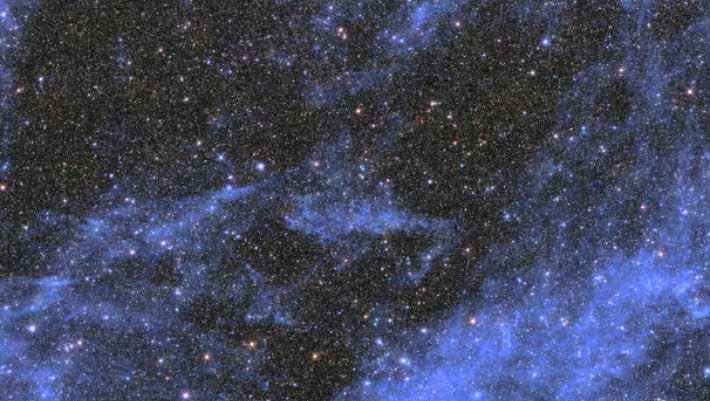
In early 2024, the European Space Agency (ESA) took a monumental leap forward in cosmic exploration with the release of the first segment of data from its Euclid mission. Launched in 2023, Euclid’s primary goal is to unravel the mysteries behind the accelerating expansion of the Universe by mapping billions of galaxies across vast cosmic distances. The newly released 208-gigapixel mosaic image, comprised of 260 observations covering an expansive 132 square degrees of the southern sky, represents just 1% of Euclid’s ambitious six-year survey. This initial glimpse is set to revolutionize our understanding of dark matter, dark energy, and the large-scale structure of the cosmos.
Euclid is a space telescope developed by ESA, launched in July 2023 with the mission to investigate why the Universe’s expansion is accelerating. By studying the distribution and shapes of billions of galaxies, Euclid aims to shed light on the enigmatic forces of dark energy and dark matter that dominate the cosmos.
Equipped with two cutting-edge instruments—a visible light camera and a near-infrared spectrometer—Euclid captures high-resolution images and spectra of distant galaxies. These instruments allow scientists to measure galaxy shapes, distances, and movements, providing the data necessary to construct a comprehensive 3D map of cosmic structures.
The mission’s scope is unprecedented: over six years, Euclid will survey more than one-third of the sky, observing galaxies up to 10 billion light-years away. This vast coverage will enable astronomers to analyze cosmic evolution across a significant portion of the Universe’s history.
In April 2024, ESA released a stunning 208-gigapixel mosaic image created from 260 observations captured between March 25 and April 8. This mosaic spans 132 square degrees, an area more than 500 times larger than the full Moon, showcasing Euclid’s remarkable ability to survey vast regions of the sky with exquisite detail.
This initial mosaic represents just 1% of Euclid’s wide survey, yet it contains approximately 100 million sources, including stars within the Milky Way and galaxies beyond. Among these, around 14 million galaxies are suitable for probing the influence of dark matter and dark energy, highlighting the immense scientific value packed into this single release.
The image not only reveals distant galaxies but also captures delicate features within our own galaxy, such as the faint galactic cirrus clouds composed of gas and dust. These clouds appear as ethereal blue streaks against the blackness of space, visible due to Euclid’s sensitive visible light camera.
One of Euclid’s core objectives is to understand dark energy—the mysterious force driving the accelerated expansion of the Universe—and dark matter, which exerts gravitational influence but remains invisible. By analyzing the shapes and distributions of billions of galaxies, scientists can infer the presence and effects of these unseen components.
The 3D map Euclid is constructing will allow researchers to observe how dark matter clusters and how dark energy affects cosmic expansion over time. This data is crucial for testing cosmological models and potentially revising our understanding of fundamental physics.
Moreover, Euclid’s observations will complement other missions and ground-based surveys, creating a holistic picture of the Universe’s structure and evolution. This synergy is expected to yield breakthroughs in cosmology and astrophysics.
Euclid’s achievements are underpinned by advanced technology, including its 1.2-meter diameter telescope and state-of-the-art detectors capable of capturing images with unprecedented clarity. The visible light camera alone can detect faint galactic features that were previously undetectable from space.
The mission benefits from precise onboard instruments that maintain stability and accuracy during long exposures, essential for producing sharp, high-resolution mosaics. These technological advancements enable Euclid to scan large sky areas rapidly without sacrificing image quality.
Data handling and processing pipelines developed by the Euclid Consortium play a vital role in converting raw observations into scientifically useful products. Sophisticated algorithms identify and classify millions of celestial objects, preparing the dataset for cosmological analysis.
Euclid represents a collaborative endeavor involving ESA, NASA, and numerous scientific institutions worldwide. NASA contributes key instruments and scientific expertise, including a dedicated dark energy science team led by Dr. Jason Rhodes at the Jet Propulsion Laboratory.
The Euclid Consortium, comprising hundreds of scientists and engineers, manages data analysis, calibration, and interpretation. This global partnership ensures that the mission’s outputs serve the broader scientific community and maximize the mission’s impact.
International collaboration also facilitates the integration of Euclid’s findings with data from other observatories, such as ESA’s Planck mission, which observes the cosmic microwave background, and ground-based telescopes conducting complementary surveys.
Since starting routine science observations in February 2024, Euclid has completed approximately 12% of its planned survey, setting a rapid pace for data acquisition. The next major data release is scheduled for March 2025 and will include an additional 53 square degrees of sky coverage along with previews of the Euclid Deep Field regions.
In 2026, the mission plans to release its first year of cosmology data to the global scientific community. This dataset will provide researchers with unprecedented opportunities to analyze the large-scale structure of the Universe and test cosmological theories.
As Euclid continues its six-year mission, the cumulative data will enable detailed studies of billions of galaxies, bringing humanity closer to understanding the fundamental forces shaping the cosmos.
The released mosaic image offers a breathtaking visualization of the Universe, ranging from nearby structures within the Milky Way to distant galaxies billions of light-years away. One striking feature is the galactic cirrus clouds, faint blue wisps of gas and dust that reflect optical light and reveal the complexity of our galaxy’s interstellar medium.
Beyond the Milky Way, Euclid captures galaxy clusters and filamentary structures that form the cosmic web—the vast network of matter connecting galaxies across the Universe. Mapping these structures in three dimensions is essential for understanding how the Universe evolved from the Big Bang to its present state.
These visualizations not only serve scientific purposes but also inspire awe and curiosity, providing the public with a tangible connection to the vastness and beauty of the cosmos.
Euclid’s comprehensive 3D mapping will have profound implications for cosmology, potentially challenging or refining the standard model of the Universe. Insights into dark energy’s nature could transform our understanding of cosmic fate and fundamental physics.
The mission’s data will also aid in studying galaxy formation and evolution, shedding light on how galaxies assemble over cosmic time. This knowledge is crucial for constructing accurate models of the Universe’s history.
Furthermore, Euclid’s discoveries may influence other fields such as particle physics and astronomy by providing empirical evidence that guides theoretical advancements and future missions.
The release of Euclid’s first mosaic marks a significant milestone in humanity’s quest to understand the Universe’s grand design. By capturing billions of galaxies and revealing intricate cosmic structures, Euclid is poised to transform cosmology and deepen our knowledge of dark matter and dark energy. As the mission progresses, the wealth of data it provides will empower scientists worldwide to explore fundamental questions about the cosmos, bringing us closer to unraveling the mysteries of our Universe.
Originally reported by sci.news. Adapted for our readers.
Keep reading
Top Stories
NEWYou can now listen to Fox News articles! Researchers recently uncovered a long-lost medieval convent in an unusual location in Denmark: a soccer field…
News
By Engr. Tamunofiniarisa BrownReading Time: 6 Minutes The conflict between Russia and Ukraine is often framed in the media as a simple battle between…
TAMFIS NIG LTD
Electrical and instrumentation engineering, bid preparation and consulting, IT and software.