
Educational Resources
The Impact of Digital Twins in Oil & Gas Plant Maintenance
The Impact of Digital Twins in Oil & Gas Plant Maintenance is a topic that deserves thorough explora...
TAMFIS NIG LTDRC 8067447CAC ACTIVEFinima, Bonny Island, Rivers State

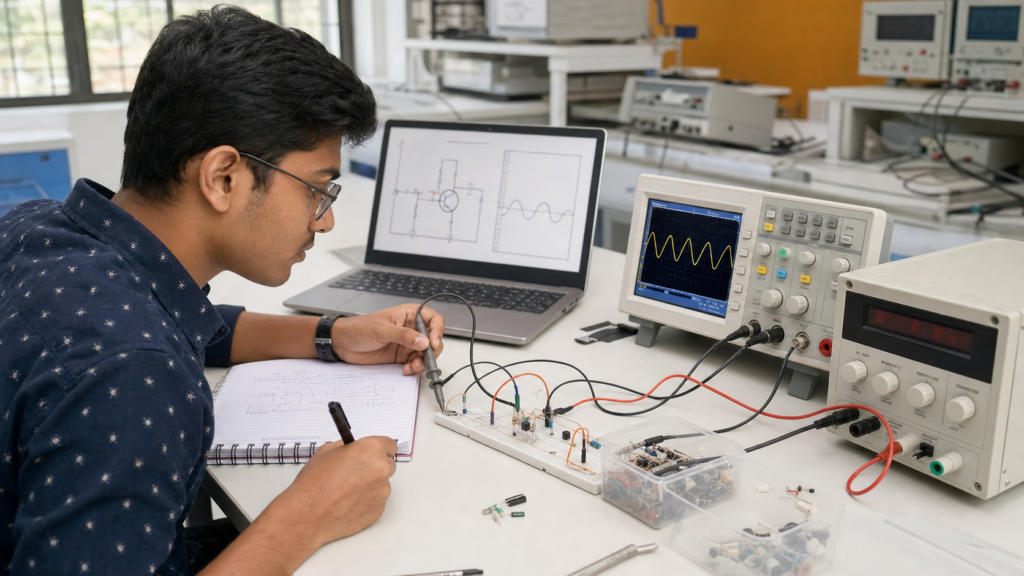
NPTEL gives learners access to university-level courses across electronics, electrical engineering, communication and related disciplines. Its catalogue can support formal study, exam preparation, professional refreshers or independent learning. The large selection is an advantage, but it also makes sequence important: an advanced course is difficult to use when mathematics, circuit theory or semiconductor fundamentals are missing.
NPTEL, the National Programme on Technology Enhanced Learning, is a joint initiative of India’s IITs and IISc funded by the Ministry of Education. Its official about page explains that course enrolment and learning materials are free, while optional proctored certification follows a separate process. Always check the current course page for dates, assessment rules, fees and exam arrangements.
“Learn electronics” is too broad for a useful plan. Decide whether you need device physics, analog design, digital logic, signals and systems, communication, embedded systems, control, power electronics, electromagnetic theory or semiconductor fabrication. Then identify what you should be able to calculate, simulate, build or explain when the course ends.
Use the official discipline and course pages rather than a random video playlist. Read the syllabus, intended audience, prerequisites, duration, instructor details and assessment pattern. An archived course may remain excellent for concepts, but its certification run and discussion support may no longer be active.
For example, the archived NPTEL Basic Electronics course states that learners should already know core circuit analysis. That is a useful warning: “basic” describes the electronics level, not the absence of all prerequisites. Pause and repair gaps instead of memorising later derivations.
Preview the week’s topics, then watch with paper or a digital notebook. Stop before a worked result and attempt the next step. Record definitions, assumptions and units, but spend more effort on why a model applies. After the lecture, close it and reconstruct the argument from memory. Rewatch only the part you cannot explain.
Create a question log. Mark whether each difficulty is mathematical, conceptual, notational or practical. Search the course forum and recommended references, then write your own resolution. Passive viewing can feel fluent because the instructor’s reasoning is visible; retrieval and problem solving reveal whether the knowledge is actually yours.
For a circuit topic, first estimate expected behaviour by hand. Simulate it with an appropriate tool, inspect operating points and waveforms, then compare with a safe physical circuit when facilities and supervision allow. Explain differences using component tolerance, instrument loading, parasitics, model limits and wiring.
Simulation is not proof that hardware is safe or correct. Set current limits, verify equipment ratings and understand oscilloscope grounding before connecting probes. Mains, high-voltage, power-electronics and radio-frequency work require suitable laboratories and competent supervision. An online lecture does not authorise hazardous experimentation.
Attempt problems before viewing solutions or discussing them. Show units and intermediate reasoning. When an answer is wrong, classify the cause: concept, algebra, sign, units, approximation or misread question. Redo it later without the solution. A mistake catalogue quickly exposes patterns that additional video watching may hide.
If you are enrolled in a current run, follow its academic-integrity rules. Discussing concepts can be helpful; copying submitted work prevents accurate feedback and may violate course requirements. Keep a separate set of extension problems so exam preparation is not limited to recognising familiar assignments.
Certification is optional and its rules can change between runs. Confirm enrolment deadlines, assignment eligibility, exam registration, identity requirements, location and score calculation on the current official page. Do not rely on an old blog post or archived announcement. If you only need knowledge, you can still design your own completion evidence without sitting the exam.
For exam preparation, create a formula sheet from understanding rather than copying one. Practise timed problems, mix topics and identify the assumptions behind standard results. Review assignments, but also vary component values and question wording. Sleep and travel planning matter when the assessment is in person.
Possible projects include a low-voltage sensor interface, transistor amplifier, filter, regulated supply study or digital logic controller. Choose a scope you can explain completely. Remove personal data, licensed course materials and copied solutions before publishing. Your own plots, schematics and observations are stronger evidence than screenshots of completed videos.
Reserve separate sessions for lecture, problems and practical work. Use one short review session to retrieve earlier topics, because electronics courses build cumulatively. If you fall behind, prioritise foundational concepts and graded deadlines; do not accelerate every video while abandoning exercises. A slower completed course is more valuable than several playlists watched at double speed.
NPTEL is most powerful when used as a structured learning environment rather than a video library. Choose a course with the right prerequisites, solve before observing solutions, connect equations to measurements and verify current certification details through NPTEL itself. The outcome should be knowledge you can apply and explain, whether or not you pursue the certificate.
Keep reading
Educational Resources
The Impact of Digital Twins in Oil & Gas Plant Maintenance is a topic that deserves thorough explora...
Educational Resources
Smart homes have transitioned from futuristic concepts to tangible realities that enhance everyday livin...
Educational Resources
As a small or medium-sized business owner in Nigeria, you are a master of spinning plates. You are the CEO, the head of sales,…
TAMFIS NIG LTD
Electrical and instrumentation engineering, bid preparation and consulting, IT and software.

