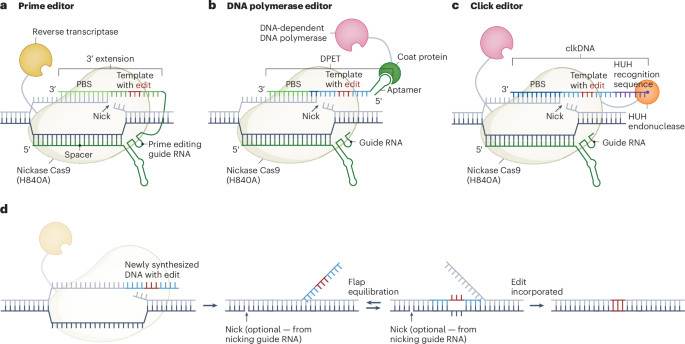
Genome editing has revolutionized biotechnology and medicine, enabling targeted modifications to DNA sequences with unprecedented accuracy. Among the tools driving this revolution, DNA-dependent polymerases have gained prominence for their unique ability to synthesize DNA based on a DNA template, facilitating precise genome alterations. Recent advancements have harnessed these polymerases in innovative gene editing platforms, addressing limitations of earlier techniques like CRISPR-Cas9 and prime editors. This article provides a comprehensive overview of genome editing with DNA-dependent polymerases, detailing their mechanisms, applications, and future potential in therapeutic development.
Fundamentals of DNA-Dependent Polymerases
DNA-dependent polymerases are enzymes that catalyze the synthesis of DNA strands complementary to an existing DNA template. These enzymes play a critical role in DNA replication and repair across all domains of life, ensuring genetic information is accurately copied and maintained.
Structurally, DNA polymerases possess domains responsible for DNA binding, nucleotide selection, and catalysis. Their fidelity and processivity vary among different polymerase families, influencing their suitability for various biotechnological applications.
In genome editing, DNA-dependent polymerases are exploited for their ability to extend DNA strands at targeted loci, enabling precise introduction of genetic changes without relying solely on nucleases to create double-strand breaks.
Emergence of Polymerase-Based Genome Editing Tools
Traditional genome editing technologies, such as CRISPR-Cas9, rely on generating double-strand breaks followed by cellular repair mechanisms, which can lead to unintended mutations. To overcome these challenges, researchers have integrated DNA-dependent polymerases into editing platforms to achieve more accurate DNA modifications.
Prime editors represent a breakthrough in this area, combining a catalytically impaired Cas9 nickase fused to a reverse transcriptase—a specialized DNA-dependent polymerase—to directly write new genetic information into the genome with minimal off-target effects.
Recent studies have introduced novel polymerase-based editors that utilize different DNA polymerases to expand editing capabilities, improve efficiency, and reduce undesired byproducts, highlighting the versatility of DNA-dependent polymerases in genome manipulation.
Mechanisms of DNA-Dependent Polymerase-Mediated Editing
DNA-dependent polymerase-mediated editing typically involves guiding the enzyme to a specific DNA site using a programmable nucleic acid component, such as a guide RNA or DNA oligonucleotide, which directs the polymerase to the target sequence.
Once positioned, the polymerase extends the DNA strand by incorporating nucleotides complementary to a template sequence, effectively rewriting the genomic DNA to introduce insertions, deletions, or base substitutions without inducing double-strand breaks.
This mechanism allows for precise and predictable edits, reducing reliance on error-prone endogenous repair pathways, and minimizing risks of chromosomal rearrangements or off-target mutagenesis.
Advantages Over Conventional Genome Editing Approaches
One key advantage of polymerase-based genome editing is the high precision afforded by template-directed DNA synthesis, enabling targeted base changes without the collateral damage associated with nuclease-induced double-strand breaks.
These systems exhibit reduced dependence on cellular repair pathways such as non-homologous end joining, which often introduces insertions or deletions, thereby enhancing the safety profile for therapeutic applications.
Additionally, DNA-dependent polymerase editors can achieve a broader spectrum of edits, including targeted insertions and complex sequence alterations, expanding the toolkit available for genetic engineering beyond what is possible with conventional CRISPR nucleases.
Current Applications in Research and Medicine
Polymerase-based genome editing has been successfully applied in various research contexts, including correcting pathogenic mutations in human cells, engineering disease models, and enhancing agricultural traits in plants.
In medicine, these tools hold promise for treating genetic disorders by enabling precise correction of mutations responsible for diseases such as sickle cell anemia, cystic fibrosis, and muscular dystrophies.
Ongoing clinical research is exploring the safety, efficacy, and delivery methods for polymerase-mediated editors, aiming to translate laboratory successes into viable gene therapies with durable and controlled outcomes.
Challenges and Limitations
Despite their advantages, DNA-dependent polymerase-based editors face hurdles including delivery efficiency, potential immunogenicity, and the need for optimized polymerase variants with improved fidelity and activity in diverse cellular environments.
Off-target activity, while reduced compared to nuclease-based approaches, still requires thorough characterization to ensure safety, especially in clinical applications where unintended edits could have deleterious effects.
Moreover, the complexity of these systems demands sophisticated design of guide sequences and templates, alongside comprehensive validation protocols to confirm precise editing outcomes and minimize mosaicism.
Future Directions and Innovations
Future research is focused on engineering novel DNA-dependent polymerases with enhanced properties such as increased processivity, reduced error rates, and compatibility with a wider range of cell types and organisms.
Integration with other emerging technologies, including base editing and epigenetic modulation, could further expand the versatility of polymerase-based genome editing platforms.
Advancements in delivery methods, such as viral vectors, lipid nanoparticles, and physical methods, will be critical to realizing the full therapeutic potential of these editors in vivo, enabling safe and efficient gene correction in patients.
Ethical and Regulatory Considerations
As genome editing technologies evolve, ethical considerations regarding germline modifications, equitable access, and long-term effects become increasingly important in guiding responsible research and clinical use.
Regulatory frameworks must adapt to encompass the unique features of polymerase-mediated editing, balancing innovation with rigorous safety assessments and monitoring.
Public engagement and transparent communication about the capabilities and limitations of these technologies are essential to foster informed decision-making and societal acceptance.
Conclusion
Genome editing with DNA-dependent polymerases represents a transformative advancement in genetic engineering, combining the precision of template-directed DNA synthesis with the programmability of modern gene editing platforms. By mitigating the risks associated with double-strand breaks and expanding the scope of possible genetic alterations, polymerase-based editors hold immense promise for both basic research and therapeutic interventions. Continued innovation and rigorous evaluation will be essential to harness their full potential, paving the way for safer, more effective treatments for a wide range of genetic disorders and contributing to the future of precision medicine.
Originally reported by nature.com. Adapted for our readers.
Recent advances in machine perfusion technology are not only preserving donated livers but also making them biologically younger at a molecular level. This breakthrough…
What happens when human imagination, artificial intelligence, art and technology come together? From September 1 to 6, Samsung Electronics presented a special exhibition themed…