
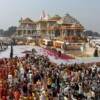
New York City's annual India Day Parade, a vibrant celebration of India's democracy and cultural diversity, took a contentious turn in 2024 with the appearance of a float featuring a model of the Ram Mandir temple. While parade organizers defended the float as an expression of Hindu heritage, critics argue that it symbolizes a divisive ideology rooted in religious nationalism and exclusion. This article explores the complex history of the Ram Mandir, its political implications in India, and the broader impact of such symbols within the Indian American community and beyond.
The Ram Mandir: A Contested Symbol
The Ram Mandir in Ayodhya, India, stands on the site of the Babri Masjid, a mosque with centuries of history that was demolished in 1992 by a mob of Hindu extremists. This act of destruction triggered widespread Hindu-Muslim riots, resulting in the deaths of approximately 2,000 people, predominantly Muslims. The controversy centers on the claim that the mosque was built over the birthplace of Lord Rama, a revered Hindu deity. However, this claim has been challenged by historians, the Archaeological Survey of India, and until recently, the Indian judiciary.
The temple's construction has been championed by the Bharatiya Janata Party (BJP), which promotes Hindutva—a Hindu nationalist ideology. This movement has been criticized for fostering exclusionary and often authoritarian policies, particularly targeting Muslim and Christian minorities in India. The Ram Mandir thus transcends its religious significance, becoming a potent political symbol associated with communal tensions and nationalist agendas.
The Ram Mandir Float in the NYC Parade: Heritage or Hate?
The decision to feature a Ram Mandir float in the 2024 India Day Parade in New York City has sparked significant debate within the Indian American community. Organizers argue that the float represents Hindu cultural heritage and religious pride. However, many view it as a troubling emblem of exclusion and intolerance, given the temple's contentious history and the ideology it represents.
This controversy is not isolated. In 2022, the India Day Parade in Edison, New Jersey, included a bulldozer float—symbolizing the aggressive tactics employed by the current Indian government to demolish homes, disproportionately affecting Muslim communities. Such displays raise questions about the appropriateness of bringing politically charged and divisive symbols into multicultural celebrations in the United States.
For many Americans unfamiliar with the nuances of Indian politics, these symbols may seem perplexing or irrelevant. Yet, they serve as a stark reminder of how political ideologies and conflicts from abroad can permeate diaspora communities, influencing social dynamics and public discourse far from their origins.
Political Shifts in Ayodhya: A Sign of Hope
Despite the prominence of the Ram Mandir and the BJP's influence, recent political developments in Ayodhya offer a hopeful counter-narrative. In a surprising election outcome, Awadhesh Prasad of the socialist Samajwadi Party defeated a BJP parliamentarian in Ayodhya, a city with a predominantly Hindu population and the site of the Ram Mandir.
Prasad, a Dalit candidate and devotee of Lord Rama, has emphasized an inclusive vision of Hinduism that embraces marginalized communities and respects diverse beliefs. His victory signals a rejection of Hindu nationalist politics in favor of a more compassionate and pluralistic approach.
Religious leaders in Ayodhya, including Swami Ram Das—the mahant of Sidh Peeth Mandir—have supported Prasad. Swami Ram Das articulated a vision of Hinduism centered on love, unity, and respect for all religions, contrasting sharply with the exclusivist ideology associated with the Ram Mandir's political symbolism. He also highlighted the irony that he and other local religious figures were excluded from the grand inauguration of the Ram Mandir, underscoring the disconnect between political spectacle and grassroots religious sentiment.
Implications for the Indian American Community
As Indian Americans increasingly participate in U.S. public life and politics, the symbols and messages they present in communal events carry significant weight. The inclusion of the Ram Mandir float in a major cultural celebration raises critical questions about the values the community wishes to project.
New York City, known as a sanctuary for persecuted and marginalized groups, has a history of opposing hate and discrimination, exemplified by its response to policies like the Muslim travel ban during the Trump administration. The presence of a symbol linked to an ideology accused of fostering religious intolerance and violence challenges the city's commitment to inclusivity.
Moreover, the BJP-led regime in India has faced credible accusations of targeting critics abroad, including attempts on the lives of dissidents in the United States. This international dimension underscores the urgency for diaspora communities to critically assess the political implications of their cultural expressions.
Ultimately, Indian Americans face the task of balancing pride in their heritage with a commitment to democratic values, pluralism, and respect for diversity—principles that resonate both in India and the United States.
What this means
The appearance of the Ram Mandir float in New York City's India Day Parade is more than a cultural statement; it is a reflection of ongoing tensions within the Indian diaspora about identity, politics, and values. While the temple holds deep religious significance for many, its association with divisive and exclusionary ideologies cannot be overlooked. The Indian American community stands at a crossroads, with an opportunity to embrace a vision of heritage that honors diversity, inclusivity, and democratic principles. By doing so, it can ensure that cultural celebrations in the United States reflect not only pride in Indian traditions but also a commitment to the pluralistic ideals that define both India’s democracy and American society.
This article was curated with AI assistance and reviewed according to Tamfis editorial settings.