Mysterious Ultra-Massive Galaxies Spotted in Early Universe
Top Stories

Mysterious Ultra-Massive Galaxies Spotted in Early Universe

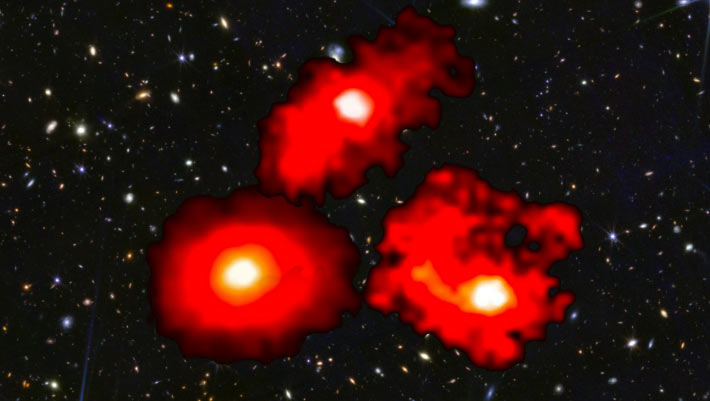
Top Stories Tamfitronics Astronomers using the NASA/ESA/CSA James Webb Space Telescope have discovered three ultra-massive galaxies — nearly as massive as our own Milky Way Galaxy — already in place within the first billion years after the Big Bang. Part of the JWST/FRESCO survey, this discovery indicates that stars in the early Universe grew much more rapidly than previously thought, challenging existing galaxy formation models.The three red monster galaxies discovered by Webb. Image credit: NASA / CSA / ESA / M. Xiao & P. A. Oesch, University of Geneva / G. Brammer, Niels Bohr Institute / Dawn JWST Archive.Until now, it was believed that all galaxies formed gradually within large halos of dark matter.Dark matter halos capture gas (atoms and molecules) into gravitationally bound structures.Typically, 20% of this gas, at most, is converted into stars...
Continue reading
Metabolic Compound Found to Regulate Appetite and Body Weight
Top Stories

Metabolic Compound Found to Regulate Appetite and Body Weight

Top Stories Tamfitronics Until now, β-hydroxybutyrate (BHB) has been known as a compound produced by the liver to be used as fuel. In a new study, researchers discovered that BHB also participates in another metabolic pathway; in this case, an enzyme called CNDP2 joins BHB to amino acids; furthermore, the most abundant BHB-amino acid, N-β-hydroxybutyryl phenylalanine (BHB-Phe), can influence body weight and metabolism in animal models.β-Hydroxybutyrate (BHB) is an abundant ketone body. To date, all known pathways of BHB metabolism involve the interconversion of BHB and primary energy intermediates. Moya-Garzon et al. identified a previously undescribed BHB secondary metabolic pathway via CNDP2-dependent enzymatic conjugation of BHB and free amino acids. Image credit: Moya-Garzon et al., doi: 10.1016/j.cell.2024.10.032.Mammals have evolved complex nutrient-responsive pathways that link the availability of external energy sources to internal metabolic homeostasis.These pathways...
Continue reading
New Theoretical Model Calculates Chances of Intelligent Life in Our Universe and Beyond
Top Stories

New Theoretical Model Calculates Chances of Intelligent Life in Our Universe and Beyond

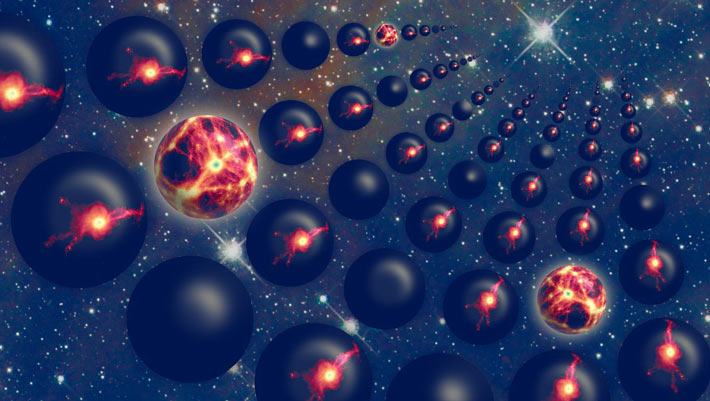
Top Stories Tamfitronics In 1961, American astrophysicist and astrobiologist Dr. Frank Drake devised an equation in which several factors are multiplied together to estimate the number of intelligent civilizations in our Milky Way Galaxy capable of making their presence known to humans. More than 60 years on, astrophysicists have produced a different model which instead focuses on the conditions created by the acceleration of the Universe’s expansion and the amount of stars formed. It is thought this expansion is being driven by dark energy that makes up more than two thirds of the Universe.Artistic impression of a Multiverse. Image credit: Jaime Salcido / EAGLE Collaboration.“Understanding dark energy and the impact on our Universe is one of the biggest challenges in cosmology and fundamental physics,” said Dr. Daniele Sorini, a researcher at Durham University’s Institute for...
Continue reading
New Species of Bioluminescent Sea Slug Discovered
Top Stories

New Species of Bioluminescent Sea Slug Discovered

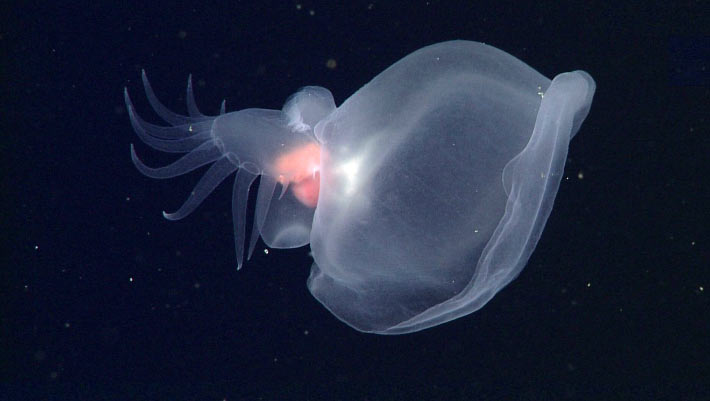
Top Stories Tamfitronics Marine biologists at Monterey Bay Aquarium Research Institute (MBARI) have described an exceptional sea slug (nudibranch) species, new to science, from depths of the eastern North Pacific Ocean. Named Bathydevius caudactylusthe species is bioluminescent and represents the third independent origin of bioluminescence among sea slugs.Bathydevius caudactylus has a voluminous hooded structure at one end, a flat tail fringed with numerous finger-like projections at the other, and colorful internal organs. Image credit: Bruce H. Robison & Steven H.D. Haddock / MBARI.Bathydevius caudactylus is the first sea slug species known to live in the deep water column.The new species is currently known to live in the waters offshore of the Pacific coast of North America.It can be found in the ocean’s midnight zone, an expansive environment of open water 1,000 to 4,000 m (3,300-13,100...
Continue reading